Category Archives: ~ politics petitions pollution and pop culture

on this day … 9/27 1973 – U.S. Vice President Spiro Agnew said he would not resign after he pled “no contest” to a charge of tax evasion. He did resign on October 10th. 


1779 – John Adams was elected to negotiate with the British over the American Revolutionary War peace terms.

1825 – George Stephenson operated the first locomotive that hauled a passenger train.

1894 – The Aqueduct Race Track opened in New York City, NY.

1928 – The U.S. announced that it would recognize the Nationalist Chinese Government. 

1938 – The League of Nations branded the Japanese as aggressors in China.

1939 – After 19 days of resistance, Warsaw, Poland, surrendered to the Germans after being invaded by the Nazis and the Soviet Union during World War II.

1940 – The Berlin-Rome-Tokyo Axis was set up. The military and economic pact was for 10 years between Germany, Italy and Japan.

1954 – The “Tonight!” show made its debut on NBC-TV with Steve Allen as host.

1962 – The U.S. sold Hawk anti-aircraft missiles to Israel. 

1968 – The U.K.’s entry into the European Common Market was barred by France.

1970 – “The Original Amateur Hour” aired for the last time on CBS. It had been on television for 22 years.

1973 – U.S. Vice President Spiro Agnew said he would not resign after he pled “no contest” to a charge of tax evasion. He did resign on October 10th. 

1979 – The Department of Education became the 13th Cabinet in U.S. history after the final approval from Congress.

1982 – Italian and French soldiers entered the Sabra and Chatilla refugee camps in Beirut. The move was made by the members of a multinational force due to hundreds of Palestinians being massacred by Christian militiamen.

1983 – Larry Bird signed a seven-year contract with the Boston Celtics worth $15 million. The contract made him the highest paid Celtic in history.

1986 – The U.S. Senate approved federal tax code changes that were the most sweeping since World War II.

1989 – Columbia Pictures Entertainment agreed to buyout Sony Corporation for $3.4 billion.

1989 – Two men went over the 176-foot-high Niagara Falls in a barrel. Jeffrey Petkovich and Peter Debernardi were the first to ever survive the Horshoe Falls.

1990 – The deposed emir of Kuwait addressed the U.N. General Assembly and denounced the “rape, destruction and terror” that Iraq had inflicted upon his country.

1991 – U.S. President George H.W. Bush eliminated all land-based tactical nuclear arms and removed all short-range nuclear arms from ships and submarines around the world. Bush then called on the Soviet Union to do the same.

1994 – More than 350 Republican congressional candidates signed the Contract with America. It was a 10-point platform they pledged to enact if voters sent a GOP majority to the House.

1995 – The U.S. government unveiled the redesigned $100 bill. The bill featured a larger, off-center portrait of Benjamin Franklin.

1998 – In Germany, Social Democrat Gerhard Schroeder was elected chancellor. The election ended 16 years of conservative rule.

1998 – Mark McGwire (St. Louis Cardinals) set a major league baseball record when he hit his 70th home run of the season.

2004 – North Korean Vice Foreign Minister Choe Su Hon announced that North Korea had turned plutonium from 8,000 spent nuclear fuel rods into nuclear weapons. He also said that the weapons were to serve as a deterrent against increasing U.S. nuclear threats and to prevent nuclear war in northeast Asia. The U.S. State Department noted that the U.S. has repeatedly said that the U.S. has no plans to attack North Korea.

September – National Awareness


nationaldaycalendar.com

HATCH ACT/ AN ACT TO PREVENT PERNICIOUS POLITICAL ACTIVITIES [AUGUST 2, 1939]


Has the trump campaign violated the Hatch and the Logan Act?

8/2 1939 – U.S. President Roosevelt signed the Hatch Act. The act prohibited civil service employees from taking an active part in political campaigns.

Be it enacted, That it shall be unlawful for any person to intimidate, threaten, or coerce, or to attempt to intimidate, threaten, or coerce, any other person for the purpose of interfering with the right of such other person to vote or to vote as he may choose, or of causing such other person to vote for, or not to vote for, any candidate for the office of President, Vice President, Presidential elector, Member of the Senate, or Member of the House of Representatives at any election….

SEC. 2. It shall be unlawful for any person employed in any administrative position by the United States, or by any department, independent agency, or other agency of the United States (including any corporation controlled by the United States or any agency thereof, and any corporation all of the capital stock of which is owned by the United States or any agency thereof ), to use his official authority for the purpose of interfering with, or affecting the election or the nomination of any candidate for the office of President, Vice President, Presidential electors Member of the Senate, or Member of the House of Representatives, Delegates or Commissioners from the Territories and insular possessions.

SEC. 3. It shall be unlawful for any person, directly or indirectly, to promise any employment, position, work, compensation, or other benefit, provided for or made possible ill whole or in part by any Act of Congress, to give consideration, favor, or reward for any political activity or for the support of or opposition to any candidate or any political party in any election.

SEC. 4. Except as may be required by the provisions of subsection (b), section 9 of this Act, it shall be unlawful for any persons to deprive, attempt to deprive, or threaten to deprive, by any means, any person of any employment, position, work, compensation, or other benefit provided for or made possible by any Act of Congress appropriating funds for work relief or relief purposes, on account of race, creed, color, or any political activity, support of, or opposition to any candidate or any political party in any election.

SEC. 5. It shall be unlawful for any person to solicit or receive or be in any manner concerned in soliciting or receiving any assessment, subscription, or contribution for any political purpose whatever from any person known by him to be entitled to or receiving compensation, employment, or other benefit provided for or made possible by any Act of Congress appropriating funds for work relief or relief purposes.

SEC. 6. It shall be unlawful for any person I for political purposes to furnish or to disclose, or to aid or assist in furnishing or disclosing, any list or names of persons receiving compensation, employment, or benefits provided for or made possible by any Act of Congress appropriating, or authorizing the appropriation of, funds for work relief or relief purposes, to a political candidate, committee, campaign manager, or to any person for delivery to a political candidate, committee, or campaign manager, and it shall be unlawful for any person to receive any such list or names for political purposes.

SEC. 7. No part of any appropriation made by any Act, heretofore or hereafter enacted making appropriations for work relief, relief, or otherwise to increase employment by providing loans and grants for public-works projects, shall be used for the purpose of, and no authority conferred by any such Act upon any person shall be exercised or administered for the purpose of, interfering with, restraining, or coercing any individual in the exercise of his right to vote at any election.

SEC. 8. Any person who violates any of the foregoing provisions of this Act upon convict; on thereof shall be fined not more than $1,000 or imprisoned for not more than one year, or both.

SEC. 9. (a) It shall be unlawful for any person employed in the executive branch of the Federal Government, or any agency or department thereof, to use his official authority or influence for the purpose of interfering; with an election or affecting the result thereof. No officer or employee in the executive branch of the Federal Government, or any agency or department thereof, shall take any active part in political management or in political campaigns. All such persons shall retain the right to vote as they may choose and to express their opinions on all political subjects. For the purposes of this section the term “officer” or “employee” shall not be construe to include

(1) the President and the Vice Presdent of the United States;

(2) persons whose compensation is paid from the appropriation for the office of the President;

(l) heads and assistant heads of executive departments; (4) officers who are appointed by the President, by and with the advice and consent of the Senate, and who determine policies to be pursued by the United States in its relations with foreign powers or in the Nation-wide administration of Federal laws.

(b) Any person violating the provisions of this section shall be immediately removed from the position or office held by him, and thereafter no part of the funds appropriated by any Act of Congress for such position or office shall be used to pay the compensation of such person.

SEC. 9A. (1) It shall be unlawful for any person employed in any capacity by any agency of the Federal Government, whose compensation, or any part thereof, is paid from funds authorized or appropriated by any Act of Congress, to have membership in any political party or organization which advocates the overthrow of our constitutional form of government in the United States.

(2) Any person violating the provisions of this section shall be immediately removed from the position or office held by him, and thereafter no part of the funds appropriated by any Act of Congress for such position or office shall be used to pay the compensation of such person.

SEC. 10. All provisions of this Act shall be in addition to, not in substitution for, of existing law.

SEC. 11. If any provision of this Act, or the application of such provision to any person or circumstance, is held invalid, the remainder of the Act, and the application of such provision to other persons or circumstances, shall not be affected thereby.

resource: historycentral.com

on this day 9/26


1777 – Philadelphia was occupied by British troops during the American Revolutionary War.

1789 – Thomas Jefferson was appointed America’s first Secretary of State. John Jay was appointed the first chief justice of the U.S. Samuel Osgood was appointed the first Postmaster-General. Edmund Jennings Randolph was appointed the first Attorney General. 

1892 – “The King of Marches” was introduced to the general public.

1908 – Ed Eulbach of the Chicago Cubs became the first baseball player to pitch both games of a doubleheader and win both with shutouts.

1908 – In “The Saturday Evening Post” an ad for the Edison Phonograph appeared.

1914 – The U.S. Federal Trade Commission was established. 

1918 – During World War I, the Meuse-Argonne offensive against the Germans began. It was the final Allied offensive on the western front.

1950 – U.N. troops recaptured the South Korean capital of Seoul from the North Koreans during the Korean Conflict.

1955 – The New York Stock Exchange suffered its worst decline since 1929 when the word was released concerning U.S. President Eisenhower’s heart attack.

1960 – The first televised debate between presidential candidates Richard M. Nixon and John F. Kennedy took place in Chicago, IL.

1962 – “The Beverly Hillbillies” premiered on CBS-TV.

1964 – “Gilligan’s Island” premiered on CBS-TV. The show aired for the last time on September 4, 1967.

1969 – “The Brady Bunch” series premiered on ABC-TV.

1980 – The Cuban government abruptly closed Mariel Harbor to end the freedom flotilla of Cuban refugees that began the previous April.

1981 – The Boeing 767 made its maiden flight in Everett, WA.

1984 – Britain and China initialed a draft agreement on the future of Hong Kong when the Chinese take over ruling the British Colony.

1985 – Shamu was born at Sea World in Orlando, FL. Shamu was the first killer whale to survive being born in captivity. 

1986 – The episode of “Dallas” that had Bobby Ewing returning from the dead was aired.

1986 – William H. Rehnquist became chief justice of the U.S. Supreme Court following the retirement of Warren Burger.

1990 – The Motion Picture Association of America announced that it had created a new rating. The new NC17 rating was to keep moviegoers under the age of 17 from seeing certain films.

1991 – Four men and four women began their two-year stay inside the “Biosphere II.” The project was intended to develop technology for future space colonies.

1991 – The U.S. Congress heard a plea from Kimberly Bergalis concerning mandatory AIDS testing for health care workers.

1993 – The eight people who had stayed in “Biosphere II” emerged from their sealed off environment.

1995 – The warring factions of Bosnia agreed on guidelines for elections and a future government.

1996 – Shannon Lucid returned to Earth after being in space for 188 days. she set a time record for a U.S. astronaut in space and in the world for time spent by a woman in space. 

2000 – Slobodan Milosevic conceded that Vojislav Kostunica had won Yugoslavia’s presidential election and declared a runoff. The declared runoff prompted mass protests.

2001 – In Kabul, Afghanistan, the abandoned U.S. Embassy was stormed by protesters. It was the largest anti-Amercian protest since the terror attacks on New York City and Washington, DC, on September 11.

2001 – Palestinian leader Yasser Arafat and Israeli Foreign Minister Shimon Peres announced plans to formalize a cease-fire and end a year of fighting in the region.

2006 – Facebook was openened to everyone at least 13 years or older with a valid email address.

1789 – Bill of Rights passes Congress


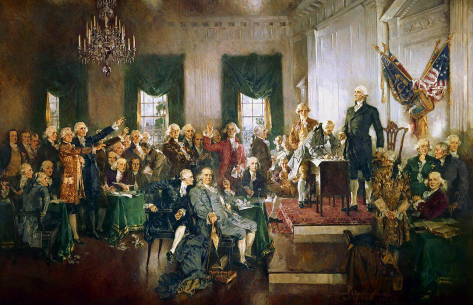
The first Congress of the United States approves 12 amendments to the U.S. Constitution, and sends them to the states for ratification. The amendments, known as the Bill of Rights, were designed to protect the basic rights of U.S. citizens, guaranteeing the freedom of speech, press, assembly, and exercise of religion; the right to fair legal procedure and to bear arms; and that powers not delegated to the federal government were reserved for the states and the people.

For the complete article: history.com

READ MORE: Before Drafting the Bill of Rights, James Madison Argued the Constitution Was Fine Without It

Citation Information

Article Title

Bill of Rights passes Congress

AuthorHistory.com Editors

Website Name

HISTORY

URL

https://www.history.com/this-day-in-history/bill-of-rights-passes-congress

Access Date

September 24, 2022

Publisher

A&E Television Networks

Last Updated

September 23, 2019

Original Published Date

March 3, 2010

U.S. CONGRESS