1942 – U.S. President Roosevelt created the National War Labor Board.


The National War Labor Board was reestablished by President Roosevelt on January 12, 1942, under the chairmanship of William Hammatt Davis. It became a tripartite body and was charged with acting as an arbitration tribunal in labor-management dispute cases, thereby preventing work stoppages which might hinder the war effort. It administered wage control in national industries such as automobiles, shipping, railways, airlines, telegraph lines, and mining. The Board was originally divided into twelve Regional Administrative Boards which handled both labor dispute settlement and wage stabilization functions for specific geographic regions. The National Board further decentralized in 1943, when it established special tripartite commissions and panels to deal with specific industries on a national base. It ceased operating on December 31, 1945, some four months after the war’s close. Labor disputes were thereafter handled by the National Labor Relations Board, originally set up in 1935. Second incarnation

The National War Labor Board (NWLB) was a United States federal agency created in two different incarnations, the first by President Woodrow Wilson from 1918–19 during World War I and the second by President Franklin D. Roosevelt from 1942–45 during World War II. In both cases the board’s purpose was to arbitrate disputes between workers and employers in order to ensure labor reliability and productivity during war.

The board began operations on April 8, 1918, after Wilson’s action. It was composed of twelve representatives from business and labor, and co-chaired by former President William Howard Taft. The decisions of the NWLB generally supported and strengthened the position of labor. Although it opposed the disruption of war production by strikes, it supported an eight-hour day for workers, equal pay for women, and the right to organize unions and bargain collectively. Although the NWLB did not have any coercive enforcement power, Wilson generally ensured compliance with its decisions.

In general, the relative strength of organized labor in America grew substantially during the war. Union membership almost doubled after the formation of the NWLB. Of note, the AFL membership rose from 2 million in 1916 to 3.2 million in 1919. By the end of the decade, 15 percent of the nonagricultural work force was unionized.

In all, the board ruled on 1,245 cases. Almost 90 percent of them sprang from worker complaints, and five skilled trades accounted for 45 percent. Of the cases, 591 were dismissed, 315 were referred to other federal labor agencies, and 520 resulted in formal awards or findings. In reaching decisions, the board was aided by an office and investigative staff of 250 people. Approximately 700,000 workers in 1,000 establishments were directly affected.

The board was disbanded on May 31, 1919, some six and a half months after the war’s close.

military.wikia.org

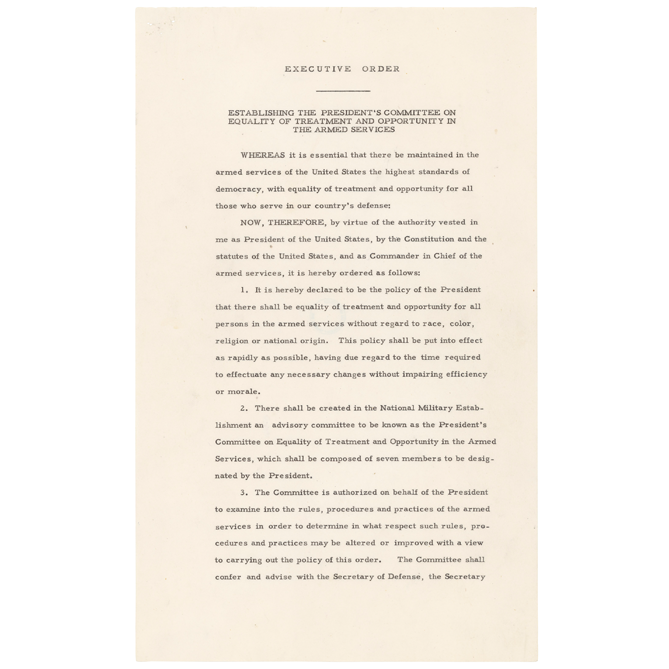
1948 – U.S. President Truman signed executive orders that prohibited discrimination in the U.S. armed forces and federal employment.


Executive Order 9981: Ending Segregation in the Armed Forces

On July 26, 1948, President Harry S. Truman signed this executive order establishing the President’s Committee on Equality of Treatment and Opportunity in the Armed Services, committing the government to integrating the segregated military.
In 1940, the US population was about 131 million, 12.6 million of which was African American, or about 10 percent of the total population. During World War II, the Army had become the nation’s largest minority employer. Of the 2.5 million African Americans males who registered for the draft through December 31, 1945, more than one million were inducted into the armed forces. Along with thousands of black women, these inductees served in all branches of service and in all Theaters of Operations during World War II.
During World War II, President Roosevelt had responded to complaints about discrimination at home against African Americans by issuing Executive Order 8802 in June 1941, directing that blacks be accepted into job-training programs in defense plants, forbidding discrimination by defense contractors, and establishing a Fair Employment Practices Commission (FEPC).
After the war, President Harry S. Truman faced a multitude of problems and allowed Congress to terminate the FEPC. However, in December 1946, Truman appointed a distinguished panel to serve as the President’s Commission on Civil Rights, which recommended “more adequate means and procedures for the protection of the civil rights of the people of the United States.” When the commission issued its report, “To Secure These Rights,” in October 1947, among its proposals were anti-lynching and anti-poll tax laws, a permanent FEPC, and strengthening the civil rights division of the Department of Justice.
In February 1948, President Truman called on Congress to enact all of these recommendations. When Southern Senators immediately threatened a filibuster, Truman moved ahead on civil rights by using his executive powers. Among other things, Truman bolstered the civil rights division, appointed the first African American judge to the Federal bench, named several other African Americans to high-ranking administration positions, and most important, on July 26, 1948, he issued an executive order abolishing segregation in the armed forces and ordering full integration of all the services.
Executive Order 9981 stated that “there shall be equality of treatment and opportunity for all persons in the armed forces without regard to race, color, religion, or national origin.” The order also established an advisory committee to examine the rules, practices, and procedures of the armed services and recommend ways to make desegregation a reality. There was considerable resistance to the executive order from the military, but by the end of the Korean conflict, almost all the military was integrated.
Download a high-resolution version of this document from the National Archives’ Online Public Access Database.

archivesfoundation.org

1964 – US Surgeon General announces definitive link between smoking and cancer


United States Surgeon General Luther Terry knew his report was a bombshell. He intentionally chose to release it on January 11, 1964, a Saturday, so as to limit its immediate effects on the stock market. It was on this date that, on behalf of the U.S. Government, Terry announced a definitive link between smoking and cancer.

The link had long been suspected. Anecdotal evidence had always pointed to negative health effects from smoking, and by the 1930s physicians were noticing an increase in lung cancer cases. The first medical studies that raised serious concerns were published in Great Britain in the late 1940s. 

Source: history.com

History… January 11


1569 – England’s first state lottery was held.

1770 – The first shipment of rhubarb was sent to the United States from London.

1805 – The Michigan Territory was created.

1861 – Alabama seceded from the United States.

1867 – Benito Juarez returned to the Mexican presidency, following the withdrawal of French troops and the execution of Emperor Maximilian.

1878 – In New York, milk was delivered in glass bottles for the first time by Alexander Campbell.

1902 – “Popular Mechanics” magazine was published for the first time.

1913 – The first sedan-type car was unveiled at the National Automobile Show in New York City. The car was manufactured by the Hudson Motor Company.

1922 – At Toronto General Hospital, Leonard Thompson became the first person to be successfully treated with insulin.

1935 – Amelia Earhart Putnam became the first woman to fly solo from Hawaii to California.

1938 – In Limerick, ME, Frances Moulton assumed her duties as the first woman bank president.

1942 – Japan declared war against the Netherlands. The same day, Japanese forces invaded the Dutch East Indies.

1943 – The United States and Britain signed treaties relinquishing extraterritorial rights in China.

1947 – “Murder and Mrs. Malone” debuted on ABC radio.

1958 – “Seahunt” debuted on CBS-TV. The show was aired on the network for four years.

1964 – U.S. Surgeon General Luther Terry released a report that said that smoking cigarettes was a definite health hazard.

1973 – The Open University awarded its first degrees.

1973 – Owners of American League baseball teams voted to adopt the designated-hitter rule on a trial basis.

1977 – France released Abu Daoud, a Palestinian suspected of involvement in the massacre of Israeli athletes at the 1972 Munich Olympics.

1978 – Two Soviet cosmonauts aboard the Soyuz 27 capsule linked up with the Salyut 6 orbiting space station, where the Soyuz 26 capsule was already docked.

1980 – Nigel Short, age 14, from Bolton in Britain, became the youngest International Master in the history of chess.

1986 – Author James Clavell signed a 5$ million deal with Morrow/Avon Publishing for the book “Whirlwind”. The book is a 2,000 page novel.

1988 – U.S. Vice President George Bush met with representatives of independent counsel Lawrence E. Walsh to answer questions about the Iran-Contra affair.

1991 – An auction of silver and paintings that had been acquired by the late Ferdinand Marcos and his wife, Imelda, brought in a total of $20.29 million at Christie’s in New York.

1996 – Ryutaro Hashimoto become Japan’s prime minister. He replaced Tomiichi Murayama who had resigned on January 5, 1996.

2000 – The merger between AOL and Time Warner was approved by the U.S. government with restrictions.

2000 – The U.S. Postal Service unveiled the second Vietnam Veterans Memorial commemorative stamp in a ceremony at The Wall.

2001 – The Texas Board of Criminal Justice released a review of the escape of the “Texas 7.” It stated that prison staff missed critical opportunities to prevent the escape by ignoring a fire alarm, not reporting unsupervised inmates and not demanding proper identification from inmates.

2001 – The U.S. Federal Trade Commission approved the merger of America Online and Time Warner to form AOL Time Warner.

on-this-day.com

January 10, 1973: Hunt to Burglars: White House Will Take Care of Families If They Plead Guilty, Remain Quiet – things we must not forget


January 10, 1973: Hunt to Burglars: White House Will Take Care of Families If They Plead Guilty, Remain Quiet

E. Howard Hunt, the leader of the seven Watergate burglars (see 2:30 a.m.June 17, 1972) currently on trial, tells fellow burglars Frank Sturgis, Virgilio Gonzalez, Eugenio Martinez, and Bernard Barker (sometimes called the “Cubans”) that if they plead guilty and keep their mouths shut, the White House will financially take care of their families. Hunt will plead guilty the next day; the others will plead guilty days later (see January 8-11, 1973). [Spartacus Schoolnet, 8/2007] Hunt has been pressuring the White House for executive clemency—in essence, a presidential pardon—for himself in return for his and the burglars’ guilty pleas and subsequent silence. [Reeves, 2001, pp. 557-558] Watergate burglar Bernard Barker will write of the decision to plead guilty in October 1974. He will recall Hunt as being thoroughly demoralized by the death of his wife Dorothy (see December 8, 1972), and telling Barker, “Well, you do what you want, but I am going to plead guilty.” When Barker asks why, Hunt replies: “We have no defense. The evidence against us is overwhelming.” Barker asks, “What about Liddy and McCord?” asking about the two accused burglars, G. Gordon Liddy and James McCord, who are being tried separately. Hunt replies: “Liddy and McCord are in a different sector. We are in one sector and they are in another. They have their own plan.” Barker then asks the Cubans’ lawyer, Henry Rothblatt, what his strategy is. Rothblatt confirms that they have no defense against the charges (see Early January, 1973), but he intends to “aggravate that Judge Sirica [John Sirica, presiding over the trial] to the point where I am going to drive him out of his cotton-pickin’ mind, and he is going to make so many mistakes with his arrogance that this will be a perfect case for appeal.” Unimpressed, Barker says he will follow Hunt’s lead and plead guilty. Rothblatt insists that Barker not trust Hunt and the others, saying: “They are a bunch of b_stards. They’ll double-cross you. They’ll sell you down the river.” Nevertheless, Barker and the other three burglars agree to follow Hunt’s lead and plead guilty. Rothblatt resigns from the case. Apparently, Barker is unaware at this time of Hunt’s negotiations with the White House for executive clemency for himself. [Harper’s, 10/1974]
Entity Tags: Henry Rothblatt, E. Howard Hunt, Dorothy Hunt, Bernard Barker, Eugenio Martinez, G. Gordon Liddy, John Sirica, Virgilio Gonzalez, James McCord, Frank Sturgis, Nixon administration
Timeline Tags: Nixon and Watergate

source: historycommons.org

politics,pollution,petitions,pop culture & purses