
 1609 – Delaware Bay was discovered by Henry Hudson.
1619 – Ferdinand II was elected Holy Roman Emperor. His policy of “One church, one king” was his way of trying to outlaw Protestantism.
1774 – The first American-born saint was born in New York City. Mother Elizabeth Ann Seton was canonized in 1975.
1830 – “The Tom Thumb” was demonstrated in Baltimore, MD. It was the first passenger-carrying train of its kind to be built in America.
1833 – Slavery was banned by the British Parliament throughout the British Empire.
1907 – “American Messenger Company” was started by two teenagers, Jim Casey and Claude Ryan. The company’s name was later changedto “United Parcel Service.”
1916 – Italy’s declaration of war against Germany took effect duringWorld War I.
1917 – Ten suffragists were arrested as they picketed the White House.
1922 – The first radio commercial aired on WEAF in New York City. The Queensboro Realty Company bought 10 minutes of time for$100.
1922 – The Walker Cup was held for the first time at Southampton, NY. It is the oldest international team golf match in America.
1939 – The first successful flight of a jet-propelled airplane took place. The plane was a German Heinkel He 178.
1941 – The Football Writers Association of America was organized.
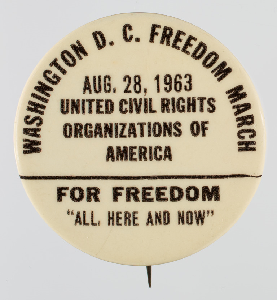
1963 – Dr. Martin Luther King, Jr., gave his “I Have a Dream” speech at a civil rights rally in Washington, DC. More than 200,000 people attended.
1972 – Mark Spitz captured the first of his seven gold medals at the Summer Olympics in Munich, Germany. He set a world record when he completed the 200-meter butterfly in 2 minutes and 7/10ths of a second.
1981 – “The New York Daily News” published its final afternoon edition.
1990 – Iraq declared Kuwait to be its 19th province and renamed Kuwait City al-Kadhima.
1995 – The biggest bank in the U.S. was created when Chase Manhattan and Chemical Bank announced their $10 billion deal.
1996 – A divorce decree was issued for Britain’s Charles and Princess Diana. This was the official end to the 15-year marriage.
1998 – The Pakistani prime minister created new Islamic order and legal system based on the Koran.
2004 – George Brunstad, at age 70, became the oldest person to swim the English Channel. The swim from Dover, England, to Sangatte, France, took 15 hours and 59 minutes.
2008 – In China, the Shanghai World Financial Center officially opened. The observation decks opened on August 30.
2014 – Google announced its Project Wing. The project was aimed at delivering products across a city using unmanned flying vehicles.




 Be a Seed for Change
You must be logged in to post a comment.