
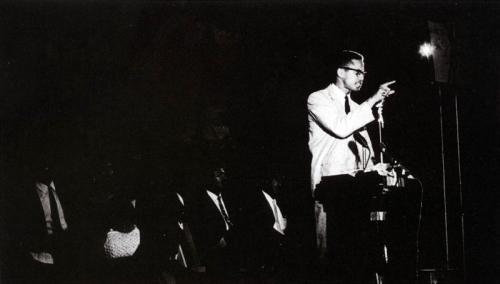
1964 – Malcolm X founded the Organization for Afro American Unity to seek independence for blacks in the Western Hemisphere. In Memory


(1964) Malcolm X's Speech at the Founding Rally of the Organization of ...Malcolm X, OAAU foundation rally, Audubon Ballroom, New York City, 1964

Fair use image

The Organization of Afro-American Unity (OAAU) was founded by Malcolm XJohn Henrik Clarke, and other black nationalist leaders on June 24, 1964 in Harlem, New York. Formed shortly after his break with the Nation of Islam, the OAAU was a secular institution that sought to unify 22 million non-Muslim African Americans with the people of the African Continent. The OAAU was modeled after the Organization of African Unity (OAU), a coalition of 53 African nations working to provide a unified political voice for the continent. In the coalition spirit of the OAU, Malcolm X sought to reconnect African Americans with their African heritage, establish economic independence, and promote African American self-determination. He also sought OAAU representation on the OAU.

The OAAU was designed to encompass all peoples of African origin in the Western hemisphere, as well those on the African continent. Malcolm X insisted that progress for African Americans was intimately tied to progress in Africa, and outlined a platform of five fronts for this progress called “The Basic Unity Program.” This program called for Restoration, Reorientation, Education, Economic Security, and Self-Defense as a means of promoting Pan-African unity and interests. With a strong focus on education as the primary means of repairing the damages of slavery, economic discrimination, and physical violence directed towards African Americans, the OAAU hoped to foster pan-African consciousness. Among the more controversial positions taken by the OAAU was the suggestion that leaders of African states held more legitimate political power for African Americans than did the American government.

At the founding conference, Malcolm X stressed the importance of escaping terms like “negro,” “integration,” or “emancipation,” insisting that such language was inherently pejorative and antithetical to the ideology of the OAAU. The OAAU called for African American-run institutions within the black community as well as increased participation in mainstream politics. In order to keep the OAAU strictly in African American hands, Malcolm X insisted that there be no monetary donations from non-African sources. The organization also refused membership to whites.

After Malcolm X was assassinated in the Audubon Ballroom on February 19, 1965, the fledgling movement died. Malcolm’s half-sister Ella Collins took over the OAAU, but without his charismatic leadership, most members deserted the organization. Nonetheless the OAAU became the inspiration for hundreds of “black power” groups that emerged during the next decade.


on this day … 6/29 1953 – The Federal Highway Act authorized the construction of 42,500 miles of freeway from coast to coast.


1236 – Ferdinand III of Castile and Leon took Cordoba in Spain.

1652 – Massachusetts declared itself an independent commonwealth.

1767 – The British Parliament approved the Townshend Revenue Acts. The acts imposed import duties on glass, lead, paint, paper and tea shipped to America.

1776 – The Virginia constitution was adopted and Patrick Henry was made governor.

1804 – Privates John Collins and Hugh Hall of the Lewis and Clark Expedition were found guilty by a court-martial consisting of members of the Corps of Discovery for getting drunk on duty. Collins received 100 lashes on his back and Hall received 50.

1860 – The first iron-pile lighthouse was completed at Minot’s Ledge, MA.

1880 – France annexed Tahiti.

1888 – Professor Frederick Treves performed the first appendectomy in England.

1897 – The Chicago Cubs scored 36 runs in a game against Louisville, setting a record for runs scored by a team in a single game.

1903 – The British government officially protested Belgian atrocities in the Congo.

1905 – Russian troops intervened as riots erupted in ports all over the country. Many ships were looted.

1917 – The Ukraine proclaimed independence from Russia.

1925 – Marvin Pipkin filed for a patent for the frosted electric light bulb.

1926 – Fascists in Rome added an hour to the work day in an economic efficiency measure.

1932 – Siam’s army seized Bangkok and announced an end to the absolute monarchy.

1941 – Joe DiMaggio got a base hit in his 42nd consecutive game. He broke George Sisler’s record from 1922.

1946 – British authorities arrested more than 2,700 Jews in Palestine in an attempt to end alleged terrorism.

1950 – U.S. President Harry S. Truman authorized a sea blockade of Korea.

1951 – The United States invited the Soviet Union to the Korean peace talks on a ship in Wonson Harbor.

1953 – The Federal Highway Act authorized the construction of 42,500 miles of freeway from coast to coast.

1954 – The Atomic Energy Commission voted against reinstating Dr. J. Robert Oppenheimer’s access to classified information.

1955 – The Soviet Union sent tanks to Poznan, Poland, to put down anti-Communist demonstrations.

1966 – The U.S. bombed fuel storage facilities near the North Vietnamese cities of Hanoi and Haiphong.

1967 – Israel removed barricades, re-unifying Jerusalem.

1972 – The U.S. Supreme Court ruled that the death penalty could constitute “cruel and unusual punishment.” The ruling prompted states to revise their capital punishment laws.

1982 – Israel invaded Lebanon.

1987 – Vincent Van Gogh’s “Le Pont de Trinquetaille” was bought for $20.4 million at an auction in London, England.

1995 – The shuttle Atlantis and the Russian space station Mir docked, forming the largest man-made satellite ever to orbit the Earth.

1998 – With negotiations on a new labor agreement at a standstill, the National Basketball Association (NBA) announced that a lockout would be imposed at midnight.

2000 – In Santa Rosa, CA, the official groundbreaking ceremony took place for the Charles M. Schulz Museum.

2007 – The first generation Apple iPhone went on sale.

2011 – The state of Nevada passed the first law that permitted the operation of autonomous cars on public roads. The law went into effect on March 1, 2012 and did not permit the use of the cars to the general public. Google received the first self-driving vehicle license in the U.S. on May 4, 2012 in Nevada.

on this day … 6/28


1635 – The French colony of Guadeloupe was established in the Caribbean.

1675 – Frederick William of Brandenburg crushed the Swedes.

1709 – The Russians defeated the Swedes and Cossacks at the Battle of Poltava.

1776 – American Colonists repulsed a British sea attack on Charleston, SC.

1778 – Mary “Molly Pitcher” Hays McCauley, wife of an American artilleryman, carried water to the soldiers during the Battle of Monmouth and, supposedly, took her husband’s place at his gun after he was overcome with heat.

1869 – R. W. Wood was appointed as the first Surgeon General of the U.S. Navy.

1894 – The U.S. Congress made Labor Day a U.S. national holiday.

1902 – The U.S. Congress passed the Spooner bill, it authorized a canal to be built across the isthmus of Panama.

1911 – Samuel J. Battle became the first African-American policeman in New York City.

1914 – Archduke Franz Ferdinand of Austria, the heir to the Austro-Hungarian throne, was assassinated in Sarajevo along with his wife, Duchess Sophie.

1919 – The Treaty of Versailles was signed ending World War I exactly five years after it began. The treaty also established the League of Nations.

1921 – A coal strike in Great Britain was settled after three months.

1930 – More than 1,000 communists were routed during an assault on the British consulate in London.

1939 – Pan American Airways began the first transatlantic passenger service.

1938 – The U.S. Congress created the Federal Housing Administration (FHA) to insure construction loans.

1940 – The “Quiz Kids” was heard on NBC radio for the first time.

1942 – German troops launched an offensive to seize Soviet oil fields in the Caucasus and the city of Stalingrad.

1945 – U.S. General Douglas MacArthur announced the end of Japanese resistance in the Philippines.

1949 – The last U.S. combat troops were called home from Korea, leaving only 500 advisers.

1950 – North Korean forces captured Seoul, South Korea.

1954 – French troops began to pull out of Vietnam’s Tonkin Province.

1960 – In Cuba, Fidel Castro confiscated American-owned oil refineries without compensation.

1964 – Malcolm X founded the Organization for Afro American Unity to seek independence for blacks in the Western Hemisphere.

1965 – The first commercial satellite began communications service. It was Early Bird (Intelsat I).

1967 – Israel formally declared Jerusalem reunified under its sovereignty following its capture of the Arab sector in the June 1967 war.

1971 – The U.S. Supreme Court overturned the draft evasion conviction of Muhammad Ali.

1972 – U.S. President Nixon announced that no new draftees would be sent to Vietnam.

1976 – The first women entered the U.S. Air Force Academy.

1978 – The U.S. Supreme Court ordered the medical school at the University of California at Davis to admit Allan Bakke. Bakke, a white man, argued he had been a victim of reverse racial discrimination.

1996 – The Citadel voted to admit women, ending a 153-year-old men-only policy at the South Carolina military school.

1996 – Charles M. Schulz got a star on the Hollywood Walk of Fame.

1998 – Poland, due to shortage of funds, is allowed to lease, U.S. aircraft to bring military force up to NATO standards.

1998 – The Cincinnati Enquirer apologized to Chiquita banana company and retracted their stories that questioned company’s business practices. They also agreed to pay more than $10 million to settle legal claims.

2000 – The U.S. Supreme Court declared that a Nebraska law that outlawed “partial birth abortions” was unconstitutional. About 30 U.S. states had similar laws at the time of the ruling.

2000 – The European Commission announced that they had blocked the planned merger between the U.S. companies WorldCom Inc. and Sprint due to competition concerns.

2000 – Six-year-old Elián González returned to Cuba from the U.S. with his father. The child had been the center of an international custody dispute.

2001 – Slobodan Milosevic was taken into custody and was handed over to the U.N. war crimes tribunal in The Hague, Netherlands. The indictment charged Milosevic and four other senior officials, with crimes against humanity and violations of the laws and customs of war in Kosovo.

2001 – The U.S. Court of Appeals for the District of Columbia Circuit set aside an order that would break up Microsoft for antitrust violations. However, the judges did agree that the company was in violation of antitrust laws.

2004 – The U.S. turned over official sovereignty to Iraq’s interim leadership. The event took place two days earlier than previously announced to thwart insurgents’ attempts at undermining the transfer.

2004 – The U.S. resumed diplomatic ties with Libya after a 24-year break.

2004 – The U.S. Supreme Court ruled that enemy combatants could challenge their detention in U.S. Courts.

2005 – The final design for the “Freedom Tower” (One World Trade Center) was formally unveiled.

2007 – The American bald eagle was removed from the endangered species list.

2010 – The U.S. Supreme Court ruled 5-4 that Americans have the right to own a gun for self-defense anywhere they live.

politics,pollution,petitions,pop culture & purses