
From jankees to yankees … lol

USDA~ FSN ~ FDA ~ August 2025 -Recalls – Food Safety Alerts – Previous Month & last day of prior month updates
** BETHLEHEM, PA – August 19, 2025 – B. Braun Medical Inc. (B. Braun) is voluntarily recalling two lots of Lactated Ringers Injection USP 1000 mL,and 0.9% Sodium Chloride Injection USP 1000 mL to the hospital level due to the presence of particulate matter inside the container.
B. Braun has identified through complaints the potential for the product to contain particulate matter in solution. To date there have been no reports of serious injury, death or other adverse events associated with this issue. If the particulate matter is observed before use, a minor delay could occur while obtaining a replacement product. If the particulate matter is loose and the container is used on a patient, there is a potential for the particulate to be infused into the circulatory system. This could lead to patient harm that may require additional medical intervention and/or lead to permanent impairment or death.

** Viva Raw LLC, Charlotte, NC is voluntarily recalling two lots of dog and cat foods due to contamination with Salmonella and Listeria monocytogenes. The recall is for Lot 21495 (Viva Ground Beef for Dogs; Viva Beef & Turkey for Puppies) and Lot 21975 (Viva Ground Chicken for Dogs; Viva Chunked Chicken for Dogs; Viva Chicken for Cats; Viva Pure Chicken) The potential for contamination was identified after routine testing was conducted by the North Carolina Department of Agriculture. Only products from Lots 21495 and 21975 are affected. No illnesses in dogs, cats, or humans related to these lots have been reported to date.
If you have products from Lot 21495 or Lot 21975, please contact Viva Raw at info@vivarawpets.com for a refund on any remaining product. You should then dispose of the food in a way that children, pets, and wildlife cannot access. Do not sell or donate the recalled products. Do not feed the recalled product to pets or any other animals. Wash and sanitize pet food bowls, cups, and storage containers. Always ensure you wash and sanitize your hands after handling recalled food or any utensils that come in contact with recalled food.
** French Listeria outbreak spreads to other countries; 2 patients dead
By Joe Whitworth on August 19, 2025
The European Centre for Disease Prevention and Control (ECDC) has weighed in on a multi-country outbreak of Listeria monocytogenes with 25 cases.
France has 21 infections since December 2024, including 18 since June 2025. Two people died.
Patients are between 34 and 95 years old and 11 are women. Dates…Continue Reading
**
** Five sick in Argentinian Listeria outbreak
By Joe Whitworth on August 19, 2025
A Listeria outbreak that sickened five people in Argentina has been traced to a type of cheese.
Outbreak details were reported in Argentina’s national epidemiological bulletin (Boletín Epidemiológico Nacional).
It is the first time that a link between human cases of listeriosis and a common source, confirmed by…Continue Reading
** Wegmans: The affected products were sold in the cheese department at all Wegmans stores located in Connecticut, Delaware, Maryland, Massachusetts, New Jersey, New York, North Carolina, Pennsylvania, Virginia, and Washington, D.C. No illnesses associated with this recall have been reported to Wegmans or its supplier, to date.
Wegmans has placed automated phone calls to alert customers who purchased these products using Shoppers Club.
Customers should not consume the products and return them to the service desk for a full refund. Those with questions may contact Wegmans Food Markets at 1-855-934-3663, available daily from 8:00 a.m. through 8:00 p.m. EST.
Affected items, sold between July 1 and August 12, 2025, include:
Wegmans Caramel Apple Pecan Topped Brie Cheese, 13 OZ, UPC: 2-77645-00000-3
Wegmans Medium Camembert Soft Ripened Cheese, 8.8 OZ, UPC: 77890-53515 with best by dates of 7/26/25, 8/12/25, and 8/19/25
Wegmans Assorted Cheese Flight, 1 LB, UPC: 2-77100-00000-0
Wegmans Grilling Camembert with Tapenade & Roasted Tomatoes, 10 OZ, UPC: 2-77297-00000-0
** Dollar General: No illnesses or injuries have been reported to date. August 11, 2025 –Dollar General Corporation is recalling three (3) lots of its eight (8) ounce Clover Valley® Instant Coffee due to the potential presence of glass.
8-Ounce Clover Valley® Instant Coffee
Package UPC: 876941004069
Lot: L-5163 / Best By 12/13/2026
Lot: L-5164 / Best by 12/13/2026
Lot: L-5165 / Best by 12/14/2026
Customers can find the lot and best by date information around the neck of the unit.
Clover Valley® Instant Coffee was sold and distributed between July 9-21, 2025 exclusively in Dollar General retail stores located in the following states: AL, AR, AZ, CA, CO, CT, DE, FL, GA, IA,ID, IL, IN, KS, KY, LA, MA, MD, ME, MI, MN, MO, MS, MT, NC, ND, NE, NH, NJ, NM, NV, NY, OH, OK, OR, PA, RI, SC, SD, TN, TX, UT, VA, VT, WA, WI ,WV, and WY.
Customers who purchased this product are encouraged to discard it and contact Dollar General either via email at customercare@dollargeneral.com or by phone at 1-888-309-9030 from 6 a.m. to 1 a.m. CST seven days a week to request a full refund of the purchase price (including any tax).
** Fromi USA Recalls Brie Royal Faucon 1kg Because of Possible Health Risk
** Quesito El Establo Recalls Spanish Cheese (Quesito Colombiano) Because of Possible Health Risk
** Two deaths in French Listeria outbreak
By Joe Whitworth on August 14, 2025
Two people have died in a Listeria outbreak in France linked to cheese.
French health authorities reported 21 cases of listeriosis caused by bacterial strains with similar characteristics, including 18 cases since the beginning of June. Patients range in age from 34 to 95.
Pasteurized cow’s and goat’s milk cheeses…Continue Reading
** Goodlettsville, Tennessee – August 11, 2025 –Dollar General Corporation is recalling three (3) lots of its eight (8) ounce Clover Valley® Instant Coffee due to the potential presence of glass.
8-Ounce Clover Valley® Instant Coffee
Package UPC: 876941004069
Lot: L-5163 / Best By 12/13/2026
Lot: L-5164 / Best by 12/13/2026
Lot: L-5165 / Best by 12/14/2026
Customers can find the lot and best by date information around the neck of the unit.
Clover Valley® Instant Coffee was sold and distributed between July 9-21, 2025 exclusively in Dollar General retail stores located in the following states: AL, AR, AZ, CA, CO, CT, DE, FL, GA, IA,ID, IL, IN, KS, KY, LA, MA, MD, ME, MI, MN, MO, MS, MT, NC, ND, NE, NH, NJ, NM, NV, NY, OH, OK, OR, PA, RI, SC, SD, TN, TX, UT, VA, VT, WA, WI ,WV, and WY.
** Quesito El Establo, of Salem, NH, is recalling all of its Spanish Cheese (Quesito Colombiano) products manufactured at its facility, due to the presence of rodents, rodent activity, and other unsanitary conditions during the production and storage process. Consumers who have purchased the recalled product are encouraged not to consume it and return it to the place of purchase for a full refund. Consumers with questions can contact the company at 617-842-0513 (Monday through Saturday, 9:00 a.m. to 5:00 p.m., Eastern time).
** Wegmans The affected products were sold in the cheese department at all Wegmans stores located in Connecticut, Delaware, Maryland, Massachusetts, New Jersey, New York, North Carolina, Pennsylvania, Virginia, and Washington, D.C.
Affected items, sold between July 1 and August 12, 2025, include:
Wegmans Caramel Apple Pecan Topped Brie Cheese, 13 OZ, UPC: 2-77645-00000-3 The affected products were sold in the cheese department at all Wegmans stores located in Connecticut, Delaware, Maryland, Massachusetts, New Jersey, New York, North Carolina, Pennsylvania, Virginia, and Washington, D.C.
Wegmans Medium Camembert Soft Ripened Cheese, 8.8 OZ, UPC: 77890-53515 with best by dates of 7/26/25, 8/12/25, and 8/19/25
Wegmans Assorted Cheese Flight, 1 LB, UPC: 2-77100-00000-0
Wegmans Grilling Camembert with Tapenade & Roasted Tomatoes, 10 OZ, UPC: 2-77297-00000-0
Affected items, sold between July 1 and August 12, 2025, include:
Wegmans Caramel Apple Pecan Topped Brie Cheese, 13 OZ, UPC: 2-77645-00000-3
Wegmans Medium Camembert Soft Ripened Cheese, 8.8 OZ, UPC: 77890-53515 with best by dates of 7/26/25, 8/12/25, and 8/19/25
Wegmans Assorted Cheese Flight, 1 LB, UPC: 2-77100-00000-0
Wegmans Grilling Camembert with Tapenade & Roasted Tomatoes, 10 OZ, UPC: 2-77297-00000-0
No illnesses associated with this recall have been reported to Wegmans or its supplier, to date.
Wegmans has placed automated phone calls to alert customers who purchased these products using Shoppers Club.
Customers should not consume the products and return them to the service desk for a full refund. Those with questions may contact Wegmans Food Markets at 1-855-934-3663, available daily from 8:00 a.m. through 8:00 p.m. EST.
** Louisa Food Products, Inc. told Newsweek in a statement: “We have voluntarily recalled a limited quantity of our Jalapeño Mac and Cheese Bites with lot code 2507092 due to potential listeria contamination. This recall was initiated out of an abundance of caution following a supplier’s recall of the breadcrumb ingredient used in this product. All recalled cases have been located, isolated, and are awaiting proper handling and disposal.
“We are actively collaborating with our supplier to address the root cause of this issue and are implementing additional preventive measures to ensure it does not recur. The quality and safety of our products will always be our highest priority, and we appreciate the understanding and trust of our customers.”
** The recall affects 8-ounce packages of the brand’s Three Cheese Mac & Cheese Bites. Over 4,000 cases have been affected, according to the FDA.
Best by dates: June 19, 2026 or June 20, 2026
UPC: 8-99039-00280-8
Lot codes: 24354AV1 or 24355AV1
** Power Stick: On July 10, the Food and Drug Administration announced the recall of certain Power Stick deodorants, made by A.P. Deauville, LLC.1
- More than 67,000 cases of deodorant have been recalled nationwide due to safety concerns.
- The recall affects three Power Stick deodorant products, made by A.P. Deauville, LLC.
- Check if your deodorant is part of the recall, and toss or return it.
- Power Stick for her PH Balanced Roll-On Antiperspirant Deodorant with Powder Fresh Scent, 1.8 oz./53 mL, A.P Deauville, LLC, PA 18040, NDC# 42913-038-00, UPC Code 815195019313
D-0548-2025
Class II
Lot # 032026B011, 032226B031, 051626C241, 061526C882, 071226D371, 071226D381, 082526E341, 082826E402
21,265 cases
CGMP Deviations
2
Beauty & Skincare Power Stick original nourishing invisible protection roll-on Antiperspirant/Deodorant Spring Fresh, 1.8 oz./53 mL, A.P Deauville, LLC, PA 18040, NDC# 42913-039-00, UPC Code 815195018194
D-0549-2025
Class II
Lot # 031726A991, 041226B561, 062026C901, 062026C911, 071026D351, 071026D361, 071326D391, 111626G231
22,482 Cases
CGMP Deviations
3
Shave and Skincare Power Stick Original Nourishing Invisible Protection Roll-On Antiperspirant/Deodorant, 1.8 oz./ 53 mL, A.P Deauville, LLC, PA 18040, NDC# 42913-040-00 UPC Code 815195018224
D-0550-2025
Class II
Lot # 101225D781, 032926B281, 032826B221, 041126B531, 062226D011, 070626D301, 070626D333, 111026G051, 111326G091, 111626G221
23,467 Cases
CGMP Deviations
** DermaRite Consumers with questions regarding this recall can call Mary Goldberg at 973-569-9000 x104 Monday through Friday, 9:00 am – 5:00 pm EST or email voluntary.action@dermarite.com.
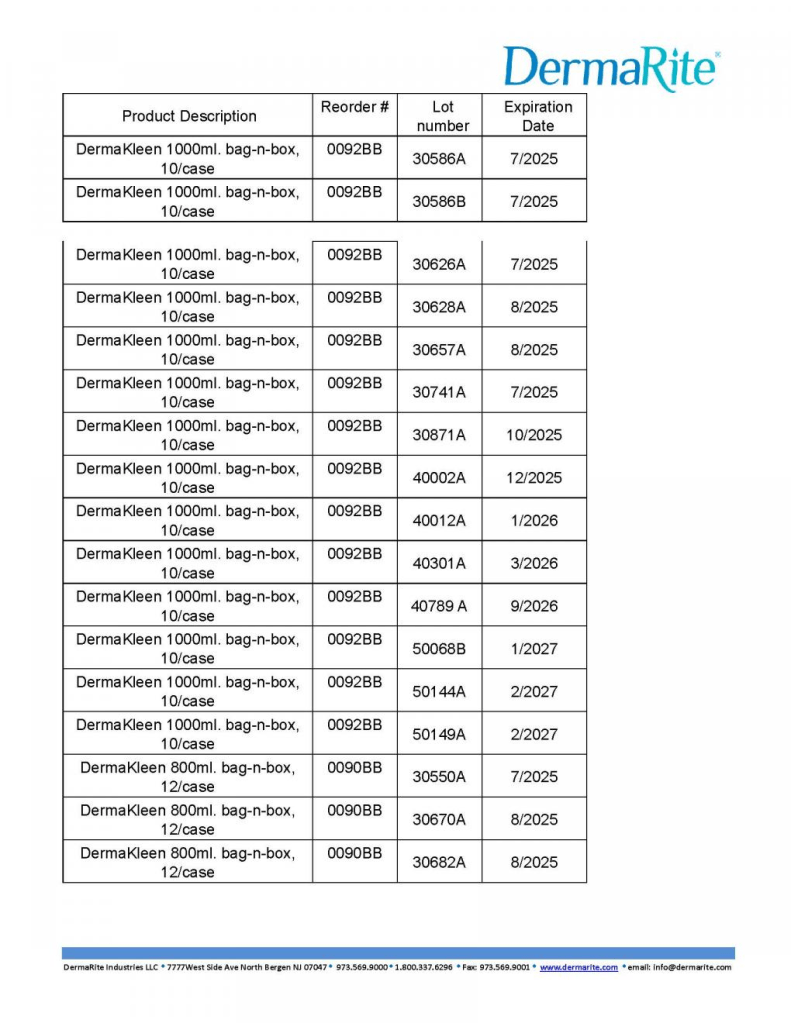
To date, DermaRite has not received any reports of adverse events related to this recall.
DermaKleen is an OTC Healthcare antiseptic lotion soap with Vitamin E indicated for handwashing to decrease bacteria on the skin.
DermaSarra is an OTC External analgesic indicated for temporary relief of itching associated with minor skin irritations due to: dry skin, insect bites, detergents, sunburn.
KleenFoam is an OTC Antimicrobial foam soap with Aloe Vera indicated for handwashing to decrease bacteria on the skin after changing diapers, after assisting ill people, or before contact with a person under medical care or treatment.
PeriGiene is an OTC Antiseptic cleanser indicated for use in the perineal area.
The recalled products were distributed nationwide in the United States and in Puerto Rico.
Recalled Product Information: (see Table image below)
DermaRite has notified its distributors and customers by e-mail to immediately examine available inventory and destroy all affected products in accordance with each facility’s process.
- AUG 1 – Member’s Mark dried fruit sold at Sam’s Clubs recalled because of Listeria contamination, Doehler Dry Ingredient Solutions, LLC Recalls Member’s Mark Freeze Dried Fruit Variety Pack for Listeria monocytogenes Contamination
- Four ill in Salmonella outbreak linked to egg product supplement
** July 31, 2025
Sold at: Select Sam’s Clubs in the following states: AL, AZ, CA, CO, CT, DE, FL, GA, HI, IA, ID, IL, IN, KS, LA, MD, ME, MI, MN, MO, MS, MT, NC, ND, NE, NH, NJ, NM, NV, NY, OH, OK, PA, PR, SC, SD, TN, TX, UT, VA, WI, WV, WY
** July 18, 2025
Sold at: All stores
June 11, 2025
Sold at: Walmart stores, Walmart.com
June 10, 2025
Amneal Pharmaceutical LLC Issues a Nationwide Recall of Sulfamethoxazole / Trimethoprim Tablets
Sold at: Select Walmart stores. See list of stores.
** Four ill in Salmonella outbreak linked to egg product supplement
** UKHSA reports continued rise in E. coli infections
** Aug. 1, 2025
Sold at: Walmart.com
By News Desk on August 1, 2025
Recently released data from the UK Health Security Agency (UKHSA) has shown another rise in E. coli infections in England in 2024.
Overall, 2,544 cultured-confirmed cases of Shiga toxin-producing E. coli (STEC) were reported with 564 STEC O157 and 1,980 non-O157. In 2023, 2,018 cultured-confirmed infections were noted compared to 2,063 in…Continue Reading
By Joe Whitworth on August 1, 2025
Four people have fallen sick after consuming a type of egg product supplement in the United Kingdom.
Public Health Scotland is leading the probe into a cluster of multidrug resistant Salmonella infections associated with an eggshell membrane food supplement sold online.
The UK Health Security Agency (UKHSA), Food Standards Agency…Continue Reading
**
** Albertsons Companies Stores in Arkansas, Louisiana, Oklahoma and Texas Voluntarily Expands Recall to Select Items Containing Tuna Salad from Reser’s Fine Foods Due to an Ingredient Recall Linked to Possible Listeria monocytogenes Contamination. The items containing tuna salad were available for purchase at the following banner stores: Albertsons, Randalls and Tom Thumb in Arkansas, Louisiana, Oklahoma and Texas.
Consumers with questions should contact Albertsons Companies’ Customer Service Center at 1-877-723-3929 Monday through Friday from 5 a.m. to 9 p.m. PST.
Product Recall Details:
| Product Name | UPC | Size | Sell Thru Dates (if applicable, Or Lot Code/Est. Number) | Store Banners | States |
|---|---|---|---|---|---|
| RM DUO TUNA SALAD W/CRACKER S | 27183000000 | EA | Jul 24 25 Thru Jul 29 25 | Albertsons, Randalls, Tom Thumb | AR, LA, OK, TX |
| RM SALAD TUNA PREMIUM SS | 21425000000 | EA | Jul 24 25 Thru Jul 29 25 | Albertsons, Randalls, Tom Thumb | AR, LA, OK, TX |
| RM SNACKER TRAY TUNA SALAD | 21151300000 | EA | Jul 24 25 Thru Jul 29 25 | Albertsons, Randalls, Tom Thumb | AR, LA, OK, TX |
| RM SNACKER TRAY TUNA SALAD | 21151300000 | EA | JUL 24 25 Thru Jul 29 25 | Albertsons, Randalls, Tom Thumb | AR, LA, OK, TX |
| RM SNDWCH TUNA SALAD CROISSANT SS COLD | 21788400000 | EA | Jul 23 25 Thru Jul 28 25 | Albertsons, Randalls, Tom Thumb | AR, LA, OK, TX |
| RM TUNA SALAD OVER BED OF LETTUCE SS | 21786400000 | EA | Jul 23 25 Thru Jul 28 25 | Albertsons, Randalls, Tom Thumb | AR, LA, OK, TX |
| SALAD TUNA PREMIUM | 21228800000 | Variable Weight | Jul 24 25 Thru Jul 29 25 | Albertsons, Randalls, Tom Thumb | AR, LA, OK, TX |
| TRAY CROISSANT MINI SALAD 16 IN | 27841300000 | EA | Jul 23 25 Thru Jul 28 25 | Albertsons, Randalls, Tom Thumb | AR, LA, OK, TX |
| TRAY CROISSANT MINI SALAD 18 IN | 27841200000 | EA | Jul 23 25 Thru Jul 28 25 | Albertsons, Randalls, Tom Thumb | AR, LA, OK, TX |
| TRAY SALAD SANDWICH 12 IN | 27841500000 | EA | Jul 23 25 Thru Jul 28 25 | Albertsons, Randalls, Tom Thumb | AR, LA, OK, TX |
| TRAY SALAD SANDWICH 16 IN | 27841400000 | EA | Jul 23 25 Thru Jul 28 25 | Albertsons, Randalls, Tom Thumb | AR, LA, OK, TX |
Share this:

Grok answers my question: Which immigration program from the past would work the best for our 21st Century

Key Points
- Research suggests the Bracero Program (1942-1964), a temporary labor agreement with Mexico, could be adapted for 21st-century needs, particularly for agricultural labor, if reformed with stronger worker protections.
- It seems likely that this program addresses modern labor shortages, but its historical issues, like exploitation, highlight the need for significant updates to align with current ethical standards.
- The evidence leans toward the Bracero Program as a model due to its scale and focus on temporary migration, though controversy exists around past labor abuses and their impact on workers.
Direct answer: The Bracero Program, active from 1942 to 1964, could work best for the 21st century if significantly reformed. This program allowed millions of Mexican workers to temporarily work in the U.S., mainly in agriculture, addressing labor shortages during and after World War II. Today, it could help meet seasonal labor needs, especially in farming, but it would need updates like guaranteed fair wages, safe housing, and protections against exploitation to meet modern ethical standards.Why It Fits Modern Needs
The U.S. still faces labor shortages in agriculture and other industries, and a reformed Bracero Program could provide legal pathways for temporary workers, reducing reliance on undocumented migration. Its historical scale—over 4.5 million participants—shows it can handle large-scale labor demands, which is relevant given current global migration patterns.Challenges and Reforms Needed
Historically, the program faced criticism for worker exploitation, low wages, and poor living conditions. For the 21st century, it would need strong labor laws, oversight to prevent abuse, and possibly options for workers to transition to permanent residency, ensuring it aligns with today’s values of fairness and human rights.Comparison to Other Programs
Other historical programs, like the Hart-Celler Act of 1965, shaped modern immigration but are more legislative frameworks than specific programs. The Bracero Program stands out for its focus on temporary labor, making it a practical model if reformed, though its past issues are a point of debate.For more details, see History.com on the Bracero Program and Wikipedia on the Bracero Program.
Survey Note: Evaluating Historical Immigration Programs for 21st-Century Relevance. This analysis explores which historical immigration program from the past could best serve the needs of the 21st century, focusing on the Bracero Program (1942-1964) as a potential model, while considering its historical context, challenges, and necessary reforms. The evaluation is grounded in a comprehensive review of historical immigration policies, their impacts, and their alignment with modern economic, humanitarian, and ethical priorities as of August 6, 2025.Historical Context and Program Overview. Immigration has been a defining feature of U.S. history, with policies evolving to meet economic, social, and political needs. The Bracero Program, initiated during World War II, was a bilateral agreement between the U.S. and Mexico to address labor shortages by allowing temporary Mexican workers, known as braceros, to work primarily in agriculture. Running from 1942 to 1964, it involved over 4.5 million workers and was the largest guest worker program in U.S. history. It was designed to fill labor gaps during the war and continued post-war, reflecting a need for seasonal agricultural labor.Other notable historical programs include:
- Hart-Celler Act (1965): Replaced national origins quotas with a system prioritizing family reunification and skilled immigration, forming the basis of current U.S. immigration law.
- Diversity Visa Program (1990): Aimed at diversifying immigration by allocating visas to underrepresented countries, though relatively recent.
- Refugee Resettlement Programs: Addressed humanitarian needs, such as resettling Vietnamese refugees in the 1970s, but lack the scale of labor-focused programs like the Bracero Program.
The Bracero Program’s structure, focusing on temporary labor migration, makes it a candidate for adaptation, given 21st-century labor demands, particularly in agriculture, where seasonal workers are crucial.Relevance to 21st-Century NeedsThe 21st century presents unique immigration challenges, including:
- Economic Needs: Labor shortages in agriculture, technology, and healthcare, driven by an aging U.S.-born workforce and global competition for skilled workers.
- Humanitarian Needs: Ongoing refugee crises and asylum seeker flows, requiring humane and legal pathways.
- Integration and Diversity: A need for policies that promote cultural diversity and successful integration, aligning with globalized societies.
- Border Security and Illegal Immigration: Managing borders while addressing undocumented migration, often linked to labor demand.
The Bracero Program addresses the economic need for temporary labor, particularly in agriculture, where mechanization has not fully replaced human workers. As of 2025, the U.S. agricultural sector continues to rely on migrant labor, with estimates suggesting significant portions of farmworkers are foreign-born. A reformed program could legalize these flows, reducing undocumented migration and improving labor conditions.Historical Analysis and Lessons LearnedThe Bracero Program’s historical impact was mixed:
- Positive Aspects: It met labor demands during and after WWII, with over 4.5 million participants contributing to U.S. agriculture. It also facilitated remittances to Mexico, supporting economic ties.
- Negative Aspects: Workers faced exploitation, including low wages, poor housing, and racial discrimination. Employers often ignored contract terms, and many braceros stayed illegally after contracts ended, contributing to undocumented immigration.
These issues highlight the need for reforms, such as:
- Worker Protections: Guaranteed minimum wages, safe housing, and access to healthcare, addressing past exploitation.
- Enforcement: Strong oversight to ensure compliance with labor laws, preventing abuse by employers.
- Legal Pathways: Options for workers to transition to permanent residency, reducing incentives for undocumented status.
Comparatively, the Hart-Celler Act shifted immigration toward family and skill-based systems, which are still relevant but lack the specific focus on temporary labor migration. The Diversity Visa Program promotes diversity but is less suited for addressing labor shortages. Refugee resettlement programs, while crucial, are humanitarian-focused and not primarily labor-oriented.Proposed Reforms for 21st-Century AdaptationTo make the Bracero Program viable today, the following reforms are essential:
- Labor Standards: Implement strict labor laws, including fair wages (e.g., aligning with H-2A visa standards) and safe working conditions, to prevent exploitation.
- Human Rights Protections: Ensure access to healthcare, education for workers’ families, and anti-discrimination measures, aligning with modern ethical standards.
- Legal Framework: Create clear legal pathways for workers, potentially allowing transitions to permanent residency after a set period, addressing long-term integration needs.
- Diversity and Inclusion: Expand eligibility to other countries facing labor surpluses, ensuring the program reflects global migration patterns and reduces dependency on a single nation.
These reforms would address the program’s historical flaws while leveraging its structure for temporary labor needs, making it a model for guest worker programs in 2025. Comparative Table: Historical Programs and 21st-Century Fit
| Program | Period | Focus | Strengths | Weaknesses | 21st-Century Fit |
|---|---|---|---|---|---|
| Bracero Program | 1942-1964 | Temporary agricultural labor | Large scale, met labor needs | Exploitation, poor conditions | High, with reforms for labor protections |
| Hart-Celler Act | 1965 | Family, skilled immigration | Foundation of current system | Not a specific program, ongoing use | Moderate, more legislative framework |
| Diversity Visa Program | 1990 | Diversity in immigration | Promotes underrepresented countries | Recent, not labor-focused | Low, less relevant for labor needs |
| Refugee Resettlement | Mid-20th C | Humanitarian protection | Addresses crises, humane | Not labor-focused, smaller scale | Low, humanitarian focus, not labor |
Controversy and DebateThe Bracero Program’s historical legacy is controversial, with labor unions and advocates criticizing its exploitation, while agricultural interests see it as a necessary labor solution. Modern debates, as seen in proposals like the “Bracero Program 2.0 Act” in 2025, highlight tensions between economic benefits and worker rights. Balancing these interests is crucial for its adaptation, with ongoing discussions about guest worker programs reflecting these tensions.ConclusionResearch suggests the Bracero Program, with significant reforms, could be the best historical immigration program for the 21st century, particularly for addressing temporary labor needs in agriculture. Its scale and focus on guest workers align with current economic demands, but its past issues necessitate updates like strong labor protections and legal pathways. While other programs like the Hart-Celler Act shaped modern policy, the Bracero Program’s specific structure makes it a practical model, provided it is adapted to meet ethical and legal standards as of August 6, 2025.For further reading, see:
- History.com on the Bracero Program
- Wikipedia on the Bracero Program
- Library of Congress on Latinx Civil Rights
:
Share this:

Emmett Till ~ never forget
mr till was born on
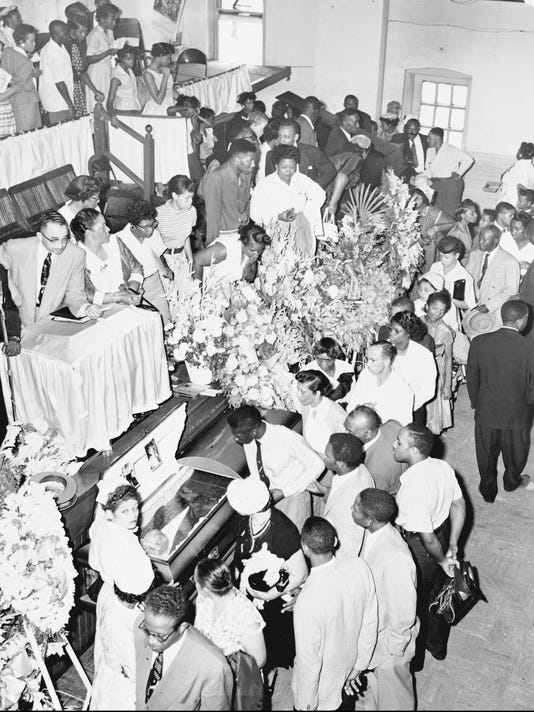
(Photo: AP Photo/Chicago Tribune)
While visiting family in Money, Mississippi, 14-year-old Emmett Till, an African American from Chicago, is brutally murdered for flirting with a white woman four days earlier. His assailants–the white woman’s husband and her brother–made Emmett carry a 75-pound cotton-gin fan to the bank of the Tallahatchie River and ordered him to take off his clothes. The two men then beat him nearly to death, gouged out his eye, shot him in the head, and then threw his body, tied to the cotton-gin fan with barbed wire, into the river.
Till grew up in a working-class neighborhood on the south side of Chicago, and though he had attended a segregated elementary school, he was not prepared for the level of segregation he encountered in Mississippi. His mother warned him to take care because of his race, but Emmett enjoyed pulling pranks. On August 24, while standing with his cousins and some friends outside a country store in Money, Emmett bragged that his girlfriend back home was white. Emmett’s African American companions, disbelieving him, dared Emmett to ask the white woman sitting behind the store counter for a date. He went in, bought some candy, and on the way out was heard saying, “Bye, baby” to the woman. There were no witnesses in the store, but Carolyn Bryant–the woman behind the counter–claimed that he grabbed her, made lewd advances, and then wolf-whistled at her as he sauntered out.
Roy Bryant, the proprietor of the store and the woman’s husband, returned from a business trip a few days later and found out how Emmett had spoken to his wife. Enraged, he went to the home of Till’s great uncle, Mose Wright, with his brother-in-law J.W. Milam in the early morning hours of August 28. The pair demanded to see the boy. Despite pleas from Wright, they forced Emmett into their car. After driving around in the Memphis night, and perhaps beating Till in a toolhouse behind Milam’s residence, they drove him down to the Tallahatchie River.
Three days later, his corpse was recovered but was so disfigured that Mose Wright could only identify it by an initialed ring. Authorities wanted to bury the body quickly, but Till’s mother, Mamie Bradley, requested it be sent back to Chicago. After seeing the mutilated remains, she decided to have an open-casket funeral so that all the world could see what racist murderers had done to her only son. Jet, an African American weekly magazine, published a photo of Emmett’s corpse, and soon the mainstream media picked up on the story.
Less than two weeks after Emmett’s body was buried, Milam and Bryant went on trial in a segregated courthouse in Sumner, Mississippi. There were few witnesses besides Mose Wright, who positively identified the defendants as Emmett’s killers.
On September 23, the all-white jury deliberated for less than an hour before issuing a verdict of “not guilty,” explaining that they believed the state had failed to prove the identity of the body. Many people around the country were outraged by the decision and also by the state’s decision not to indict Milam and Bryant on the separate charge of kidnapping.
The Emmett Till murder trial brought to light the brutality of Jim Crow segregation in the South and was an early impetus of the African American civil rights movement.
history.com
Share this:

March on Washington for Jobs and Freedom
On August 28, 1963, one-hundred years after the signing of the Emancipation Proclamation, approximately 200,000 to 250,000 people arrived in Washington, D.C., and peace fully marched down Constitution and Independence Avenues to the Lincoln Memorial, to rectify, in the words of A. Philip Randolph, “old grievances and to help resolve an American crisis.” Precipitating factors included the subjugation of African Americans to Jim Crow segregation and laws in practically every sector in society, a disproportionate level of high unemployment and unequal wages, and other forms of legal, economic, and social inequality.
The marchers, representing rural and urban areas from every corner of the nation, arrived by train, plane, bus, and car. Newspapers reported that the marchers were young and old; black, white, and brown. They were sharecroppers and socialites. The marchers were prayerful, jubilant, and tearful; embraced each other throughout the day and sang traditional spirituals such as “Oh Freedom,” “Ain’t Gon’ Let Nobody Turn Me Round,” and “We Shall Overcome.” These supporters of the March were in Washington to introduce ten levels of demands, of which the first was the demand for comprehensive and effective civil rights legislation that would guarantee all Americans: (1) access to all public accommodations, (2) decent housing, (3) adequate and integrated education, and (4) the right to vote. Other demands included: withholding Federal funds from all programs in which discrimination exists; a massive federal program to train and place all unemployed workers –black and white—on meaningful and dignified jobs with decent wages.

The six primary organizers and organizations for the March were: (1) James Farmer, National Director of the Congress of Racial Equality (CORE), (2) Reverend Martin Luther King, President of the Southern Christian Leadership Conference (SCLC), (3) John Lewis, Chairman of the Student Non-violent Coordinating Committee (SNCC), (4) A. Philip Randolph, President of the Negro American Labor Organization, (5) Roy Wilkins, Executive Secretary of the National Association for the Advancement of Colored People (NAACP), and (6) Whitney Young, Executive Director of the Urban League. These leaders of prominent civil rights organizations came together to commemorate the centennial of the Emancipation Proclamation and to call attention to the atrocities African Americans were still experiencing. The Reverend Dr. Martin Luther King gave his iconic “I Have a Dream”External speech on this occasion.

The 1963 March on Washington for Jobs and Freedom drew attention to the systemic racism and the discrimination which African Americans still experience in education, housing, and jobs. It also called for Federal legislation to guarantee the right to vote for all Americans.

Learn More
- Explore the Rosa Parks Papers to discover additional primary sources about the March on Washington. For example, in a Subject File folder on the March, read the Organizing Manual and other materials created by the organizers.
- Listen to A. Philip Randolph, the organizer of the March on Washington for Jobs and Freedom, at the National Press Club two days before the March, where he explains the reasons for the March on Washington (listen to 05.00-14.09), how it serves as a model against racial bias, what it will achieve in motivating people to do something about the problem of abolishing racial violence in America, and its goal to “highlight the idea of the struggle of Negroes in America to achieve the transition from second class citizenship, to first class citizenship,” and…“bring world pressure upon the United States of America to step up the struggle to wipe out race bias.”
- Read Protests That Changed America: The March on Washington to review selected reasons the March on Washington is considered “the most significant protest for social justice in the nation.”
- Experience the March on Washington through images found in the collections of the Library’s Prints & Photographs Division. Selections are included in the online exhibit, A Day Like No Other: Commemorating the 50th Anniversary of the March on Washington.
- Explore the history and lyrics of the song “We Shall Overcome.” Read “Tracing the Long Journey of “We Shall Overcome”.
- Search on the term civil rights leaders in Today in History to read more about the lives of civil rights leaders such as Martin Luther King, Rosa Parks, James Baldwin, Booker T. Washington, and Mary Church Terrell.
- Explore the Civil Rights History Project. Included are interviews of several people who participated in the March on Washington as well as many other aspects of the Civil Rights movement to obtain justice, freedom and equality for African Americans. This collection seeks to record and make widely accessible interviews with people who participated in the struggles.

 Be a Seed for Change
You must be logged in to post a comment.