Tag Archives: BP

The Charleston Shooting … In memory of


By

Wednesday’s tragic murder of nine black parishioners in Charleston’s Emanuel African Methodist Episcopal Church by a 21-year-old white man wanting “to start a civil war” is weighing heavily on the hearts of all of us. We cannot begin to understand the grief felt by the families of those lost or the Charleston community. But we can speak about what we do know. This was a racist committing a racially motivated murder. This was another tragic example of how guns too easily fall into the hands of dangerous people. This was a terrorist act.

Here is a round-up of the columns and news that we are reading and talking about. We hope they foster and inform your conversations, reflections, and actions too:

1. Jelani Cobb in The New Yorker: Murders in Charleston. “We have, quite likely, found at 110 Calhoun Street, in Charleston, South Carolina, the place where Columbine, Aurora, and Newtown cross with Baltimore, Ferguson, and Sanford.”

2. Ta-Nehisi Coates in The Atlantic: Take Down the Confederate Flag—Now. “Moral cowardice requires choice and action. It demands that its adherents repeatedly look away, that they favor the fanciful over the plain, myth over history, the dream over the real. Here is another choice. Take down the flag. Take it down now.”

3. Jeff Duo in the Washington Post: The legal loophole that allowed Dylann Roof to get a gun. “Dylann Roof, the man accused of a shooting spree that left nine people dead at a historic black church in Charleston on Wednesday night, should not have been able to get a gun.”

4. Jamelle Bouie in Slate: The Black American Holiday Everyone Should Celebrate but Doesn’t. “Juneteenth isn’t just a celebration of emancipation, it’s a celebration of our commitment to make it real.”

5. Jennifer Mascia in The Trace: Charleston Area Faced Gun Violence Spike Before Church Shooting. “Nearly eight out of every 10 killings in the area last year involved a firearm.”

6. Dan Wasserman’s editorial cartoon in The Boston Globe:

wasserman charleston

CREDIT: Dan Wasserman

And be sure to check out the latest news and opinions from our partners at ThinkProgress:

1. Judd Legum: NRA Board Member Blames Charleston Victim For His Own Death. Seriously.

2. Ian Millhiser: When John Roberts Said There Isn’t Enough Racism In America To Justify The Voting Rights Act. It’s a sordid business, this divvying up the amount of racism in the United States to decide whether Congress is allowed to enact laws intended to fix it.

3. Jack Jenkins: How The Charleston Shooting Is Linked To The Confederate Flag, According To A South Carolinian. While the Confederate flag is certainly about heritage, it is and always has been about hate.

4. Kiley Kroh: Charleston Victim’s Son Addresses Media On The Baseball Field. “Love is always stronger than hate. So if we just love the way my mom would, then the hate won’t be anywhere close to where the love is.”

Wishing you a safe and peaceful weekend.

Cherokee Freedmen Facts – by Marilyn Vann – Black History


Cherokee Freedmen Facts – by Marilyn Vann – President – Descendants of Freedmen

www.freedmen5tribes.com

1) Who are Cherokee freedmen and their descendants?
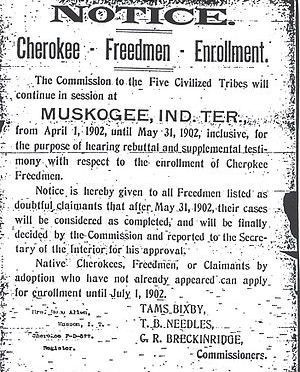
Cherokee freedmen are people of African descent who have rights to Cherokee citizenship since 1866 (and in some cases
prior) based under a treaty between the US government and the Cherokee nation, the amended 1839 constitution and the
present 1976 constitution. The freedmen were either former slaves of the Cherokees or were free mixed black Cherokees who
generally did not have citizenship rights prior to 1866.

******
2) Who has the right to Cherokee citizenship now?
All persons who were listed on the Dawes Rolls and their descendants, during the early 1900s have the right to Cherokee
citizenship based on the 1976 constitution. The Dawes rolls of the Cherokee nation have several sections – Delaware,
Cherokee by blood, Cherokee Freedmen, etc.

******
3) Didn’t the Freedmen lose their tribal membership and voting rights for a few years?
In 1983, the freedmen people were voting against Chief Swimmer, the registrar sent out letters canceling their tribal
membership cards and the freedmen were blocked from voting at the polls. In 1988, under Chief Mankiller, the tribal council
approved the registration policy of requiring all tribal members to have a CDIB card to keep tribal membership. A tribal
court in 2006 ruled that the tribal council could not pass additional requirements to bar any segment of Dawes enrollees from
receiving tribal membership cards or voting.

******
4) If most of the freedmen have Cherokee blood, why cant they get a cdib card?
The current BIA policy is to only give the card based on the blood degree listed on the Dawes Rolls. The Dawes
Commissioners had the sole authority to place people on any part of the Dawes rolls they wanted to. Because Congress had
decided that people listed as Freedmen would have unrestricted allotments, Commissioners were encouraged to list as many
people as possible as Freedmen with no blood degrees listed rather than as Cherokees with blood degrees even if the person
was listed on previous rolls as blood Cherokee or received payments earlier from the US government as a Cherokee by
blood. An example was Perry Ross who had a Cherokee mother and black father. Perry Ross, was listed on the 1852 Drennan
Roll proving Cherokee by blood, received a 1908 Guion Miller payment for having Cherokee blood, but yet was listed as a
freedmen citizen on the Dawes Rolls. Some Freedmen did get CDIB cards in the past based on other records, but they
stopped giving them out. The tribe never kept degrees of blood records and anything on the Dawes Roll is just guesswork so
far as a true degree of blood. To determine blood degrees for freedmen one must look at Dawes testimony and other records.

******
5) Chief Smith and Councilman Jackie Bob Martin have called for a special election to see if the freedmen people
should keep their tribal membership rights. What’s wrong with that?
Whats right about it? There something wrong about trying to take away the rights of people who have had them for more than
100 years. The court held that the people had been wronged, and now, instead of accepting that, these people are to be more
wronged? Would you not fight a president who wanted to put the US citizenship rights of Cherokee people on a ballot to the
people? Whose next to lose rights? Also, the people who are being asked to vote on the freedmen citizenship rights are not
being told that the freedmen have had rights since at least 1866, have served on the tribal council, generally have Cherokee
blood, and voted between 1971 and 1983 (between 1907 and 1971 there were no elections at all). When did Cherokee people
ever kick people out of the tribe? And why kick out only freedmen who came before Delaware and Shawnee – all 3 have
treaty rights to citizenship? Does anyone sitting here wonder if the movement to kick out the freedmen is fear that they may
not vote for some people now serving in office? Hardly any freedmen will be able to vote in such election because of the
slow process to register tribal members and even freedmen people with old 1970s membership cards must reregister. Is this
justice? Is it right for Cherokee leaders to break the promises made to these people by previous chiefs such as Lewis
Downing and WP Ross – just as the whites have broken their word to the Cherokee people time after time? What if the white
people say, if the Cherokees can break their treaty at will, we will do so too and demand back the Arkansas Riverbed money?

******
6) Won’t the freedmen take away from the rest of the Cherokees so far as benefits?
The Chief and the tribal council can request additional funds from the US government and supposedly are working hard on
economic development. Stop and think – Would you want your US citizenship rights to be taken away because white people
don’t want you to have rental assistance or such the same as them? Freedmen wont cancel medical insurance to go to I H S.

******

7) Did Freedmen get the same rights as Cherokees by blood previously?
Yes, all citizens including freedmen received 110 acres of tribal land equivalent when tribal lands were allotted, they received
the 1912 payroll, and the per capita payment given out in 1962. Freedmen held office between 1866 and 1907 – One
freedman Frank Vann even served with Redbird Smith on the council. Another freedmen councilman was Stick Ross.

Politics | Funding for black farmers, Indians stalls again |blame Republicans


Repost

August 5, 2010

Funding for black farmers, Indians stalls again

Despite broad support, legislation to finalize $4.6 billion in settlements with black farmers and American Indians stalled in the Senate again Thursday amid partisan bickering.

By BEN EVANS

Associated Press Writer

Related

WASHINGTON —

Despite broad support, legislation to finalize $4.6 billion in settlements with black farmers and American Indians stalled in the Senate again Thursday amid partisan bickering.

Lawmakers from both parties say they support resolving the long-standing claims of discrimination and mistreatment by federal agencies. But the funding has been caught up for months in a fight over spending and deficits, with Republicans and Democrats arguing over how to pay for them. Read more …click on the link below

Politics | Funding for black farmers, Indians stalls again | Seattle Times Newspaper.

July 22, 2010

Senate rejects $3 billion Indian trust settlement

The U.S. Senate has rejected a $3.4 billion government settlement with American Indians that had been added to a much larger war-funding bill.

The Associated Press

Related

HELENA, Mont. —The U.S. Senate has rejected a $3.4 billion government settlement with American Indians that had been added to a much larger war-funding bill.

The Senate passed the almost $60 billion bill funding President Obama’s troop surge in Afghanistan late Wednesday – but not before stripping out the settlement and $20 billion in other domestic spending approved by the House.

The Senate’s approval would have given the Obama administration the authority to settle a class-action lawsuit filed in 1996 by Elouise Cobell of Browning, Mont. Between 300,000 and 500,000 Native Americans claim the Interior Department mismanaged billions of dollars held in trust by the government.

The House attached the settlement to the war-funding bill earlier this month.

Thursday’s vote marks the second time the settlement has failed to pass the Senate. It was originally included in the Democrats’ jobs-agenda bill that was caught in a filibuster last month.

In the Library … “Injustices” by Ian Millhiser


ThinkProgress

Injustices: The Supreme Court’s History of Comforting The Comfortable And Afflicting The Afflicted

InjusticesThey won’t be selling Injustices at the Supreme Court gift shop. Ian Millhiser’s scathing, exuberant indictment of the many misdeeds of the nation’s highest court is a necessary, and highly entertaining, corrective to the mythology that has always surrounded the work of the Justices.”

~Jeffrey Toobin,
Author of The Oath and The Nine

by: ThinkProgress Justice Editor, Ian MillhiserOrder now: Amazon, Barnes and Noble, Indie Bound

Dear ThinkProgress Reader:

For the last five years, I’ve covered the Supreme Court for ThinkProgress. I’ve chronicled the justices’ decision to open the floodgates to corporate election spending, and I’ve reported on the rash of voter suppression laws that followed after the Court gutted the Voting Rights Act. I’ve shared your bewilderment when the Court held that a woman’s choice whether to use birth control could be given to her boss, and I’ve shared your terror at the prospect that the justices could rip health care away from millions of Americans.

Yet, as I explain in Injustices: The Supreme Court’s History of Comforting the Comfortable and Afflicting the Afflicted, these cases are hardly anomalies in the Supreme Court’s history. To the contrary, the justices of the Supreme Court shaped a nation where children toiled in coal mines, where Americans could be forced into camps because of their race, and where a woman could be sterilized against her will by state officials. The Court was the midwife of Jim Crow, the right hand of union busters, and the dead hand of the Confederacy.

Injustices tells the history of the Supreme Court through the eyes of the people that it has hurt the most — the young people stripped of their childhoods, the freedmen forced into peonage, the men and women who will die needlessly if the Supreme Court guts Obamacare. In my coverage of the Court over at ThinkProgress, I’ve strived to provide clarity on what the law provides and how the justices should decide their cases in accordance with that law, but I’ve also strived to reach beyond arcane legal arguments to show how the Court’s decisions shape the lives of millions of Americans. I bring that same ethic to over 150 years of Supreme Court history in Injustices. I urge you to check it out.

Sincerely,
Ian Millhiser

Get It Here:
Amazon BarnesNoble IndieBound

* * *

“More than just an indictment of the Supreme Court, Injustices offers a stirring defense of the role government plays in bettering people’s lives-and a heartbreaking window into the lives that are ruined when the justices place their own agenda above the law.”

~Ted Strickland,
Former Ohio Governor and US Representative
Former President, Center for American Progress Action Fund

“A powerful critique of the Supreme Court, which shows that it has largely failed through American history to enforce the Constitution and to protect our rights. With great clarity and poignant human stories throughout, Ian Millhiser has written a book that all who are interested in American government and our legal system – which should be all of us – must read.”

~Erwin Chemerinsky,
Founding Dean & Distinguished Professor, UC Irving Law School

“Ian Millhiser’s Injustices is a powerful reminder that for most of its history, the Supreme Court has erred on the side of protecting the privilege and powers of America’s elites-and that it has so often done so by reading the Constitution upside-down. Millhiser has crafted an indictment of the Court’s treatment of workers, minorities, women, voters, and powerless groups, with a deeply researched grounding in history and the law. His dispiriting conclusion is a powerful reminder of how much the Court matters, and how much more it could be.”

~Dahlia Lithwick,
Senior Editor, Slate

Jefferson Thomas and the courage of Children ~ Black History


Jefferson Thomas and the Courage of Children

by Marian Wright Edelman

In 1957, Jefferson Thomas and eight fellow black students known as the Little Rock Nine stood up to institutionalized segregation in America‘s education system and helped our nation live up to the promise of Brown v. Board of Education. Thomas passed away, but Change.org Changemaker Marian Wright Edelman writes that his legacy will live on in all who fight for equality.

for the complete article … use the link below

https://www.huffingtonpost.com/marian-wright-edelman/jefferson-thomas-and-the_b_714390.html?ncid=engmodushpmg00000004 via huffingtonpost.com