Tag Archives: Canada

It’s about the climate


The Climate Reality Project

In the next few days, the U.S. Senate will vote to determine the fate of a pipeline that would link a vast tar sands deposit in Alberta, Canada to refineries on the Texas Gulf Coast. The construction of the pipeline has been blocked once by President Obama, who refused to buckle to pressure from Congress and industry to cut short the environmental review. Unfortunately, they are at it again.
If approved and built, this pipeline, Keystone XL, would carry one of the most carbon-intensive sources of oil on the planet.
For the next 24 hours, The Climate Reality Project is joining with 350.org, MoveOn, League of Conservation Voters, Patagonia, Sierra Club, Energy Action Coalition and others to garner 500,000 signatures in a community-wide effort against the pipeline. Bill McKibben of 350.org will be on The Colbert Report tonight and will update the world on our progress — so sign now, and then pass it on. We’ve come together before to stop production of this dangerous pollutant — and with your help, we can do it again:
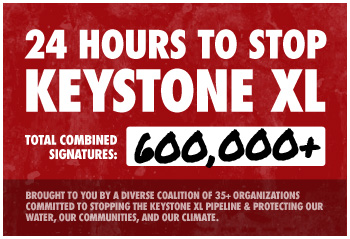
Join me in telling the U.S. Senate to say NO to one of the most carbon-intensive oils on the planet:

http://forms.climaterealityproject.org/keystone
If you care about the climate, you have to care about stopping this dangerous pollutant and the pipeline that carries it. After extensive research, the EPA estimates that annual carbon pollution from the Keystone XL pipeline could be at least 82% higher than average crude refined in America — if not more.
What does that number really mean? That’s the same amount of pollution as adding 4.8 million cars to our roads: an additional 27 million metric tons of carbon pollution.
Instead of pouring money into the production of more dirty oil, we need to work with Canada to invest in clean energy and energy efficiency. Clean energy is already the fastest growing industry in the U.S. and one of the fastest growing industries around the world.
It doesn’t matter where you live, or if the pipeline crosses into your home state. An increase of carbon pollution anywhere leads to climate change everywhere.
I just returned from an expedition to the Antarctic Peninsula, where the temperature has risen by over 8 degrees in the last 60 years. And more than that, the glacial retreat caused by this temperature increase means sea level is rising and dangerous changes are happening around the globe. To put it simply: it means we are all living on thin ice.
Take a minute and sign this important petition and tell the Senate to say NO to Keystone XL:
http://forms.climaterealityproject.org/keystone
Thanks,
Al Gore Founder and Chairman

the Climate Reality Project …


A special thank you and congratulations

Posted by , President & CEO

© 2011 Shravya K. Reddy, The Climate Reality Project

Today, we have cause for celebration. For much of this year, a large, diverse and growing grassroots movement has worked tirelessly to stop the Keystone XL pipeline, which would transport carbon-polluting tar sands oil from Canada to the Gulf of Mexico. Last weekend, thousands of people circled the White Houseto tell our leaders this pipeline would be devastating for our climate. This was an important statement of physical opposition to a foolish and unnecessary proposal. 

And now, our leaders have listened. President Obama and the State Department announced they will delay any decision on the pipeline at least until 2013. This means we will have at least another year to continue educating our leaders and the public on why this pipeline is such a terrible idea. Some early reports suggest that in practical terms, this delay means the pipeline will never get built.

We have faced many setbacks in our fight to solve the climate crisis. But over the long run, it is clear we will prevail. We will prevail because every day, millions of people around the world are demanding that their leaders face the reality of this crisis. This is one of those moments. This time, the people were heard.

The reality of climate change is the defining challenge of our time. It’s up to all of us to reject the deniers and the special interests and build a sustainable future for our planet. Congratulations and thank you to everyone who took part in this fight — to members and supporters of Climate Reality, and the whole band who were physically present and those who joined hands online. We all know there is a great deal of work ahead but it is victories like this that show us real change can be achieved. We must keep up the fight

The sad life of Petland puppies …Cristina Moon, Change.org


Change.org
                Call on Petland USA to stop supporting cruel puppy mills.             
Sign the Petition

While the puppies in Petland USA stores may look cute in their cages, chances are the puppies have led miserable lives that threaten their health from the day they’re born.

Petland USA is the country’s largest chain of stores that sell puppies. Most of Petland’s animals come from puppy mills, where thousands of dogs are bred again and again to supply the pet trade. Dogs are kept in cramped, unsanitary conditions, and they often lack adequate vet care.

There’s hope to stop puppy mill sales at Petland stores. Last month Petland Canada ordered its stores to stop selling puppies, in part due to continuous pressure from animal protection advocates. So Mary Haight, a Change.org member from Chicago, wants Petland USA to do the same. She started a petition on Change.org asking Petland USA to end puppy mill sales in its stores. Click here to sign her petition.

Walk into any major pet store like Petco or PetSmart, and you won’t find puppies for sale. Those stores work with local animal shelters to find homes for the countless animals waiting to be adopted across the country. Yet Petland stores prioritize profit by selling animals from puppy mills, propping up this cruel business.

Puppies bred in puppy mills are often plagued with poor health. Kept in cramped conditions and often housed outside in all types of weather, animals in puppy mills lead a pitiful existence. Puppy mill operators are also known to in-breed puppies, leading to other health and behavior problems.

Each Petland store in the US is an individually-owned franchise, meaning Petland USA’s corporate headquarters can’t ban puppy sales in stores on its own. But Petland USA can stop any new stores from selling puppies, and a strong statement from the corporation would go a long way to putting a stop to its existing stores that buy animals from puppy mills.

Please join Mary Haight in calling on Petland USA to support adoption and speak out against its stores doing business with puppy mills. Sign the petition:

http://www.change.org/petitions/petland-usa-stop-selling-pets-fire-puppy-mills-petland-canada-has

Thanks for being a change-maker,

– Cristina and the Change.org team

Exxon warned years before Yellowston​e spill -Brant Olson


By now you have likely heard about last weekend’s horrifying oil spill in which Exxon’s pipeline ruptured and spilled 42,000 gallons of crude oil onto Yellowstone River’s overflowing banks.

What we’ve learned since the spill is that federal regulators warned Exxon about problems with its pipeline in 2009. Then Friday happened, spilling oil into one of the world’s most beautiful places.

Here is the full story. In July 2009, federal inspectors found evidence that an above-ground span of Exxon’s pipeline in Montana had become submerged under a creek and was piling up debris. Nearly 20 months later, in March of this year, Exxon reported that it was “evaluating control measures to keep future debris from accumulating over the pipeline.”

Last weekend, in the same region cited in the inspection, the same pipeline ruptured during record flooding of the Yellowstone River. Oil has already been found hundreds of miles away.

Exxon’s spill in Montana is just the latest in a string of accidents as long as the industry is old. And while Big Oil says that it is learning from its mistakes, even its newest pipelines can’t seem to contain the increasingly corrosive oil, much of which is mined from Canada’s tar sands.

We don’t need more pipelines. And we don’t need more dirty oil. Most analysts actually expect a steady decline in U.S. demand for oil. What we do need is a system of regulations and penalties that keep our communities safe from the pipelines already in the ground

Thanks for taking action to stop more oil spills!

For a clean energy future,

Brant Olson
Freedom From Oil Campaign Director

The First Founders of PEI -Prince Edward Island


The First Founders of PEI

Road to Avonlea is rich in historical detail about the lives of the settlers of Prince Edward Island just after the turn of the 20th century.  But, much like the rest of Canada and the United States, the residents of Avonlea were not the initial founders of the land.  Here is a short summary of the history of one of the most culturally and physically beautiful islands in the world.

–    For thousands of years, it was the Micmac (or Mi’kmaq)  people who lived on Prince Edward Island.  They originally called it Epekwit (pronounced Abegweit), which means “land cradled on the waves”.   Their legend says that the Great Spirit first created the universe, then the Micmac people, and then saw that there was extra clay left over.  So he molded the clay into a crescent form, which became the island – “the most beautiful jewel in the universe”.  Today, the Micmacs represent a very tiny percentage of the main population.

–    The first explorer to find the island was Jacques Cartier in 1534.  When he first saw the land, he was overcome with its beauty and, standing on his ship, described it as “…the fairest land ‘tis possible to see!”.

–    The first white settlers – who were Acadian, of French origin – settled themselves at Port La Joye in 1720.  This was right across the harbour from Charlottown.  They named the island Île Saint-Jean, but due to the ensuing war between the French and English, the island’s name and occupiers changed many times.

–    In 1758, when Britain was occupying the island, they deported many of the Acadian people back to Europe.  Some of these people were then sent from France to settle Louisiana, which makes them the “Cajuns”.  Those who stayed on the island had to find a safe place to live.

–    Captain Samuel Holland was sent in 1764 to survey the land.  He then divided it into 67 different townships, and land grants were bid on by rich British subjects back in London.  For about a century after, the settlers and farmers of these townships had to deal with landlords that were not present and unwavering rent collectors.  It wasn’t until 1853 that the Land Purchase Act was passed, which allowed the Island government to buy back these lots and sell them to the tenants.

–    In 1873, Prince Edward Island officially joined the confederation of Canada.

–    PEI became very prosperous and experienced a “golden age” in the mid-nineteenth century due to its ship-building industry.  Within 50 years, 3,100 vessels were built there.

–    Throughout the 18th and 19th century, the island accepted Scottish settlers fleeing from hardships in their own land, as well as thousands of Irishmen hoping to find a better life there.  It also saw many Americans – the United Empire Loyalists – move up north to the island during the American War of Independence.

Source: Prince Edward Island Visitor’s Guide

Photo: The Micmac tribe of PEI.