
 By Marianne Gravely, Food Safety Technical Information Specialist, Food Safety & Inspection Service, USDA By Marianne Gravely, Food Safety Technical Information Specialist, Food Safety & Inspection Service, USDA
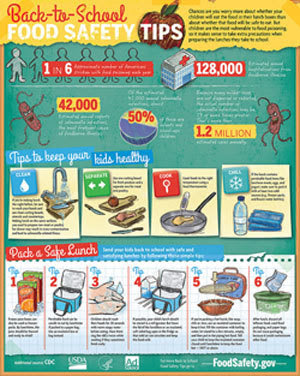
Back to school, back to the books, back in the saddle or back in the car for all the parents. The new school year means it’s back to packing lunches and after-school snacks for students, scouts, athletes, dancers, and all the other children who carry these items to and from home. One ‘back’ you do not want to reacquaint children with, however, is Bacteria. Read our latest blog for tips on how to keep bacteria from the cafeteria by safely packing and storing school lunches and snacks.
|
 |
Tag Archives: cheney

More Like National Employee Suppression Week
During National Employee Freedom Week, Conservatives Promote The Ruse of Right To Work Laws
Today marks the last day of “National Employee Freedom Week,” a week created by conservatives to promote the benefits of right-to-work laws. Anti-union policy groups and lawmakers in states across the country are attacking an already weakened labor movement by advancing so-called “right-to-work” laws, which inhibit workers from collectively bargaining for better wages, benefits and protections, under the guise of ‘choice.’ These laws allow some workers to get the advantages of a union contract—such as higher wages, benefits, and protection against arbitrary discipline—without paying any fee associated with negotiating on these matters.
Proponents of right-to-work argue a multitude of benefits from enacting such laws such as, lower unemployment, higher wages, less workplace injuries, and that workers’ families and states’ economies fare better. But here are the facts:
- The typical worker in a right-to-work state makes about $1,560 less per year than she would in a state without such a law.
- The rate of employer-sponsored health insurance is 2.6 percentage points lower in right-to-work states.
- The rate of employer-sponsored pensions is 4.8 percentage points lower in right-to-work states.
- Even workplace safety is affected—the rate of worker fatalities in construction is 34 percent higher in right-to-work states than non-right-to-work states
Last spring, under the leadership of Governor and presidential candidate Scott Walker, Wisconsin became the latest state to adopt a right-to-work law and take its working families in the wrong direction. Estimates by Marquette University economist Abdur Chowdhury suggest that Wisconsin workers and families will lose between $3.89 and $4.82 billion in direct income annually due to effects of the law. Unsurprisingly, Walker is one of several GOP candidates speaking at the Americans for Prosperity confab in Columbus this weekend. Americans for Prosperity, the Koch brothers’ flagship organization, has been a staunch supporter of right-to-work laws and has had a hand in almost every right-to-work fight across the country.
Over the last several decades, the share of income going to middle-class Americans has fallen in conjunction with the falling rate of union membership. Analysis by CAP Action shows a strong correlation between the decline in national union membership and the declining share of total national income going to the middle class. Take Wisconsin for example—from 1977 to 2013, Wisconsin middle-class families have seen their share of income fall more than 12 percent as the rate of union membership in the state has decreased. Meanwhile, the share of income going to the top 20 percent of households increased by nearly 20 percent during this time period.

With wages stagnant, inequality at record levels, and union membership in serious decline, we should use this misguided “Employee Freedom Week” as an opportunity to set the record straight and focus on rebuilding the middle class by raising state laws above and beyond federal standards—not by racing to the bottom with right-to-work.
BOTTOM LINE: Workers, their families, and states’ economies fare worse in right-to-work states, which is why the majority of Americans support labor unions. Proponents of right-to-work argue they’re fighting for choice and the right of workers to decide on their representation, but it’s the workers whose rights are being trampled on by this political ruse. Wisconsin and fellow right-to-work states need policies to empower workers and boost their ability to bargain collectively, not strip away the few protections they have left.
Share this:

We want Jon Stewart to moderate a 2016 presidential debate.
 |
|||||||||||||||||
|


Share this:

A New Plan To Invest In Kids … a repost
Harnessing The Child Tax Credit As A Tool To Invest In The Next Generation
It’s no secret that middle-class Americans are being squeezed. The price tag on middle-class economic security has grown significantly in recent years thanks to a dramatic increase in costs associated with a middle-class lifestyle such as housing, health care, college savings, and retirement savings. The combination of rising costs and stagnant wages has left millions of American families strained. American families with kids are the most likely to be struggling—child related costs account for nearly 70 percent of the rising costs associated with being in the middle class. Moreover, the costs of child poverty are staggering, costing the U.S. economy $672 billion a year–or nearly 4 percent of GDP–in lower educational outcomes, higher health costs, and increased spending on criminal justice.
But a new report from the Center for American Progress outlines how policy makers can help relieve the middle-class squeeze by strengthening the Child Tax Credit (CTC). The current CTC has several limitations that affect the families who need it most. For example, the credit is not fully refundable, preventing it from reaching the lowest-income children, and its minimum earnings requirement excludes many families who experience job loss. Our colleagues at CAP have suggested a few key proposals to strengthen this important credit:
- Making permanent the improvements to the CTC and Earned Income Tax Credit is slated to expire at the end of 2017, as failure to do so would push nearly 8 million children into or more deeply into poverty.
- Eliminating the minimum earnings requirements and making the credit fully refundable to ensure it reaches all low- and moderate-income families with children.
- Indexing the value of the credit to inflation so that it does not continue to lose value over time even as the costs of reaching or staying in the middle class are rising.
- Enhancing the CTC with a supplemental Young Child Tax Credit of $125 a month for children under the age of 3. The Young Child Tax Credit would be made available to families on a monthly basis with the understanding that many child-related costs cannot wait until tax season.
These changes would not only help parents afford necessities associated with raising young children like buying diapers, car seats, and cribs, but they would also help parents meet the rising costs of middle-class economic security.
The birth of a child is one of the leading triggers of poverty in the United States, so families with young children are particularly at risk. Furthermore, the effect of poverty on young children is hugely detrimental: ongoing economic instability hurts children’s long-term health, educational, and employment outcomes. But enhancing the CTC would go a long way in alleviating child poverty. Along with the report, CAP also released an interactive map that shows just how much the depth of child poverty would be reduced in each state with the proposed reforms to the Child Tax Credit. Check it out!

BOTTOM LINE: Americans are being squeezed by the rising price tag of middle-class economic security, and families with children are the most likely to be struggling. The United States has shockingly high levels of child poverty, but making a few basic changes to strengthen the Child Tax Credit would help families better invest in the next generation and lessen the depth of child poverty.
Share this:

Stop a pesticide that is simply too dangerous for widespread use
|
Enlist Duo—a highly toxic herbicide containing an active ingredient in Agent Orange—is simply too dangerous for people and animals! |
|
 |
|
|
Help us fight back in court with an emergency gift today!
|

 Be a Seed for Change
You must be logged in to post a comment.