Tag Archives: Democratic Party (United States)

MLK jr. speech 5/17/1957 ~ Give Us the Ballot ~ In Memory


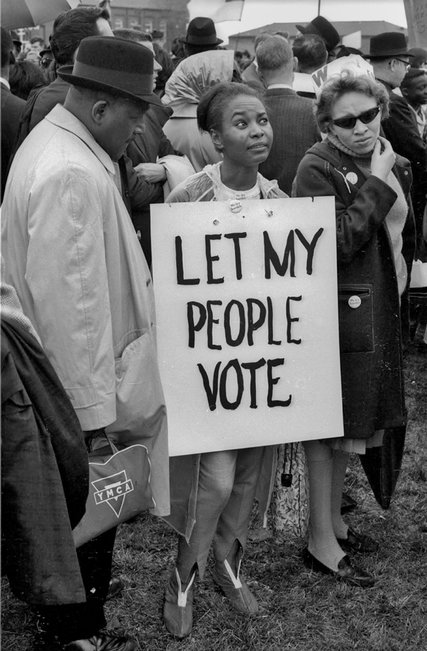
“Give Us the Ballot, We Will Transform the South”

giveustheballot

by Martin Luther King, Jr.
Speech given before the Lincoln Memorial at the March on Washington, May 17, 1957

Three years ago the Supreme Court of this nation rendered in simple, eloquent and unequivocal language a decision which will long be stenciled on the mental sheets of succeeding generations. For all men of good will, this May 17 decision came as a joyous daybreak to end the long night of segregation. It came as a great beacon light of hope to millions of distinguished people throughout the world who had dared only to dream of freedom. It came as a legal and sociological deathblow to the old Plessy doctrine of “separate-but-equal.” It came as a reaffirmation of the good old American doctrine of freedom and equality for all people.

Unfortunately, this noble and sublime decision has not gone without opposition. This opposition has often risen to ominous proportions. Many states have risen up in open defiance. The legislative halls of the South ring loud with such words as “interposition” and “nullification.” Methods of defiance range from crippling economic reprisals to the tragic reign of violence and terror. All of these forces have conjoined to make for massive resistance.

But, even more, all types of conniving methods are still being used to prevent Negroes from becoming registered voters. The denial of this sacred right is a tragic betrayal of the highest mandates of our democratic traditions and its is democracy turned upside down.

So long as I do not firmly and irrevocably possess the right to vote I do not possess myself. I cannot make up my mind — it is made up for me. I cannot live as a democratic citizen, observing the laws I have helped to enact — I can only submit to the edict of others.

So our most urgent request to the president of the United States and every member of Congress is to give us the right to vote. Give us the ballot and we will no longer have to worry the federal government about our basic rights. Give us the ballot and we will no longer plead to the federal government for passage of an anti-lynching law; we will by the power of our vote write the law on the statute books of the southern states and bring an end to the dastardly acts of the hooded perpetrators of violence. Give us the ballot and we will transform the salient misdeeds of blood-thirsty mobs into calculated good deeds of orderly citizens. Give us the ballot and we will fill our legislative halls with men of good will, and send to the sacred halls of Congressmen who will not sign a Southern Manifesto, because of their devotion to the manifesto of justice. Give us the ballot and we will place judges on the benches of the South who will “do justly and love mercy,” and we will place at the head of the southern states governors who have felt not only the tang of the human, but the glow of the divine. Give us the ballot and we will quietly and nonviolently, without rancor or bitterness, implement the Supreme Court’s decision of May 17, 1954.

<!–Read about recent allegations of voter disenfranchisement in Florida
and other states across the country in these articles.

17

–>

Learn more about Martin Luther King, Jr. and read more of his speeches and writings at The Martin Luther King, Jr. Papers Project at Stanford University.

Resources: pbs.org

Celebrate black history all year round ~~ repost


naacp

Black History Month may be over, but, we can celebrate the stories that make up our history throughout the year.
We are making history every day thanks to the men and women who serve our communities all over the country, fighting for justice and equality.
The NAACP’s commitment to those who move black history forward has been unbroken for more than a century. Let’s continue that commitment together. Become a member of the NAACP. Support our work and join us in making new stories—American stories.

Join today!Every time a new voter is registered, or we march in unison to a state capitol, lifting our voices for those who can’t, or fight to end a “Stand Your Ground” law, we are creating black history—American history. Not every hero is as well known as W. E. B. DuBois, Harriet Tubman, or Rosa Parks, but this in no way diminishes the measure of these accomplishments and contributions.
NAACP members stand behind these champions by fighting for the things that matter to all of us. When we work to ensure every person has the right to vote, when we demand an end to racial profiling, when we help to ensure folks have access to health insurance, when we fight for better education and an end to economic inequality, it amplifies the work being done by our unsung heroes every day. We all know that black history is more than one month of note—we stand tall throughout the year. Stand with us. Join us in making history. Become an NAACP member today:

http://action.naacp.org/history-year-round
Thank you for making history with us,
Lorraine C. Miller Interim President and CEO

Selling Artifacts – In Memory


Talk about poppin’ tags.

Goodwill offers up African artifacts for sale

Posted on November 19, 2013 | By
Goodwill African artifacts
antique-african-art
Some of the artifacts for sale

Goodwill in Tacoma is beginning to sell African artifacts valued at more than $11,000.

The 55 artifacts, from the mid-19th to mid-20th century, were used in tribal life and for tribal ceremonies. An anonymous donor left the 55 artifacts at the Port Townsend Goodwill store last month.

The items will be sold online at Shopgoodwill.com, a site used to produce the highest prices for items. The site uses competitive bidding to sell high-end fashion, jewelry, art and other items.

Go to the search portion of the site, pick Tacoma in the drop-down menu of sellers, then search for the items.

Goodwill wants the public to know about the online sales. Officials figure if people know valuable goods can fetch a good price, they might be more willing to donate.

“Many people hesitate to donate their high-end furniture, jewelry, clothing, art and collectibles because they assume their treasures will end up for $4 in our thrift stores,” said Dylan Lipert, manager of online sales, in a news release. “My job is to make sure that doesn’t happen.”

(The gallery above shows some of the artifacts, as well as other items that have or will be sold online.)

More than 140 Goodwill agencies provide items for sale online. In the past six years, Tacoma online operations have more than doubled in size and sales from $2.1 million in FY 2008 to $4.5 million in FY 2013.

**************************************************

Century-old Native American artifact dropped off at Goodwill

                  By                                        Published:  Jan 30, 2013 at 4:01 PM PST Last Updated: Apr 26, 2013 at 12:40 PM PST
Century-old Native American artifact dropped off at Goodwill
»Play Video          
SEATTLE — Someone recently donated an old vest

SEATTLE — Someone recently donated an old vest to Goodwill, and while that could happen everyday, this one was unusual.

By old, we mean a century old. It’s a beaded Native American vest that’s so valuable, Goodwill couldn’t bear to sell it.

Instead, the non-profit decided to make its own donation. Now, curators from the Burke Museum are analyzing the vest.

It’s an exquisitely detailed piece from the early 1900s. Everything from the color of the beads to the geometric designs to the velvet lining is a clue pointing to the vest’s history.

“Whoever gave it to Goodwill probably knew more about it. They probably knew their grandfather got it while on a train ride through Glacier. That’s the kind of information we’d love to have,” said Robin Wright, Curator of Native American Art.

The vest was inside a trunk, donated to Goodwill in 2006. Someone recognized its value, and instead of going up for sale, the vest went into storage.

Katherine Boury of Goodwill explained, “We have to make the decision, what’s the best use of the donation. In this case because it’s of cultural significance, it seems it would be best to be accessible to everyone.”

Assessors pinpointed it as Native American work from the northern plains.

“There’s been some discussion with various experts about which particular tribe and we’re not able to say precisely which tribe it might be,” said Wright.

It might have been regalia for a pow wow, but at some point, it seems it was sold to a tourist.

Written on the lining – a price tag of $18 – for a vest that probably took several months to make. There is no price on the vest now, and while there are still questions about where it came from, there’s no question where it’s going.

The museum will keep the vest in its collection for the public to see and treasure.

Do you think you have an artifact in your home? Take up to three objects to the annual Artifact ID Day at the Burke on Feb. 9.

********************************************************

Buyer Will Return Hopi

Face it, says auctioneer, not every mask is sacred

theage.com.au – 10 months ago
Seventy masks revered as sacred by an American Indian tribe have been auctioned in Paris, despite a court attempt to stop the sale.
 

Hopi masks snapped up after French court allows auction

msnbc.msn.com – 10 months ago
The Hopi tribe of northeastern Arizona and supporters including the U.S. ambassador to France and actor Robert Redford had urged the Paris auction house to suspend the sale due to the masks’ cultural
 

Hopi masks auctioned in Paris amid outrage and legal objections

latimes.com – 10 months ago
The gavel came down on 70 sacred Hopi Indian masks at the Drouot auction house in Paris on Friday, generating $1.2 million for the owners and auctioneers – and anger and emotional cries from

wonder if there are updates on any of these stories and hopefully progress on stopping this from happening… return them to their place of origin

WHITE ON WHITE CRIME IN WACO TEXAS MOTORCYCLE MASSACRE! (ARTICLE )


Our-Truth Media's avatarOUR✊🏿TRUTH

image

BY : LEON KWASI KUNTUO-ASARE

In another tragic case of white on white violent crime, on sunday afternoon May 17, 2015 several white supremacist motorcycle gangs got into a shot out. There were at least five gang factions involved and 9 people were murdered while 18 were injured as a result of the guns, chains, clubs and knives used in the Waco, Texas motorcycle gang melee.
When police arrived they set up a command center to interview , arrest and process the biker thugs involved in the mini massacre. Fortunately for the murderous gang members, unlike the Baltimore and Ferguson protestors, who killed no one, the national guard was not called and Waco was not occupied like Iraq, even though there were over a 100 weapons recovered .

For additional information use the link:

http://www.cnn.com/2015/05/17/us/texas-shooting/

View original post

21st Century … Colonialism


Residual Colonialism In The 21St Century …

  The 21st century deserves better. More importantly, the nearly 2 million people still living under colonial rule deserve better.

Article
definitely a repost
  • 2012•05•29

    John Quintero

    Residual colonialism in the 21st centuryPhoto: DB King

    Though colonialism is generally considered to be a relic of the past, nearly 2 million people in 16 “non-self-governing territories” across the globe still live under virtual colonial rule.  In recognition of the United Nations International Week of Solidarity with the Peoples of Non-Self-Governing Territories (25–31 May), we present this analysis of “residual colonialism in the 21st century”.

    ♦ ♦ ♦

    In 2009, the Government of the United Kingdom (UK) suspended parts of the Constitution of the Turks and Caicos Islands (TCI), a British Overseas Territory, in response to allegations of systemic corruption in the territory. Direct rule from London was imposed over the democratically elected local government. This unilateral, top-down action removed the constitutional right to trial by jury, suspended the ministerial government and the House of Assembly, and charged a UK-appointed Governor with the administration of the islands.

    A tentative period for elections has been given (fall 2012 at the earliest), but this is subject to the deliberation of the British government and tied to a series of specific milestones that must be met. These announcements provoked protests and demonstrations by the islanders. The suspension of the TCI government over corruption allegations seems to run contrary to the way in which financial and governance crises are handled around the world, including in the UK itself. Scandals are part of political life, but constitutions are not suspended nor are democratically elected governments and institutions disbanded.

    How is it that these events have occurred in a world based on a system of supposedly equal sovereign states? The answer lies in the little known fact that colonial structures continue to exist even today in some parts of the world.

    Continuing colonialism

    The wave of decolonization that swept around the world in the latter half of the 20th century was once heralded as one of the great liberating movements in history. Yet, few seem to realize that colonialism is still with us. As of 2012, 16 territories are deemed still to be under colonial rule and are labeled by the United Nations as “non-self-governing territories (NSGTs)” — areas in which the population has not yet attained a full measure of self-government.

    The 16 NSGTs, home to nearly 2 million people, are spread across the globe. They remain under the tutelage of former colonial powers (currently referred to as “administering powers”), such as the UK, the USA and France.

    Most of the NSGTs feature as only small dots on the world map but are in fact prominent players on the world stage. Some act as the world’s leading financial centres, with GDP per capita amongst the world’s top 10 (e.g., the Cayman Islands and Bermuda), some constitute vital bastions for regional security (e.g., Guam), and there are those whose geographical location has made them prone to diplomatic disputes (e.g., Gibraltar and the Falklands/Malvinas).

    A UN committee on decolonization does exist (Special Committee of 24 on Decolonization), under the purview of the Fourth Committee of the United Nations General Assembly (Special Political and Decolonization Committee). Its mission is to oversee the implementation of the Declaration on the Granting of Independence to Colonial Countries and Peoples (14 December 1960).

    The world underwent a political renovation following the formation of the United Nations in 1945, and the number of sovereign UN Member States has skyrocketed from the original 51 to 193. However, the 50-plus years since the founding of the United Nations have proved to be insufficient to eradicate a centuries-old structure of dominance. This is in spite of the advancement of legal systems based on the notions of the sovereign equality of states and human rights prevalent in the contemporary world.

    Decolonization, as bluntly put by UN Secretary General Ban Ki-moon, remains an unfinished business; an unfinished process that has been with the international community for too long. In solidarity with the peoples of the NSGTs, the present decade (2010-2020) has been declared the Third International Decade for the Eradication of Colonialism (as the past two decades have proved inadequate to ensure the disappearance of such an archaic concept).

    Independence is not the only option

    The doctrine of self-determination and political equality has prevailed as the guiding principle for decolonization ever since the inception of the United Nations. Much progress has been achieved and political autonomy for many former dependent states (micro-states, even) has been realized, but the decolonization process remains stalled. No territory has achieved self-government since East Timor (now Timor-Leste) won full independence from Indonesia in 2002.

    The many achievements of decolonization by the United Nations cannot be considered truly global while some peoples continue to live under colonial rule. Administering states such as the UK and France continue to exercise top-down authority through modernized dependency governance models that, while perhaps ensuring sustained economic progress, create a democratic deficit and political vulnerability based on unequal status.

    The decolonization agenda championed by the United Nations is not based exclusively on independence. There are three other ways in which an NSGT can exercise self-determination and reach a full measure of self-government (all of them equally legitimate): integration within the administering power, free association with the administering power, or some other mutually agreed upon option for self-rule.

    The current impasse is due, in part, to the denial by the administering states of these options, but also to a lack of public awareness on the part of the peoples of the NSGTs that they are entitled to freely determine their territory’s political status in accordance with the options presented to them by the United Nations. It is the exercise of the human right of self-determination, rather than independence per se, that the United Nations has continued to push for.

    ColonizedNon-Self-GoverningThe framework against colonialism

    International law provides a particularly effective conceptual framework from which to criticize these complex dependency arrangements. In the UN Charter, not only Articles 1 and 55 maintain that one of its fundamental purposes and principles is “to develop friendly relations among nations based on respect for the principle of equal rights and self-determination of peoples”. A further three chapters of the Charter are devoted to the dependent territories, namely Chapter XI (Declaration regarding Non-Self-Governing Territories), Chapter XII (International Trusteeship System) and Chapter XIII (The Trusteeship Council).

    Core human rights conventions, such as the International Covenant on Civil and Political Rights (ICCPR) and the International Covenant on Economic, Social and Cultural Rights (ICESCR) both affirm the right of self-determination and that the states parties to the covenants have the responsibility to promote the realization of self-determination, in conformity with the provisions of the Charter of the United Nations. Colonialism has been formally delegitimized as an acceptable international practice, as per the Declaration on the Granting of Independence to Colonial Countries and Peoples (General Assembly Resolution 1514 [XV]) in 1960 and a companion resolution defining the three legitimate models of political equality (General Assembly Resolution 1541 [XV]). Further resolutions, for example, established permanent sovereignty over natural resources (General Assembly Resolution 1803 [XVII]).

    In October 1970, UN General Assembly Resolution 2621 (XXV) declared that the further continuation of colonialism in all its forms and manifestations is a crime, and in 1977 General Assembly Resolution 32/14 reaffirmed the legitimacy of the struggle of peoples for independence, territorial integrity, national unity and liberation from colonial and foreign domination and alien subjugation by all available means, including armed struggle.

    The road ahead

    Colonialism made the political world map look much as it does today, drawing up borders with no regard for local sensibilities and realities. It negated or purposefully misconceived the cultural, economic, political and social conditions under which the colonized led their lives. In the process, colonial powers imposed inappropriate identities on the people they ruled, crippling peoples’ self-esteem, thus diminishing their self-efficacy and potentially stunting their long-term social development.

    Given the modern emphasis on the equality of states and inalienable nature of their sovereignty, many people do not realize that these non-self-governing structures still exist. Thus, the world has closed its eyes to continuing colonial dependence.

    World media has the potential to play a pivotal role in advancing decolonization by exposing developments that infringe on the exercise of the right of self-determination and that worsen the political vulnerability of the NSGTs. The issue at hand is not that colonialism does not exist in today’s world because the populations of these territories overwhelmingly do not define these territories as colonies. Rather, it is that these populations have not been provided with an opportunity to decide on a legitimate political status through popular consultation in the form of an acceptable act of self-determination. Once this is made sufficiently clear, media coverage and overview can be expected.

    In light of the disbandment of an overseas democratically elected government in TCI, the international community, the public in general and the peoples of the NGSTs alike have been reminded that the UN agenda on colonialism is very much relevant and crucial — -not only for the protection of fundamental human rights, but to democratic governance and an international order principled upon the notions of sovereignty and the equality of states.

    One of the greatest and most visible achievements of the United Nations has been to pursue the decolonization of the colonized world. However, a successful end to this process cannot be based on simply removing territories from the UN list of NSGTs (de-listing), but rather on the actual achievement of full self-government.

    De-listing cannot be perceived as the goal, but rather as a secondary product resulting from clear indicators of self-government, political equality vis-à-vis the administering state, and the promotion and support of genuine political education programmes that allow the populace of those territories to freely choose their status and their future. Not doing so would result in stymieing the legitimate aspirations of peoples whose human rights the United Nations was created to protect.

    Colonialism is a concept of an exploitative past that runs counter to the principles of sovereign equality on which the United Nations is grounded. As commonly expressed in General Assembly debates, colonialism is anachronistic, archaic, and outmoded; it contravenes the fundamental tenets of democracy, freedom, human dignity and human rights.

    The 21st century deserves better. Most importantly, the nearly 2 million people still living under colonial rule deserve better.

    Black History Month