Dismal Town historical sign. Credit: USFWS
 |
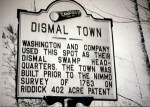 Human occupation of the Great Dismal Swamp began nearly 13,000 years ago. By 1650, few native Americans remained in the area, and European settlers showed little interest in the swamp. In 1665, William Drummond, a governor of North Carolina, discovered the lake which now bears his name. William Byrd II led a surveying party into the swamp to draw a dividing line between Virginia and North Carolina in 1728. George Washington first visited the swamp in 1763 and organized the Dismal Swamp Land Company that was involved in draining and logging portions of the swamp. A five-mile ditch on the west side of the refuge still bears his name.
Logging of the swamp proved to be a successful commercial activity, with regular logging operations continuing as late as 1976. The entire swamp has been logged at least once, and many areas have been burned by periodic wildfires.
The Great Dismal Swamp has been drastically altered by humans over the past two centuries. Agricultural, commercial, and residential development destroyed much of the swamp, so that the remaining portion within and around the refuge represents less than half of the original size of the swamp. Before the refuge was established, over 140 miles of roads were constructed to provide access to the timber. These roads severely disrupted the swamp’s natural hydrology, as the ditches which were dug to provide soil for the road beds drained water from the swamp. The roads also blocked the flow of water across the swamp’s surface, flooding some areas of the swamp with stagnant water. The logging operations removed natural stands of cypress and Atlantic white-cedar that were replaced by other forest types, particularly red maple. A drier swamp and the suppression of wildfires, which once cleared the land for seed germination, created environmental conditions that were less favorable to the survival of cypress and cedar stands. As a result, plant and animal diversity decreased.
The swamp is also an integral part of the cultural history of the region and remains a place of refuge for wildlife and people. The dense forests of the Great Dismal Swamp provided refuge to runaway slaves, resulting in the refuge becoming the first National Wildlife Refuge to be officially designated as a link in the “Underground Railroad Network to Freedom” in 2003. For more information click here.
Establishment of the refuge began in 1973 when the Union Camp Corporation donated 49,100 acres of land to The Nature Conservancy. This land was then conveyed to the Department of the Interior, and the refuge was officially established through The Dismal Swamp Act of 1974.
Last updated: January 14, 2010



 Be a Seed for Change
You must be logged in to post a comment.