
Tag Archives: Khalid Sheikh Mohammed

Gitmo -The Neverendin​g Story


Yesterday, the New York Times and other news outlets reported on a “trove of more than 700 classified military documents” that provide “new and detailed accounts of the men who have done time at the Guantánamo Bay prison in Cuba, and offers new insight into the evidence against the 172 men still locked up there.” The documents were obtained by the open government website WikiLeaks but obtained by the Times through another source. The documents reveal details about detainee behavior and treatment, but are “silent about the use of the harsh interrogation tactics at Guantánamo — including sleep deprivation, shackling in stress positions and prolonged exposure to cold temperatures — that drew global condemnation.”

THE DETAILS: The Times editorializes today that the documents serve as “a chilling reminder of the legal and moral disaster that President George W. Bush created” at Gitmo and “describe the chaos, lawlessness and incompetence in his administration’s system for deciding detainees’ guilt or innocence and assessing whether they would be a threat if released.” “Innocent men were picked up on the basis of scant or nonexistent evidence and subjected to lengthy detention and often to abuse and torture,” the Times editorial notes, adding that suicides there “were regarded only as a public relations problem.” The documents show that there were 158 detainees “who did not receive a formal hearing under a system instituted in 2004. Many were assessed to be ‘of little intelligence value’ with no ties to or significant knowledge about Al Qaeda or the Taliban.” The Guardian notes that 212 Afghans at Gitmo were either “entirely innocent,” “mere Taliban conscripts” or “had been transferred to Guantanamo with no reason for doing so.” Among inmates who proved harmless were an 89-year-old Afghan villager, suffering from senile dementia, and a 14-year-old boy who had been an innocent kidnap victim. The so-called 20th 9/11 hijacker, Mohammed Qahtani, “was leashed like a dog, sexually humiliated and forced to urinate on himself.” And U.S. forces held Sami al-Hajj, a Sudanese cameraman for Al-Jazeera, for 6 years before finally letting him go. Hajj had insisted he was just a journalist and he went back to work for Al-Jazeera after his release.

DOUBLE GUANTANAMO?: The idea of Guantanamo has become so toxic internationally that even military leaders such as Gen. David Petraeus want it shut down. “Gitmo has caused us problems, there’s no question about it,” Petraeus said in 2009, adding, “I oversee a region in which the existence of Gitmo has indeed been used by the enemy against us.” Yet at the same time, others sing Guantanamo’s praises. Former Massachusetts governor Mitt Romney (R), who will likely run for president next year, said in his last campaign for the White House that the prison needs to be expanded, not closed. “I want them on Guantanamo, where they don’t get the access to lawyers they get when they’re on our soil. I don’t want them in our prisons, I want them there,” Romney said during a 2007 presidential debate. “Some people have said we ought to close Guantanamo. My view is we ought to double Guantanamo,” he later added.

FAILING TO CLOSE GITMO: Just three years ago, closing the Guantanamo Bay prison had broad bipartisan support. While Obama campaigned on closing Gitmo, even Republicans, including President Bush and Obama’s opponent, Sen. John McCain (R-AZ), agreed. But Attorney General Eric Holder’s recent announcement that alleged 9/11 mastermind Khalid Sheik Mohammed would be tried in a military tribunal instead of a civilian court all but ended any hopes that the prison would be closed anytime soon. Yet, as the Washington Post chronicled last weekend, “For more than two years, the White House’s plans had been undermined by political miscalculations, confusion and timidity in the face of mounting congressional opposition.” Who’s fault is it that Gitmo is still open? While Democrats in Congress largely abandoned the President, the White House didn’t exactly put a lot of political capital on the line either. As former White House counsel Greg Craig noted, “There was a real serious problem of coordination in this whole thing.” Indeed, the administration had planned to transfer some uncontroversial detainees to Northern Virginia but abandoned the move at the last hour after Rep. Frank Wolf (R-VA) discovered that Gitmo detainees would be moving to his district. The White House never cleared their plan with Wolf. Since then, as Obama noted last year, Gitmo has “been subject to a lot of…pretty rank politics.” And as “Not In My Backyard” cries from members of Congress intensified, the legislative branch eventually cut off funds to close Gitmo and approved a measure to bar any detainees from being relocated to the United States.

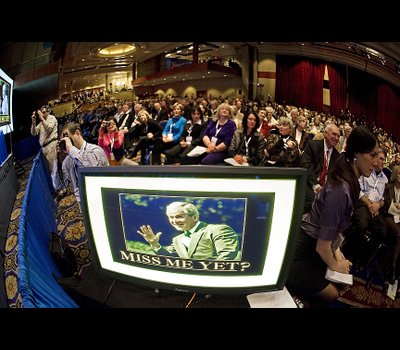
BUSH LEGACY: Decision Points Of Failure


President  Bush’s new memoir, Decision Points, hits stores today. In a series of promotional interviews with mainstream and conservative news outlets, Bush opens up about his personal fight with alcoholism, his mother’s traumatic miscarriage, and some of the most defining moments of his presidency. Judging from press accounts, the memoir offers few substantive revelations. It is, as the Washington Post‘s book critic Jonathan Yardley describes it, “not a memoir as the term is commonly understood — an attempt to examine and interpret the writer’s life — but an attempt to write history  before the historians get their hands on it.” Indeed, Bush’s memoir is full of the kind of half truths, stubborn rationalizations, and outright misrepresentations that dominated his eight-year presidency. Throughout the book, Bush admits only to the most cursory of mistakes and communications failures, while defending his most unpopular decisions.

IRAQ — ‘I WAS A DISSENTING VOICE’:   Bush doubles down on the disastrous war in Iraq, writing, “Saddam Hussein didn’t just pursue weapons of mass destruction. He had used them.” “He deployed mustard gas and nerve agents against the Iranians and massacred more than five thousand innocent civilians,” Bush said, adding that he believed Hussein had weapons of mass destruction and was stunned to find out that he didn’t. It was “unbelievably frustrating,” Bush told Fox News‘ Sean Hannity. “Of course, it was frustrating. It — everybody thought he had WMD. Everybody being every intelligence service, everybody in the administration .” “No one was more shocked or angry than I was when we didn’t find the weapons.  I had a sickening feeling every time I thought about it. I still do,” Bush writes in his book. When asked by NBC’s Matt Lauer if he filtered out dissenting voices against the war, Bush retorted, “I was a dissenting voice. I didn’t want to use force. I mean force is the last option for a president. And I think it’s clear in the book that I gave diplomacy every chance to work. And I will also tell you the world’s better off without Saddam in power. And so are 25 million Iraqis.” Recently declassified documents and press accounts, however,  contradict Bush’s version of events and reveal that his administration was looking for a way to “decapitate” the Iraqi government since 2001. As Bush’s Treasury Secretary Paul O’Neill — who Bush fired for “disagreeing too many times” with him — puts it, Bush was “all about finding a way to [go to war]. That was the tone of it. The President saying ‘Go find me a way to do this.'” In 2002, Bush also reportedly told then-National Security Adviser Condoleezza Rice, while she was in a meeting with three U.S. Senators on how to approach Iraq diplomatically, “F— Saddam. We’re taking him out.” In “talking about why we needed this war,” Bush also later referenced an alleged Iraqi assassination plot against Bush’s father: “We need to get Saddam Hussein…that Mother F—– tried to take out my Dad.” Asked by Lauer if he ever considered apologizing to the American people over the war and the failure to find weapons of mass destruction,  Bush replied, “I mean, apologizing would basically say the decision was a wrong decision,” Bush replied. “And I don’t believe it was the wrong decision.”

TORTURE — ‘DAMN RIGHT’:   Bush writes that he also has no regrets about authorizing the CIA to use enhanced interrogation techniques on captured prisoners and admits  personally authorizing the illegal torture of Khalid Sheikh Mohammed, the self-professed 9/11 mastermind. When asked whether the partial drowning technique could be used, Bush’s answer was emphatic: “Damn right.” In his interview with Lauer, Bush said his lawyers told him waterboarding was legal. “Because the lawyer said it was legal,” Bush rationalized. “He said it did not fall within the Anti-Torture Act. I’m not a lawyer. But you gotta trust the judgment of people around you and I do,” Bush said. He also dismissed critics like former New Jersey Governor and co-head of the 9/11 Commission Thomas Kean, who has said that the administration simply shaped the legal opinions around their intended policy. [Kean] “obviously doesn’t know,” Bush replied. “I hope Mr. Kean reads the book. That’s why I’ve written the book. He can, they can draw whatever conclusion they want. But I will tell you this.   Using those techniques saved lives. My job is to protect America and I did.” It’s not clear that torture did, however. For instance, Mohammed told U.S. military officials that he gave false information to the CIA after withstanding torture, and as a former Special Operations interrogator who worked in Iraq argues, waterboarding has actually cost American lives: “The number of U.S. soldiers who have died because of our torture policy will never be definitively known, but it is fair to say that  it is close to the number of lives lost on Sept. 11, 2001,” he says. In his memoir, Bush also contends that he was “blindsided” by the photos of abused prisoners at the Abu Ghraib prison in Iraq and twice considered accepting Secretary of Defense Donald Rumsfeld’s resignation over the incident. Bush wrote, “I knew it would send a powerful signal. I seriously considered accepting his advice. I knew it would send a powerful signal to replace the leader of the Pentagon after such a grave mistake. But a big factor held me back.  There was no obvious replacement for Don.”

KATRINA — KANYE’S COMMENTS WERE ‘THE WORST’:   Bush did accept some responsibility for the government’s slow response to Hurricane Katrina, telling Lauer, “Yes. The lack of crisp response was a failure at all levels of government.” But he seemed most disappointed about the unfortunate picture taken of him in Air Force One, flying over New Orleans, and the criticism he received over the incident. Bush said he looked “detached and uncaring” in the photo, admitting, “It’s always my fault. I should have touched down in Baton Rouge, met with the governor, and, you know, walked out and said, ‘I hear you.’ I mean, ‘We know. We understand. And we’re gonna, you know, help the state and help the locals, governments with as much resources as needed.’ And — and then got back on a flight up to Washington. I did not do that and paid a price for it.” Bush also explained his now infamous “heck of a job” comments to FEMA director Mike Brown. “My intention was simply to say to somebody who’s workin’ hard, ‘Keep workin’ hard,'” Bush rationalized. “And it turns out that– those words became a club for people to say, ‘Wait, this guy’s out of touch .'” Unfortunately for Bush, the criticism is  far harsher than that. A 2006 report compiled by House Republicans slammed what it called “a failure of leadership,” saying that the federal government’s “blinding lack of situational awareness and disjointed decision making needlessly compounded and prolonged Katrina’s horror.” The report  specifically blamed Bush, noting that “earlier presidential involvement could have speeded the response” because the president alone could have cut through bureaucratic resistance. Still, for Bush, the worst moment of the disaster — and possibly his entire presidency — came when rapper Kanye West said “George Bush doesn’t care about black people” during an NBC telethon. “I faced a lot of criticism as President,” Bush writes in his book. “I didn’t like hearing people claim that I lied about Iraq’s weapons of mass destruction or cut taxes to benefit the rich. But the suggestion that I was racist because of the response to Katrina   represented an all time low.” When pressed by Lauer on why “the worst moment in your Presidency was [not] watching the misery in Louisiana, but rather when someone insulted you because of that,” Bush replied, “No, I — that — and I also make it clear that the misery in Louisiana affected me deeply as well. There’s a lot of tough moments in the book. And it was  a disgusting moment, pure and simple.”