Tag Archives: moveon.org

The Middle Class and Unions … a repost


By CAP Action War Room

With The Middle Class At Risk, We Need Unions Now More Than Ever

We’ll be taking a welcome day off next Monday, and we hope all of you can do the same. But celebrating Labor Day is about more than just a three-day weekend. It’s a chance to reflect on the importance of unions and remember that we need them now more than ever.

Unions have been at the center of some of America’s most important fights for fair labor standards. Unions helped end child labor: the very first American Federation of Labor (AFL) national convention passed a resolution calling on states to “ban children under 14 from all gainful employment.” Labor unions negotiated for and won employer-provided health insurance coverage, one of the first great expansions of health care to all Americans. And unions didn’t just give us this Labor Day long weekend – they fought for labor standards that gave us ALL weekends.

Unions are central in providing good jobs and middle-class security to America workers. As unions go, so goes the middle class. The chart below spells that out pretty clearly: as union membership has declined, the middle-class share of income has also dropped:


Nowadays, union membership is under attack from many who are either ignoring history and economic data, or only have the wealthiest Americans’ interests in mind. Anti-union policy groups and lawmakers in states across the country are attacking an already weakened labor movement by advancing so-called “right-to-work” laws, which inhibit workers from collectively bargaining for better wages, benefits and protections, under the guise of ‘choice.’ These laws allow some workers to get the advantages of a union contract—such as higher wages, benefits, and protection against arbitrary discipline—without paying any fee associated with negotiating on these matters. This doesn’t result in more freedom, it results in lower incomes.

Wisconsin became the latest state to adopt a “right-to-work” law and take its working families in the wrong direction. Estimates by Marquette University economist Abdur Chowdhury suggest that Wisconsin workers and families will lose between $3.89 and $4.82 billion in direct income annually due to effects of the law. Recently, Missouri Gov. Jay Nixon (D) vetoed a bill passed by the Missouri legislature to enact a similar policy there.

The numbers are clear. The typical worker in a “right-to-work” state makes about $1,560 less per year than she would in a state without such a law. According to new research, women in union jobs earn $212 per week, or 30.9%, more than women in non-union jobs; men in union jobs earn $173 more per week than their non-union counterparts. Union women also face a smaller gender wage gap: They earn 88.7 cents for every dollar a man makes, compared to 78 cents across all workers.

BOTTOM LINE: If you care about a strong middle class in America, you should care about unions. The organizers that have been at the heart of many important labor reforms in the past have a vital role to play for America’s economy now and in the future, too. It’s on us to take every opportunity we can to remind people that unions work. So have a great long weekend, and make sure you remind your friends and loved ones: Enjoying your labor day weekend? Thank a union.

Re: Tell President Obama: No More Public Lands and Waters Giveaways


Ran
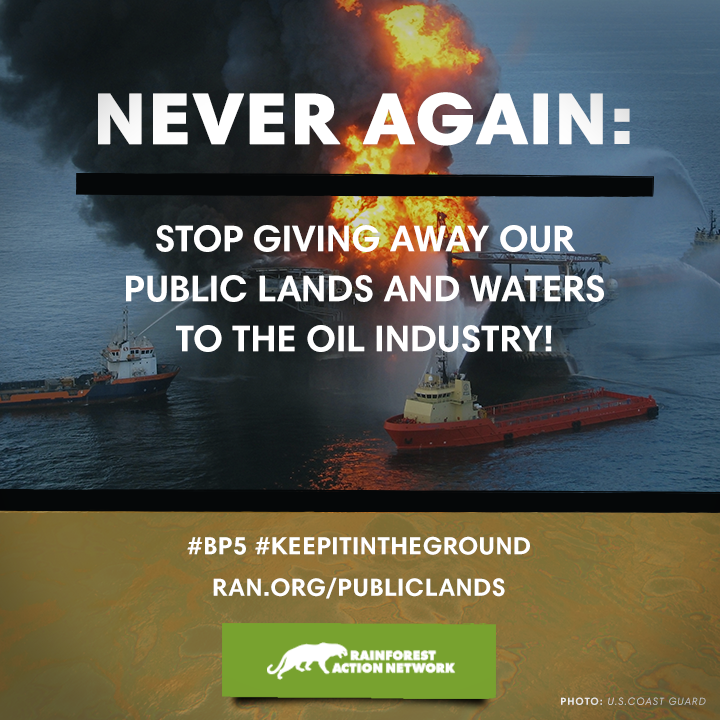
 I wanted to make sure you’d seen this, from Monday. It’s been five years since BP’s Deepwater Horizon disaster, but the Gulf Coast is still suffering. President Obama can help ensure there are no more Gulf oil spills — and establish his climate legacy at the same time.We’ve already had a great response from thousands of RAN supporters. Will you join them by adding your voice?

Tell President Obama: no more oil, coal and gas leases in coastal waters and on public lands.

Five years ago today, BP’s Deepwater Horizon drilling rig exploded, killing eleven people and sending some 210 million barrels of oil flooding into the Gulf of Mexico. President Obama called it “the worst environmental disaster America has ever faced”.1

Never again. The president can help ensure there are no more disasters like the Deepwater Horizon — and establish his climate legacy at the same time. Call on President Obama to stop leasing our public lands and waters to the fossil fuel industry.

BP5_NEVER_AGAIN_720x720_2.png

The Gulf Coast is still suffering. The 170,000 workers who cleaned up the spill are at greater risk for cancer, and kidney and liver disease.2 Last year, dolphins and whales off the Louisiana coast died at four times the usual rates.3 And 10 million gallons of oil sit on the Gulf floor in a congealed “bath mat” the size of Rhode Island.4

BP controls more of the deepwater Gulf than any other oil company, with an outrageous 600 leases.5 In the case of the Deepwater Horizon disaster, a U.S. judge found BP’s conduct to be “grossly negligent”.6 But — to be clear — when it comes to the fossil fuel industry, gross negligence is business as usual.

So we’re joining our friends at CREDO Action to say: No more Gulf oil spills. No more giving away our public lands and waters to rapacious fossil fuel companies that care only about their profits. Tell President Obama to issue an executive order now.

President Obama wants to be remembered as a climate leader. But he has a huge climate blindspot. While the president has pushed for international agreements to limit carbon pollution, he’s also presided over a massive drilling boom on our public lands and in our coastal waters.

That explosive growth is killing the climate. Emissions from federally managed lands and waters cause approximately 24 percent of U.S. energy-related greenhouse gas emissions annually — mostly from coal, oil and gas.7

The solution is simple. If President Obama wants to establish a real climate legacy, he should issue an executive order instructing federal agencies to stop granting new and expanded leases to extract fossil fuels from public lands.

To avoid catastrophic climate change, scientists say we must keep between 67% and 80% of the world’s remaining fossil fuels in the ground.8 One quarter of U.S. fossil fuel production happens on federally-managed lands and waters. The president can take a huge step towards stopping climate change — and preventing future Gulf oil spills. Urge him to issue an executive order today.

For our lands and our waters, our communities and our climate,

Amanda_400x400.jpg Amanda Starbuck
Climate and Energy Program Director
Rainforest Action Network

P.S. Bridge the Gulf, Louisiana Bucket Brigade, and Idle No More Gulf Coast are among the many organizations fighting for justice and accountability in the aftermath of the Deepwater Horizon oil spill. On this fifth anniversary of the BP disaster, support them today.

Sources:

1. “Remarks by the President to the Nation on the BP Oil Spill”, White House Office of the Press Secretary, June 15, 2010
2. “BP Oil Spill Cleanup Workers Are At Higher Risk Of Sickness, Cancer”, ThinkProgress, Sep. 17, 2013
3. “Science Links Dolphin Deaths to BP Oil Spill – Again”, National Wildlife Federation, Feb. 13, 2015
4. “Scientists have found a 10 million gallon ‘bath mat’ of oil on the floor of the Gulf of Mexico”, Business Insider, Feb. 4, 2015
5. “Deepwater Gulf of Mexico”, BP
6. “U.S. judge upholds BP ‘gross negligence’ Gulf spill ruling”, Reuters, Nov. 13, 2014
7. “Greenhouse Gas Emissions from Fossil Energy Extracted from Federal Lands and Waters: An Update”, Stratus Consulting, prepared for The Wilderness Society, Dec. 23, 2014
8. “Unburnable Carbon 2013: Wasted capital and stranded assets”, Carbon Tracker Initiative & Grantham Research Institute on Climate Change and the Environment, 2013; “Climate Change 2014: Synthesis Report”, Intergovernmental Panel on Climate Change, 2014.

Smells Like Death and Bad Decisions …repost


RioCoverby
Bring up Rio de Janeiro and you’ll conjure delectable images in my mind. Images like … Beaches. Mouthfuls of picanha bursting with juicy flavor. Grown and sexy natives are pressing their bodies against each other to samba music in dusky bars. Brazilian women flaunting their beautiful Brazilian bundas in skin-baring bikinis as they walk along the beach, hips swaying in the sunlight – not to mention their bronze skin and sun-kissed waist-length tresses. (Excuse me while I whip out my credit card to order 22 inches of Brazilian Remy hair. Now I want to look Brazilian for a few weeks.)


These appetizing images aren’t all that come to mind. I haven’t forgotten about soccer. Brazil and soccer are synonymous with one another and Brazil is hosting its first World Cup in 64 years.

Rio is also home to the 2016 Olympic Games – the first country in South America to claim the privilege. But these facts are troubling, particularly because despite these honors, Rio is socially, environmentally and financially stewing in a sewage and pollution crisis that’s as disgusting as it is disturbing. This is affecting peoples’ lives and threatening the country’s tourism industry. If these issues aren’t checked by August 5, 2016, then the 2016 Olympics are in jeopardy.

Rio’s Crappy Situation

“When Brazil was selected as the host of the World Cup five years ago, we celebrated. We celebrated because we didn’t know that it was going to cost so much,” said Mateos da Costa, a 53-year-old taxi driver told CNN. “Our leaders should have known that Brazil was not in a condition to organize the event.”

To say Brazil was not in a condition is an understatement. Brazil’s competence for hosting global events has been under scrutiny several times, but after beating out Tokyo, Madrid and Chicago to host the games, the country promised to get their act together and clean up their public sewage issues in time for the games. Now, these same unsavory sewage conditions are the reason Brazil will not make good on its commitment to clean up in time for neither the World Cup nor the 2016 Olympic Games.

UNFULFILLED PROMISES


Rio residents, or Cariocas, are frustrated with Rio’s behavior. Initially, the World Cup and the Olympics came attached to promises of economic prosperity for not only the government but also the people. Taxpayers have paid over $3.6 billion to develop stadiums across Brazil – and that amount is just a portion of the World Cup’s $11.5 billion price tag.

Despite all the money poured into these sports initiatives, Brazil’s has a laundry list of mostly built stadiums that aren’t ready for World Cup use. And according to discussions, there are so many factors to blame, including corruption, shortsighted planning and “overwhelming bureaucracy,” says to Wall Street Journal writers John Lyons and Loretta Chao. They insist there’s widespread belief prioritization of tourism and entertainment over education and health care keep the country poor.

“It’s an affront, in a country with so many deficiencies in basic needs, to organize a Cup in this way,” Alcyr Leme told the Wall Street Journal. Although Leme has “fond memories of going to see Brazilian legend Pelé play in the 1960s,” he plans to watch this Cup from home. “Buying game tickets would only condone the waste,” he said.

Continued…

skin care products …. how about sleep water and good food


shoesandblackgirl

Have you been getting digital product ads for Holiday events that are months away. I have and while I do love and buy products from certain sites, others are annoying offensive and you have to wonder how the FDA gave them the greenlight. Anyway, the ads in both print and digital have been focusing on women’s looks … how awful or our sagging skin or wrinkles … lest we talk about those aging spots oh and don’t stop there why not just lighten brighten and whiten your skin to make yourself look younger. Say what? I have admitted to having had a tough time with my skin when I was in my 20’s. I did not have acne in high school but moving to the city and indulging in food I had no idea existed … probably full of Tran’s fat and the environment forced me into doing time under the lights. I had allergy issues eczema and so on but the dermatologist was fantabulous. I did what I was told which is the most important thing during those years so my skin recovered, but the issues of wrinkles, lines and saggy parts of the face actually seem to be less when you go to sleep at a reasonable and consistent hour and to-be-honest water has and will always be our body’s savior. I have to admit, 2015 has been stressful, the heat, and working odd hours has a tendency to bring out wrinkling sagging in the neck area while the face is fine right now.  I look at those commercials, scream then wonder if I should finally break down buy the anti-aging stuff.  I actually decided to product test anti-aging wrinkle reducers’ in 2013 and did not feel the product I used made a difference.  If you just test my advice for a month in 2013 let me know if you saw a big difference; by going to sleep earlier than usual, drink 2 liters of water, and eat right you will definitely see positive changes. I love coffee tea and prefer water mixed unless it’s seriously hot or cold then I will drink what I call “naked water” … they say try to drink half your body weight though getting advice from your friendly doc or nurse is a better suggestion.   I try to drink 2 liters of liquids a day…. I do drink naked hot water. I stand by my statement in 2013.  I also went back to using coconut oil, moisturizer/creams with high SPF, vitamin C, E and B5 least we talk about adding more fan time


~ Nativegrl77