Tag Archives: news

Did you miss Barney on Leno?


Barney Frank for U.S. Congress

Watch Barney on Jay Leno

Barney Frank on Jay Leno

Barney Frank was on Jay Leno last night. In case you missed it, watch Barney talk about his plans to improve the economy and REDUCE THE DEFICIT.
Please help Barney continue his fight for jobs by making a contribution today.

Remember, you can always keep track of what Barney’s been doing on his campaign website.

Contribute to Barney Frank
Barney Frank on Facebook Barney Frank on Picasa Barney Frank on Delicious Barney Frank on YouTube

Buy nukes or feed the hungry?


Change.org
Tell the Senate: Reduce spending for the nuclear weapons complex.

Sign the Petition

$55 billion.

That’s how much the U.S. spends each year maintaining its nuclear arsenal. That’s also what it would cost to provide 350 million people worldwide with clean drinking water. Or help 30 million children survive past their 5th birthday.

But instead of relieving the suffering of millions around the world, the U.S. continues to spend billions on nuclear weapons and systems. Even though the Cold War era is over, leaders in Washington keep asking for more funding for new nuclear weapons every year, and taxpayers foot the bill every time.

We need to reassess our priorities.

There is a new Strategic Arms Reduction Treaty (New START) that calls for the U.S. and Russia to agree upon reductions in the size of their respective nuclear arsenals. But before that happens, START must be ratified by 67 votes in the U.S. Senate.

Tell your Senators to phase out our nuclear arsenal and pass START now >

The issue isn’t just the exorbitant expense of nuclear weapons – it’s their inherent instability. With the U.S. and Russia maintaining thousands of nuclear weapons on hair-trigger alert and nuclear-armed foes India and Pakistan, the elimination of nuclear weapons is more urgent than ever.

With the continued development of a nuclear arsenal, the U.S. is helping make sure nuclear weapons continue to threaten the people of the world with catastrophic possibilities. Building and maintaining nuclear weapons means there are production sites all over the world that are vulnerable to terrorist attack or to theft of weapons or weapons-grade materials.

Getting New START through the Senate is not going to be easy. Some senators still want to continue to invest billions of dollars in new nuclear weapons production facilities in exchange for a “Yes” vote on ratification.

Tell your Senators to ratify the new START agreement without preconditions or billions in new funding for the nuclear weapons complex >

If we don’t speak out and take action for a world free of nuclear weapons, who will?

Thank you for taking action,

The Change.org Team

Save the girls …


Change.org
Nearly three million young girls are at risk of female genital cutting this year. Stop this human rights abuse now.

Sign the Petition

Across parts of Africa, the Middle East and Asia, the following scene is replayed over and over: A girl, often between 4 and 12 years old, is held down by three or four women while all or part of her external and internal genitalia is cut off.

Complications from this brutal procedure can include severe hemorrhaging, infection, long-term difficulties with intercourse and childbirth, and even death.

Female genital cutting (FGC) reflects deep-rooted inequality between the sexes, and is recognized internationally as a violation of the human rights of girls and women.

Urge Secretary of State Hillary Clinton to do all she can to encourage the governments of the countries where this practice takes place to put a stop to it >

More than 100 million women and girls worldwide are affected by different forms of cutting. Infibulation is the most severe form, where some or all of the external genitalia are cut, leaving only a very small opening for urination and menstruation.

The practice of female genital cutting is hard to talk about. But ignoring it only guarantees more suffering, and leadership from the United States would go a long way in urging the countries where FGC occurs to end this human rights abuse.

Nearly three million young girls are at risk of female genital cutting this year alone. Please take action and help save these girls from a lifetime of pain and suffering >

Thank you for taking action,

The Change.org Team

GreenPeace September newsletter


Greenpeace
monthly newsletter, September

Action needed to help save sea lions!

You can help protect the world’s largest sea lion, the Steller sea lion of the North Pacific, by telling the National Marine Fisheries Service to adopt the protective measures they have identified as needed for the species to survive. After years of delays and undue industry influence, NMFS released a Draft Biological Opinion (BiOP) on Steller sea lions on August 2nd.

This new BiOp finds that commercial fishing is the most likely cause of sea lion declines in the western Aleutian Islands and their failure to recover in other areas. Fishing fleets are catching too much of the fish Steller sea lions need to eat for their survival. Take action and let the agency know you support their own conclusions and urge them to move forward and give Steller sea lions the protection they need.


Be the Change!

GOTThe Greenpeace Organizing Term is our semester-long program for students between the ages of 18-24. Through our exciting combination of classroom workshops, group work, one-on-one feedback from staff, and campaign-related travel, students are prepared to make an impact. We want smart, visionary, passionate, and community-minded students who are ready to be change-makers on their campuses.

For more information, to share this with your favorite students, or to apply TODAY for our Spring 2011 semester in San Francisco, check out the application page or email us at: got@wdc.greenpeace.org. The Spring 2011 deadline is October 15th, so apply or forward this to a student you know today!

10.10.10

Greenpeace is teaming up with 350.org, 10:10, and a global coalition of folks doing something about climate change to create a global day of action: the 10/10/10 Work Party. Help us make October 10th the biggest single day of action against global warming that the world has ever seen by signing up today!

Over 1,000 Work Parties are already planned. Find one in your area and RSVP today or add an event of your own. Don’t wait.


Ship Expedition

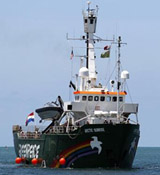
Arctic Sunrise

We’re nearly a month into our Gulf Oil Spill Impacts Expedition. See where we’ve been and follow along as we continue to support independent research into the effects of the BP Deepwater Horizon disaster.

A Milestone On The Road Out of Iraq


Yesterday evening, speaking to the nation from the Oval Office, President Obama “declared an end to the seven-year American combat mission in Iraq,” saying that “the United States has met its responsibility to that country and that it is now time to turn to pressing problems at home.” While around 50,000 U.S. troops remain in Iraq, and will still engage in combat while carrying out what is now primarily a training and advising mission, yesterday’s announcement by the President represents the fulfillment of a promise he made in February 2009, to have the majority of U.S. troops out of Iraq by the end of August 2010. The President noted that, over the last decade in Afghanistan and Iraq, “we have spent over a trillion dollars at war, often financed by borrowing from overseas,” and that “as we wind down the war in Iraq, we must tackle those challenges at home with as much energy and grit and sense of common purpose as our men and women in uniform who have served abroad.” Describing the new Iraq mission,  Vice President Biden said, “We have a written agreement with the Iraqi government, signed by George W. Bush, binding President Barack Obama to withdraw all troops by the end of next year. … But we have faith that the Iraqi troops who our sacrifices have allowed to be trained are in fact ready and will be increasingly able to supply total security to this country by the end of next year.” Biden adviser Tony Blinken told reporters, “We’re not disengaging from Iraq, and even as we draw down our troops, we are ramping up our engagement across the board.”

DEFINING THE WAR’S LEGACY: President Bush’s decision to invade and occupy Iraq remains controversial, though it’s now obvious that the main justifications for the war — Iraq’s possession of weapons of mass destruction and a substantive relationship between Saddam Hussein and al Qaeda — were false. Several key decisions the Bush administration made, such as disbanding the Iraq army and the de-Baathification of Iraq’s bureaucracy, fed a growing insurgency that was gathering steam even as President Bush prematurely declared in May 2003 that “major combat operations in Iraq have ended.” The ensuing insurgency led to years of sectarian strife and the near-collapse of the Iraqi state. With the U.S.’s attention and resources focused on dealing with the Iraq insurgency, Iran was able to extend its influence both with Shia parties in Iraq and throughout the region, the Taliban was able to retrench in Afghanistan, and anti-American extremists throughout the Middle East drew strength from the constant images of death and destruction beamed out of Iraq via satellite. Many of these radicals gained expertise from tactics honed against American forces in Iraq.

COUNTING THE COST: While the ultimate legacy of the U.S. intervention in Iraq is still to be determined, it is possible — and necessary, given the implications for future interventions —  to attempt to tally the war’s costs and benefits to the national security of the United States. In May 2010, Center for American Progress analysts Matt Duss, Brian Katulis, and Peter Juul quantified the costs in their report, The Iraq War Ledger. While recognizing that the end of Saddam Hussein’s brutal regime represents a considerable global good, the authors note that most of the war’s other benefits very much remain in the realm of conjecture. A nascent democratic Iraqi republic allied with the United States could potentially yield benefits in the future, but the war’s costs are very real in the here and now, with the current cost of Operation Iraqi Freedom hovering around $748.2 billion, and the projected total cost of veterans’ health care and disability at $422 billion to $717 billion. As of yesterday, 4,416 American troops had lost their lives in Iraq, with more than 30,000 wounded and more than 39,000 diagnosed with post-traumatic stress disorder. Low-end estimates of Iraqi civilian deaths are around 100,000, with many more wounded, and over 4 million displaced both within and outside Iraq.

THE IMPORTANCE OF TIMETABLES: While the U.S. was bound by the terms of the withdrawal agreement signed by the Bush administration and Iraq, setting August 31, 2010 as an official date for the change in mission was President Obama’s decision, and one with important implications for Afghanistan. It sends the signal that the U.S.’s deployments will not be determined by events outside of U.S. control, and that the U.S. will make the decision when it leaves. CAP’s Larry Korb and Brian Katulis observed that, while the conventional wisdom holds that Bush’s open-ended commitment of troops to Iraq created conditions for the U.S. withdrawal, “a closer examination of the facts demonstrates that the opposite is true — in Iraq, violence declined because more Iraqis perceived that U.S. troops were leaving and took appropriate action.” Sticking to a timetable for Afghanistan, Korb and Katulis write, “offers the best hope for us and the Afghan people because it will motivate them to take control of their own affairs and increase their own security forces.”