Tag Archives: Richard Polanco

New thinking about the Caribbean


June 14, 2015

In North America and Europe there are from time to time international conferences that quietly enable new thinking. It is mostly an unseen process whereby governments, foundations or think tanks facilitate conversations, in ways that variously attempt to address intractable problems such as those in the Middle East, form a consensus on future policy, or enable the participants to look over the horizon.

These events allow invited participants to escape from their day-to-day responsibilities and usually in a group of 50 or less, debate and explore new ideas or solutions in private. The value is not just in the dialogue and the outcome, but in the freedom to say what you think knowing that no one will quote you, in the personal contacts made in the margins, and the associated trust that develops which can last throughout a career.

Such events rarely focus on the Caribbean, but a little over a week ago about sixty invited guests from the Caribbean as a whole, the UK and North America met at Wilton Park in the English countryside.

The objective of ‘Caribbean 2030: new thinking for a new generation’ was to bring together a mix of voices, young and more experienced, to consider what the region might look like fifteen years from now, and to hear in particular how younger participants from politics, government, the private sector, academia and civil society see the Caribbean’s future and how they might play a role in taking it there.

The conference, which was developed in conjunction with the Caribbean Policy Research Institute (CaPRI) and Britain’s Foreign and Commonwealth Office, was wide-ranging in its scope, but a number of general themes emerged which suggest a different Caribbean in fifteen years time.

One of the more significant discussions that ran throughout the conference was whether the future fortunes of the region lay in economic convergence between complementary economies. It was suggested that rather than politically-led solutions, it was trade, investment and financial services between networked groups of nations that would create future growth and integration. One consequence was that participants from the northern Caribbean, and in particular from Jamaica and the Dominican Republic, argued that there was greater value in Jamaica, Cuba, and the Dominican Republic having a stronger economic relationship that might also involve Cayman as a financial hub. The view of some was that such an approach would enable the Caribbean to escape being defined through its colonial past.

This was not to say that in terms of foreign relations and on issues of international or thematic importance that the region should not act through Caricom, nor for most was it to suggest that Caricom should be set aside; but many participants felt there were better opportunities for growth through a more rational approach to economic integration linked to improved infrastructure. The suggestion was that this thinking ought to drive policy across the region.

FYI: Caricom members include

 Antigua and Barbuda 4 July 1974
 Bahamas 4 July 1983 Not part of customs union
 Barbados 1 August 1973
 Belize 1 May 1974
 Dominica 1 May 1974
 Grenada 1 May 1974
 Guyana
 Haiti 2 July 2002 Provisional membership on 4 July 1998
 Jamaica 1 August 1973
 Montserrat 1 May 1974 British overseas territory
 Saint Kitts and Nevis 26 July 1974 Joined as Saint Christopher-Nevis-Anguilla
 Saint Lucia 1 May 1974
 Saint Vincent and the Grenadines 1 May 1974
 Suriname 4 July 1995
 Trinidad and Tobago 1 August 1973 Founder of the Organization before handing over to Guyana
Associate  Anguilla July 1999 British overseas territory
 Bermuda 2 July 2003 British overseas territory
 British Virgin Islands July 1991 British overseas territory
 Cayman Islands 16 May 2002 British overseas territory
 Turks and Caicos Islands July 1991 British overseas territory
Observer  Aruba Country of the Kingdom of the Netherlands
 Colombia
 Curaçao Country of the Kingdom of the Netherlands
 Dominican Republic
 Mexico
 Puerto Rico Commonwealth of the USA
 Sint Maarten Country of the Kingdom of the Netherlands
 Venezuela

There were of course dissenting voices, particularly in some of the working groups. Some in particular from the Eastern Caribbean and from academia objected and declared themselves all but wedded to making what the region already had work, though when it came to the detail there was little to demonstrate how this might take the Caribbean beyond where it is today.

A second prevailing theme was that of the new economy and the growing irrelevance of borders.

These thoughts came especially from some of the younger participants involved in information technology, new media, tourism and the private sector more generally, who made clear that what they were doing made traditional geographic concepts and the size of the Caribbean irrelevant.

The conference was also notable for leaping the language and cultural divide with participants from the Dominican Republic being able to demonstrate in a neutral setting how their experience in many areas from alternative energy to tourism had relevance to most of the region. It also allowed them to set out the country’s thinking in terms of how it might be better connected with and work more closely with the nations of Caricom.

As you might expect there were detailed exchanges on energy security, the environment, and education which all agreed was a development priority if the region was to succeed. There were interesting mentions of the blue economy − the region’s largely unrealised offshore resource − and important exchanges on governance and security about which more in a future column.

There was not a stand-off between the politicians and the private sector. In fact there was a surprising degree of consensus that both needed one another and that the region had to end this false dichotomy if growth were to be achieved. It was suggested that as the generations changed this may no longer be so much of an issue. However, for some, the balance between the competing interests of social equity and the role of the market in Caribbean development needed to be resolved if the region was ever to experience significant economic growth.

For some of the younger participants the real problem that the region has to face in the next fifteen years was to escape from the dead hand of the region’s public sector. In a rarely voiced opinion it was suggested that it is the public sector and those who work with it who have a vested interest in ensuring that thinking and their influence remain the same.

The suggestion was that this was holding the region back.

Strikingly the relationship with the UK, Europe and the US was little mentioned by the younger participants. It was as if the Caribbean had moved on and had a much more balanced view of when and on what issues it wished to relate to a much broader range of external partners. In this context it was unclear whether China’s presence in the region was a threat, an opportunity, or both.

The downside of the meeting was that there was no authentic Cuban voice able to discuss the way it saw the region, the way in which detente with the US may change the Caribbean’s political and economic centre of gravity.

These are of course personal observations, and in due course there will be a report with suggested actions.

The value, however, of this quite different conference will only be known if the synergies, new thinking and the relationships established begin to change the Caribbean for the better.

Previous columns can be found at www. caribbean-council.org

Latonya Goldsby via Change.org … Never forget Tamir Rice


When my 12-year-old cousin Tamir Rice was shot and killed by a police officer as he played in a park with a toy gun, our family didn’t know what to do. Shocked and heartbroken, we knew we had to find justice for Tamir. I remembered that Trayvon Martin’s parents started a petition on Change.org when police refused to arrest the killer of their young son and that it helped draw national attention to their story.

So I started my own petition on Change.org and over 50,000 people have signed it.

It’s been one year since the protests in Ferguson, Missouri, which propelled #BlackLivesMatter into a national movement. I never thought my family would be part of this conversation – that my little cousin would become one of the reasons we needed to call for police accountability and racial justice here in Cleveland and nationwide.

The simple act of signing a petition can make a difference and other families at the center of the #BlackLivesMatter movement have started petitions on Change.org. The parents of John Crawford, who was killed in a Walmart while he held a toy gun sold at the store used a petition to secure an important Department of Justice investigation into the death of their son. The brother of Walter Scott, shot and killed as he ran away, and the parents of Michael Brown, have each started petitions to call for body cameras nationwide.

You can view all of these petitions on one page by clicking here. There are more than three million signatures from people like you who have shown us that we’re not alone – and that meant the world to us.

From body cameras to a police shooting database, from individual calls for justice to national racial profiling reforms, the petitions on this page not only tell the stories of those directly affected, but provide a way for you to take action and continue to be part of this national conversation. Please use this moment to read these petitions and reflect on what you can do today.

Please continue to support these families’ petitions as we continue to push for justice for our loved ones and positive changes in our communities.

Thank you,

Latonya Goldsby
Cleveland, Ohio

Mall cop ignores racist harassing Seattle protesters and pepper sprays black bystander instead-reminder


By David Edwards
Thursday, August 14, 2014 8:53 EDT

An African-American Seattle man who happened to be walking by a pro-Palestinian protest said that he is still confused as to why a security guard would have pepper sprayed him instead of a white man who was harassing demonstrators and yelling racial slurs.

Freelance photographer Alex Garland, who photographed and videotaped the incident, told The Stranger that a white shirtless man had been trying to start fights with activists at a pro-Palestinian rally on Saturday.

Garland said that the man had been shouting epithets like “towelhead” and “sand n*gger.”

As 26-year-old Raymond Wilford was walking to a friend’s house, the shirtless man apparently confused him for a protester.

“I was trying to avoid him because I heard him say a bunch of racial stuff,” Wilford told The Stranger.

In photos taken by Garland, the two men can be seen squaring off in a fighting stance, but Wilford said he never actually threw a punch.

That’s when a Westlake Center security guard arrived on the scene.

“The security guard was like, ‘Stop,’” Wilford recalled. “The white guy was still yelling and walking towards the security guard. I was like, ‘Why are you pointing your mace at me? He’s the one being aggressive.’ And then he pepper-sprayed me.”

Photos show the security guard walking past the shirtless white man to pepper spray Wilford, who is black.

“The guy that was the aggressor was closer to the security guard,” Garland said, according to MyNorthwest.com. “The other individual, the person of color, was further away but he was the one who got pepper sprayed.”

Video taken by Garland shows protesters pleading with the security guard, saying, “You Maced the wrong guy.” A Seattle police officer arrived on the scene, and the security guard took Wilford away to be detained. Meanwhile, the photos show the shirtless man casually walking away.

The security guard later told Seattle officers that Wilford “took an aggressive step towards him” so he was forced to deploy his pepper spray, a police reported indicated.

Valor Security Services, which employs the security guard, told KING that the guard gave multiple warnings.

“Please know these actions are never done without warning and careful consideration,” Valor spokesperson Scott Born insisted in a statement. “It is always our goal to try to resolve all situations as peacefully as possible.”

Valor declined to tell KING if the guard was still working for the company. The Seattle Police Department was investigating the incident.

For his part, Wilford said that he would like to speak with management at Westlake, and he has not ruled out legal action.

“I’ve been treated like that all my life, so it kinda brushes off,” Wilford explained to The Stranger. “I’m from the South, I’m from New Orleans. I’ve seen the worst of it.”

“People here seem to be more secretive about their not liking black people, or their racism,” he added. “I’m so used to it I don’t know what’s wrong and what’s right half the time.”

Watch the video below from KING, broadcast Aug. 12, 2014.

#BlackLivesMatter … How will candidates2016 address the use of #Excessiveforce


Just another rant …

I question anyone who decides one or two people represent the whole, but when a group of people found out that, their family members, neighbors, co-workers and friends have experienced some form of excessive use of force the need and demand for change happens in forms.  There was a time when i was convinced that only Conservative Politicians wanted more control more swat equipment. Wethepeople  Unfortunately, most Governors or Mayors on both sides of the political aisle think cracking down stricter measures is the only way to handle crime seemingly without any consequences. We all seemed to have forgotten Rodney King’s experience.  Then we all saw heard officers lying to hide the truth and wonder what it will take Politicians legislators to see minorities as they see white people. There are good bad and ugly in all races cultures and communities. Why not address Police use of excessive force why not accept that ALL people want the police to protect & serve NOT to act as social controllers of children and or adult minorities …Why not tase, ask questions or shoot to stop FIRST? The use of excessive force by the police seems to be increasing. We used to believe it was only NRA supporters assuming blacks are a threat more likely than being a victim. Then we saw Black People who were in accidents in hours after 10pm killed for being suspicious…why? They were asking for help! Now its politicians on both sides who want the issue to go away and THAT is new.

~ Nativegrl77

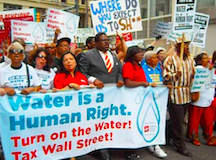
ACTION:Turn On The Water … it’s the right thing -reminder


Thousands of low-income Black Detroit residents have already had their water shut-off risking both public health and personal safety. What’s worse — the city plans to resume shut-offs tomorrow.
Water is a human right.ImageTell the panel: turn the water back on in DetroitTake Action

Thousands of low income Black Detroit residents have already had their water shut off, risking both public health and personal safety. What’s worse — the city plans to resume shut-offs tomorrow.1

Just weeks ago, under pressure from organizers in Detroit and thousands of supporters online, Governor Rick Snyder’s hand-picked Emergency Manager returned control of the Detroit Water and Sewerage Department (DWSD) to the duly-elected mayor.2 While a small victory for local control, the move was ultimately a political ploy to provide cover for Emergency Manager Kevyn Orr. Mayor Duggan’s “10 Point Plan” does little more than offer better customer service while continuing the inhumane and unjust practice of shutting off water.3

The solution is the Water Affordability Program (WAP) passed by the city council back in 2005. The WAP would provide relief to thousands and create a safety net that allows low income residents to pay on a sliding scale, based on their income. A 3-judge panel is holding a hearing on August 29th during which they could order the WAP back into effect and end the shutoffs once and for all.

Sign the petition: tell the panel to turn the water back on and implement the Water Affordability Program.

While Detroiters suffer under policies implemented by an unelected emergency manager, corporations are protected and speculators are circling. Individuals with as little as $33 owed have had their water shut off without warning while the Palmer Park Golf Course which owes $437,714 still has water.4 The initial round of shutoffs were a tactic to make the city’s water rights a more attractive target to potential private investors. 5

Even with authority tenuously returned to the Mayor, his plan offers little hope to residents whose rates have risen 119% in the past decade.6 Under this scheme, relief is only available after putting down a large lump sum payment and there is no promise that the emergency manager will not seize back control and change the rules yet again.

The Water Affordability Program would provide relief to all residents living under 175% of the federal poverty line and reign in the out-of-control rates DWSD has charged.7 The WAP is the best way to restore water to thousands of residents in Detroit at reasonable rates.

Turn the water back on: Sign the petition to implement the WAP.

Water is a basic human right and denying access to water poses a dire threat to public health. To make matters worse, earlier this month there were historic floods in Detroit. A state of emergency was declared. The flooding has caused millions of gallons of sewage to back up into waterways and basements. 8 How are you supposed to clean sewage from your basement when the city has shut off your water?

Sign the petition: Turn the water back on in Detroit!

Thanks and Peace,

Aimée, Rashad, Arisha, Matt, Johnny and the entire ColorOfChange.org team.

Help support our work. ColorOfChange.org is powered by YOU—your energy and dollars. We take no money from lobbyists or large corporations that don’t share our values, and our tiny staff ensures your contributions go a long way.

1. “Duggan, DWSD to release updated plan on water shutoffs Thursday; moratorium extended until Aug. 25,” Metro Times, 8/4/14,
http://act.colorofchange.org/go/3787?t=8&akid=3599.1174326.1Q65qP

2.”Detroit’s drought of democracy,” New York Times, 7/29/14,
http://act.colorofchange.org/go/3789?t=10&akid=3599.1174326.1Q65qP

3.”Orr Dumps ‘Hot Mess’ of Water Shut-offs in Duggan’s Lap,” People’s Water Board, 7/29/14
http://act.colorofchange.org/go/3790?t=12&akid=3599.1174326.1Q65qP

4. “Detroit water department now sending shut-off crews to commercial customers,” Detroit Free Press, 7/14/14
http://act.colorofchange.org/go/3798?t=14&akid=3599.1174326.1Q65qP

5.”Detroit shuts off water to thousands of broke residents,” Think Progress, 6/20/14,
http://act.colorofchange.org/go/3791?t=16&akid=3599.1174326.1Q65qP

6. See reference 3.

7. See reference 3.

8. “Snyder declares flood disaster for southeast Michigan,” Detroit Free Press, 8/20/14,
http://act.colorofchange.org/go/3792?t=18&akid=3599.1174326.1Q65qP