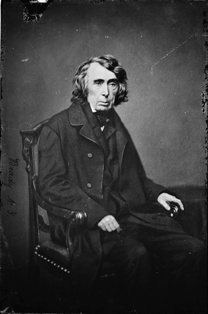
Tag Archives: Roger B. Taney

Dred Scott and Roger B. Taney – The human factor in history


Lonnie Bunch, museum director, historian, lecturer, and author, is proud to present A Page from Our American Story, a regular on-line series for Museum supporters. It will showcase individuals and events in the African American experience, placing these stories in the context of a larger story — our American story.

A Page From Our American Story

On March 6, 1857, in the case of Dred Scott v. John Sanford, United States Supreme Court Chief Justice Roger B. Taney ruled that African Americans were not and could not be citizens. Taney wrote that the Founders’ words in the Declaration of Independence, “all men were created equal,” were never intended to apply to blacks. Blacks could not vote, travel, or even fall in love and marry of their own free will — rights granted, according to the Declaration, by God to all. It was the culmination of ten years of court battles — Dred Scott’s fight to live and be recognized as a free man.

The High Court’s decision went even further, declaring laws that restricted slavery in new states or sought to keep a balance between free and slave states, such as the Missouri Compromise, were unconstitutional. In essence, Black Americans, regardless of where they lived, were believed to be nothing more than commodities.

The Taney court was dominated by pro-slavery judges from the South. Of the nine, seven judges had been appointed by pro-slavery Presidents — five, in fact, came from slave-holding families. The decision was viewed by many as a victory for the Southern “Slavocracy,” and a symbol of the power the South had over the highest court.

The dramatic ripple effect of Dred Scott — a ruling historians widely agree was one of the worst racially-based decisions ever handed down by the United States Supreme Court — reached across the states and territories. It sent shivers through the North and the free African-American community. Technically, no black was free of re-enslavement.

Free Blacks, many of whom had been in Northern states for years, once again lived in fear of being hunted down and taken back to the South in servitude. Southern slave laws allowed marshals to travel north in search of escaped slaves. The ruling was such a concern to Free Blacks, that many seriously considered leaving the United States for Canada or Liberia.

The decision played a role in propelling Abraham Lincoln — an outspoken anti-slavery voice — into the White House. The slavery issue had already created a turbulent, volatile atmosphere throughout the nation. Dred Scott, like kerosene tossed onto a simmering fire, played a significant role in igniting the Civil War. The North became ready to combat what it viewed as the South’s disproportionate influence in government.

The court case lives in infamy today, but few people know much about the actual people involved. I suspect Scott and Taney never imagined they would play such powerful roles in our great American story.

Taney was from Maryland, a slave state, but had long before emancipated his slaves and reportedly paid pensions to his older slaves, as well. As a young lawyer he called slavery a “blot on our national character.” What turned Taney into a pro-slavery advocate is not clear, but by 1857, Taney had hardened, going as far as to declare the abolitionist movement “northern aggression.”

It is reported that Dred Scott was originally named “Sam” but took the name of an older brother when that brother died at a young age. Scott was born into slavery in Virginia around 1800 (birth dates for slaves were often unrecorded), and made his way westward with his master, Peter Blow. By 1830, Scott was living in St. Louis, still a slave to Blow. He was sold to Army doctor John Emerson in 1831 and accompanied him to his various postings — including stations in Illinois and the Wisconsin Territory (what is now Minnesota).

In 1836, Scott married Harriett Robinson. Reports vary on whether she was a slave of Emerson’s prior to the marriage or Emerson purchased her from another military officer after she and Scott had fallen in love. The series of events underscored the painful and difficult lives slaves led. Love, like everything else, was subject to the vagaries of their owners’ dispositions.

Emerson died in 1843, leaving the Scott family to his wife, Irene. Three years later, Scott tried to buy his freedom, but to no avail. Scott’s only recourse was to file suit against Mrs. Emerson. He did so on April 6, 1846, and the case went to a Missouri court the following year. He would lose this case, but win on appeal in 1850. Emerson won her appeal in 1852, and shortly afterward gave the Scotts to her son, John Sanford, a legal resident of New York. Because two states were now involved, Scott’s appeal was filed in federal court in 1854 under the case name of Dred Scott v. John Sanford, the name that came before Taney in 1857.

History is filled with dramatic and strange twists of irony and fate. Those factors can be found throughout Scott’s battle for freedom. Peter Blow’s sons, childhood friends of Scott’s, paid his legal fees. Irene Emerson had remarried in 1850. Her new husband, Massachusetts Congressman Calvin Chaffee, was anti-slavery. Following Taney’s ruling, the now-Mrs. Calvin Chaffee, took possession of Dred, Harriett and their two daughters and either sold or simply returned the family to the Blows. In turn, the Blows freed the Scotts in May, 1857.

Dred Scott, a man whose name is so deeply-rooted in our history, so linked to the war that would end slavery, would die just five months later of tuberculosis. However, he died a free man.

All the best,

Scott Brown ~~ Reminders


• Is against gay marriage but favors civil unions.

running against Jeanne Shaheen, Democratic Party   <— Donate

In 2001, Brown called then state Senator Cheryl Jacques’ decision to have children with her female partner as “not normal” and referred to her parenting as “alleged family responsibilities.”

He later apologized

**********************************************************

In  January 12, 2010

Contacts:
Andrea Miller, NARAL Pro-Choice Mass, 917-975-9325
Jesse Mermell, PPLM, 617-616-1689
Pam Nourse, MWPC, 617-451-9294
Christina Knowles, Mass NOW, 508-527-6007
Leading Women’s Advocates Denounce Brown’s Record on Choice
Organizations criticize Brown’s previously proposed legislation to deny emergency contraception to rape victims;
Decry his denial of the impact of his legislation in yesterday’s Kennedy Institute debate

BOSTON – At a press conference today, Massachusetts’ leading advocacy organizations for women’s reproductive rights denounced Republican Scott Brown’s poor record on a woman’s right to choose. The organizations, including the Planned Parenthood of Massachusetts, NARAL Pro-Choice Massachusetts, the Massachusetts Women’s Political Caucus and the Massachusetts Chapter of the National Organization for Women, criticized Brown’s long record of opposition to policies that promote choice and privacy rights. The organizations highlighted Martha Coakley’s strong support of a woman’s right to choose.
The organizations blasted Scott Brown’s previously proposed legislation that, if it had passed, would have allowed hospital emergency rooms to deny emergency contraception to victims of rape. This callous approach to reproductive rights led the anti-choice Massachusetts Citizens for Life (MCFL) to endorse Scott Brown. MCFL wrote on its blog, “Our PAC has been supporting Scott Brown because he will be a pro-life vote in the Senate.”
The organizations also criticized Brown for denying the severe impact of his legislation on victims of rape in yesterday’s debate hosted by the Kennedy Institute. During the debate, Coakley repeatedly pressed Brown to acknowledge that his legislation would have allowed hospitals to deny emergency contraception to victims of rape, which he attempted to deny.
Brown was simply wrong.
“Scott Brown demonstrated in last night’s debate the lengths to which he will go to mislead the voters about his record,” said Andrea Miller, Executive Director of NARAL Pro-Choice Massachusetts. “He has repeatedly shown his willingness to compromise for political gain the health and well-being of some of the most vulnerable women in Massachusetts, including victims of sexual assault. Massachusetts needs a United States Senator who will be honest about his or her record and who will stand up every single day in defense of our rights, including a woman’s right to choose. Martha Coakley has been a true and steadfast champion for choice throughout her career.”
“Scott Brown is simply not telling the truth about his record — and, even worse, he’s not telling the truth about the impact his legislation would have on victims of sexual assault,” said Pam Nourse, Vice President of the Massachusetts Women’s Political Caucus Board of Directors. “Scott Brown is endorsed by anti-choice groups like Massachusetts Citizens for Life because of his co-sponsorship of waiting periods for abortions, and his record of supporting legislation that would allow hospitals to turn away rape victims seeking emergency contraception. There is no way Scott Brown can honestly call himself a defender of a woman’s right to choose. Martha Coakley is the candidate in this race who will protect and defend a woman’s right to choose. The National Women’s Political Caucus is proud to support Martha Coakley to be our next United States Senator.”
“Scott Brown says that victims of rape should just get back in the car and drive to another hospital,” said Christina Knowles, State Director for the Massachusetts Chapter of the National Organization for Women. “Legislation he filed would have denied rape victims access to emergency contraception at numerous hospitals across Massachusetts. His legislative record shows a deep lack of understanding of women’s health issues and an enormous lack of empathy for what victims of rape are going through. Throughout her career, Martha Coakley has been a staunch defender of fundamental democratic principles like equality and freedom of choice. We are confident that Martha will continue to defend these essential principles in Washington.”
“With many health care battles still to be fought and with a closely divided Supreme Court, who Massachusetts elects to the U.S. Senate on January 19 will have an impact that is felt nationally and felt for years to come,” said Dianne Luby of Planned Parenthood of Massachusetts. “It is baffling to hear Scott Brown paint himself as a supporter of women’s reproductive health. The amendment he filed in 2005 to the Emergency Contraception Bill would have forced rape survivors to travel from hospital to hospital seeking emergency contraception. That certainly doesn’t feel supportive.”
The four groups strongly criticized Brown’s record regarding critical health services for women:
• Brown was the lead sponsor of a legislative amendment in 2005 that would have allowed hospital emergency rooms to deny emergency contraception to victims of rape.
• Brown has co-sponsored the so-called Women’s Right to Know Bill, legislation that would impose a mandatory delay before a woman can obtain an abortion. This legislation is supported by Massachusetts Citizens for Life, an organization that has endorsed Brown for United States Senate.
• Brown recently filed legislation that, if enacted, would allow the removal of previously mandated insurance coverage for a wide array of health services, including critical health care for women. Among the women’s health services that his bill would allow to be removed as mandated coverage are mammograms, minimum maternity stays for new mothers, and screenings (pap smears) to detect, among other possible conditions, cervical cancer at an early, treatable stage.
• Brown opposes national health care reform that includes many benefits for women, such as ending denials by insurance companies to women who have had a Caesarean section or who suffered domestic abuse under the premise that they were “pre-existing conditions.”
Since 1972, NARAL Pro-Choice Massachusetts has been a leading force advocating to protect privacy and promote reproductive health. Mobilizing its 20,000 members across the Commonwealth, NARAL Pro-Choice Massachusetts uses the political process to guarantee every woman the right to make personal decisions regarding the full range of reproductive choices.
********************************************************
In 2007, Brown visited King Philip High School to discuss the topic of gay-marriage legislation. Students had posted insulting comments about Brown and his family on Facebook. At the meeting, Brown read the profanity-laced comments aloud and identified some of the students who wrote them.
*******************************************************

In 2008, he voted in favor of Massachusetts joining the Regional Greenhouse Gas Initiative, a pact among northeastern states requiring power plants to reduce emissions or to buy carbon credits. He now says he would vote against the initiative as well as a federal cap-and-trade bill.

********************************************************

Marriage
I believe marriage is between a man and a woman. States should be free to make their own laws in this area, so long as they reflect the people’s will as expressed through them directly, or as expressed through their elected representatives.

********************************************************

Although initially supportive of the health care bill, Brown now objects because Massachusetts — where nearly all citizens now have health care coverage — would end up subsidizing other states’ health care costs. (Read “5 Truths About Health Care in America.”)

“Roe v. Wade is the law of the land, and I don’t plan on overturning it, but I’ve always felt that, you know, I’m against partial-birth abortions and believe in parental consent, a strong parental-notification law.”
— The Boston Globe, Nov. 20, 2009

********************************************************

Brown owns a four-bedroom, colonial-style home in Wrentham, Mass.; a six-room house in Rye, N.H.; three small condo units in Brighton, Mass.; and a time-share unit in Aruba.

*******************************************************

Abortion
While this decision should ultimately be made by the woman in consultation with her doctor, I believe we need to reduce the number of abortions in America. I believe government has the responsibility to regulate in this area and I support parental consent and notification requirements and I oppose partial birth abortion. I also believe there are people of good will on both sides of the issue and we ought to work together to support and promote adoption as an alternative to abortion…. Scott Brown is not pro-choice ppl

*****************************************************

Immigration
I recognize that our strength as a nation is built on the immigrant experience in America. I welcome legal immigration to this country. However, we are also a nation of laws and government should not adopt policies that encourage illegal immigration. Providing driver’s licenses and in-state tuition to illegal immigrant families will act as a magnet in drawing more people here in violation of the law and it will impose new costs on taxpayers. I oppose amnesty, and I believe we ought to strengthen our border enforcement and institute an employment verification system with penalties for companies that hire illegal immigrants.