Tag Archives: Tax

President Obama in Cedar Rapids, Iowa: The McLaughlins and MiddleClass Tax Cuts


Jul 14, 2012 by    

Are you in? http://OFA.BO/TNNyjE
Before President Obama delivered remarks at Kirkwood Community College in Cedar Rapids, he visited the home of Jason and Ali McLaughlin to discuss the need for Congress to extend the middle-class tax cuts that would prevent a tax hike on all families earning less than $250,000.
As a result of the tax cuts President Obama has already signed into law, the McLaughlin’s have received a total of about $4,900 in tax relief over the President’s first term. President Obama has committed to extend the middle class tax cuts that expire at the end of this year–if these tax cuts expired, the McLaughlins could face a tax increase of about $2,000.
In his speech, President Obama outlined his plan to build an economy from the middle out, not the top down, by ensuring hard work pays off and responsibility is rewarded, making critical investments in education and clean energy, and by reforming our tax system to restore middle class security and pay down our deficits in a balanced way.

State Tabacco Taxes – done right it can be a win win solution


U.S. State and Local Issues

State Tobacco Taxes

A Win-Win-Win Solution

photo

Tobacco tax increases offer a win-win-win solution for states, especially as they face a severe fiscal crisis and work to balance budgets while preserving essential public services.

Health Win: Tobacco tax increases are one of the most effective ways to reduce smoking and other tobacco use, especially among kids. Every 10 percent increase in cigarette prices reduces youth smoking by about seven percent and total cigarette consumption by about four percent.

Budget Win: Every state that has significantly increased its cigarette tax has enjoyed substantial increases in revenue, even while reducing smoking. Higher tobacco taxes also save money by reducing tobacco-related health care costs, including Medicaid expenses. States can realize even greater health benefits and cost savings by allocating some of the revenue to programs that prevent children from smoking and help smokers quit.

Political Win: National and state polls consistently have found overwhelming public support for tobacco tax increases. Polls also show that, when it comes to balancing budgets, voters prefer raising tobacco taxes to other tax increases or cutting crucial programs such as education and public safety.

Progress, But More Work to Do

In recent years, almost every state and the federal government have increased tobacco taxes. The average state cigarette tax is currently $1.46 per pack, but rates vary widely from 17 cents in Missouri to $4.35 in New York.

On April 1, 2009, the federal cigarette tax increased by 62 cents, to $1.01 per pack.

Every state and the federal government can achieve significant health and revenue gains by further increasing tobacco taxes. Governments can raise even more revenue — and reduce all tobacco use — by increasing taxes on other tobacco products, such as smokeless tobacco and cigars, to parallel the rate on cigarettes. This discourages all tobacco use.

Trends in the Distribution of Household Income, 1979-2007


Congressional Budget Office

 Presentation to the National Tax Association 2012 Spring  Symposium – Click on link below

http://p.feedblitz.com/t2.asp?/812526/27858637/4189362/http://feeds.feedblitz.com/~/t/0/0/cbospublications/~http://www.slideshare.net/cbo

After-Tax Income Grew More for Highest-Income Households

After-tax income for the highest-income households grew more than it did for any other group. (After-tax income is income after federal taxes have been deducted and government transfers—which are payments to people through such programs as Social Security and Unemployment Insurance—have been added.)

CBO finds that, between 1979 and 2007, income grew by:

  • 275 percent for the top 1 percent of households,
  • 65 percent for the next 19 percent,
  • Just under 40 percent for the next 60 percent, and
  • 18 percent for the bottom 20 percent.

Shares of Income After Transfers and Federal Taxes, 1979 and 2007

The share of income going to higher-income households rose, while the share going to lower-income households fell.

  • The top fifth of the population saw a 10-percentage-point increase in their share of after-tax income.
  • Most of that growth went to the top 1 percent of the population.
  • All other groups saw their shares decline by 2 to 3 percentage points.

Market Income Shifted Toward Higher-Income Households

Shifts in the distribution of market income underlie most of the changes in the distribution of after-tax income. (Market income—or income before taxes and transfers—includes labor income, business income, capital income, capital gains, and income from other sources such as pensions.)

  • Each source of market income was less evenly distributed in 2007 than in 1979.
  • More concentrated sources of income (such as business income and capital gains) grew faster than less concentrated sources (such as labor income).

Government Transfers and Federal Taxes Became Less Redistributive

Government transfers and federal taxes both help to even out the income distribution. Transfers boost income the most for lower-income households, while taxes claim a larger share of income as people’s income rises.

In 2007, federal taxes and transfers reduced the dispersion of income by 20 percent, but that equalizing effect was larger in 1979.

  • The share of transfer payments to the lowest-income households declined.
  • The overall average federal tax rate fell.

Congresssional Budget Office


Economic Effects of Reducing the Fiscal Restraint That Is Scheduled to Occur in 2013

Policymakers are facing difficult trade-offs in formulating the nation’s fiscal policies. On the one hand, if the fiscal policies currently in place are continued in coming years, the revenues collected by the federal government will fall far short of federal spending, putting the budget on an unsustainable path. On the other hand, immediate spending cuts or tax increases would represent an added drag on the weak economic expansion.

read more


CBO Analyzes Effects of Fiscal Restraint Scheduled Under Current Law

Policymakers face difficult trade-offs in deciding how quickly to implement policies to reduce budget deficits. On the one hand, cutting spending or increasing taxes slowly would lead to a greater accumulation of government debt; on the other hand, immediate spending cuts or tax increases would represent an added drag on the weak economic expansion.

read more


Senate Amendment 2122 in the Nature of a Substitute to S. 3187, the Food and Drug Administration Safety and Innovation Act

CBO Estimate of the Statutory Pay-As-You-Go Effects for Senate Amendment 2122 in the Nature of a Substitute to S. 3187, the Food and Drug Administration Safety and Innovation Act


Their Fair Share by the Numbers …Joan Entmacher, National Women’s Law Center


Tired of fighting cuts to programs that women and their families depend on in the name of deficit reduction — while millionaires and billionaires haven’t been asked to contribute an extra penny? Think it’s time for millionaires and billionaires who pay lower tax rates than many middle-class Americans to start paying their fair share?

Take Action: Tell your Senators to support the Paying a Fair Share Act of 2012!   WWW.NWLC.ORG

On April 16, we expect the Senate to vote on an important piece of legislation, the Paying a Fair Share Act of 2012 (S. 2230). The bill would ensure that those with incomes over $1 million annually pay at least 30 percent of their income in federal taxes. The legislation, introduced by Senator Sheldon Whitehouse, was inspired by billionaire investor Warren Buffett, who highlighted the unfairness of a tax system that permits him to pay a lower tax rate than his secretary.

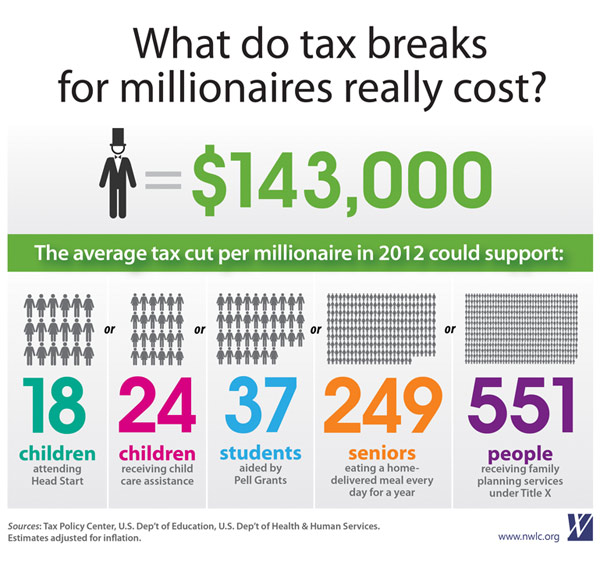
It’s time for this absurdity to stop. We can’t afford to continue lavish tax breaks for the wealthiest Americans. To help demonstrate the real cost of tax breaks for millionaires, we’ve put together a new infographic:

That’s right. This year, the average millionaire gets a tax break of $143,000 — enough to support child care assistance for 24 children, Pell Grants to 37 college students, or a home-delivered meal each day for 249 seniors.

This is a tradeoff we can’t afford to make any longer. Please share our infographic today and urge your Senators to support the Paying a Fair Share Act of 2012!

Sincerely,

Joan Entmacher Vice President,

Family Economic Security National Women’s Law Center

P.S. Please help us continue to advocate for policies that protect and improve economic security for women and their families by making a generous donation today.