
Tag Archives: Thomas Jefferson

david perdue, a Republican. The comments below were when he was running for Senate
 just another rant … Republican … david perdue
I actually searched his website for information and I found that he is seemingly doing business with folks for folks and by folks overseas and NOT for the US… This is a bit scary! I admit I could be wrong, but I can see American jobs being subjected to lower wages and or going overseas where we all know a living wage just does not seem to exist. I am willing to be corrected, but this person seems bad for trade, for jobs and again, do your research. I am no expert nor am I a one-issue voter, but any candidate that advocates “a right to life” definitely chooses to ignore “a Woman’s right to exercise choice” from all backgrounds and the need to control their own lives and or engage in family planning is a person without compassion or knowledge. I wonder if David Perdue, is one of those Republicans that should stay a businessperson, though if you go to his website, jobs, Women and a safer country all seem at risk in his hands in my opinion … anyway, David Perdue on the issues as a Senate candidate… Furthermore, I don’t know if running for Governor changes anything stated below
Defending Our Values
There are principles I share with a majority of Georgians. I believe that we should promote a culture that values life and protects the innocent, especially the unborn. I also believe that we must protect traditional marriage, keeping it clearly defined as between one man and one woman. Being pro-life and believing in the sanctity of marriage are my deeply held personal convictions. I will not waver in defending them if I have the privilege of serving you in the U.S Senate.
See David’s response to National Right to Life
The National Debt
The crushing national debt has surpassed $17 trillion. We must act now to rein it in before it becomes unsustainable. Of course we have to cut wasteful spending and unnecessary bureaucracy. We have to eliminate the billions of dollars in failed government programs and redundant agencies. However, the best way to begin getting the debt under control is to grow the economy without a tax increase.
Comprehensive Tax Reform
In the midst of a terrible economy, this would be the worst possible time to raise taxes on anyone. Too many families and too many businesses are struggling to get by. I will not support a tax increase of any kind. Furthermore, the federal tax code is too complicated and misaligned. It should be completely overhauled as a means to promote growth and encourage more domestic economic investment. My preference is the Fair Tax.
Term Limits
I have never run for public office before, which in my opinion is a good thing. Just look at the results we have gotten from career politicians. They have created a crisis in Washington. We can’t expect them to fix it. That’s why I support term limits: a maximum three terms in the House, two terms in the Senate. I’ll stick to that commitment myself. Until we get term limits in place, we should enforce them at the ballot box by voting the career politicians out of office.
See David’s term limit pledge
Balanced Budget Amendment
Every Georgia family understands that you can’t perpetually spend more than you take in without going bankrupt. The problem is that the professional politicians in Washington won’t make a tough decision. I would absolutely vote for a balanced budget amendment. However, we need immediate tax and regulatory reforms along with appropriate spending cuts so that we have a right-sized, responsible budget sooner rather than later.
Repeal ObamaCare
ObamaCare is an overreaching federal program that will actually reduce the quality of health care and increase costs. I am one of the millions of Americans that had my personal policy cancelled after being told I could keep it. To make matters worse, Obamacare is discouraging full-time job creation. The consequences of politicians passing a massive bill without reading it continue to emerge. We need to repeal ObamaCare and replace it with more affordable free market solutions.
Revitalizing American Manufacturing
I believe that we are on the verge of revitalizing American manufacturing. The private sector is primed to create quality jobs by manufacturing innovative products that require a skilled workforce and high-tech facilities. These products are needed for domestic consumption and more importantly for exports to foreign markets. But the manufacturing industry’s renewal can be stunted if we don’t correct bad energy policies, the lack of infrastructure, failures in education, and the punitive tax code.
Increasing American Exports
The best opportunity for long-term economic growth is to boost our exports to emerging economies worldwide. In fact, I have started my own exporting business where we ship American-made products overseas. They have an increasing demand for American goods, both quality manufactured products as well as other needs such as agriculture products. Increasing exports requires elected leaders who understand global trends and how to remove barriers to growth. If so, we can create a new age of American prosperity.
Local Control of Education
I grew up the son of two teachers. I married a teacher. I have seen firsthand that parents and local educators make the best decisions on how to meet the unique needs of students. For example, my mother started a program for gifted students that is still a model for schools across Georgia to this day. True innovation starts at the local level, not in Washington. We should dismantle unnecessary federal bureaucracy, including the push for Common Core, and get that funding into the classrooms.
Energy Independence
Decades after an oil embargo led to gas rationing and long lines at the pump, we still don’t have a plan for energy independence. Instead, our own government limits our options by being overtly hostile towards domestic energy producers. In the process, they force us to rely on energy resources from countries that wish to do us harm. With the right leadership, we can finally have a domestic energy policy that is environmentally responsible in the long-term while meeting our current needs.
Secure Our Borders
Securing our borders is a matter of national security. The debate in Washington over illegal immigration has become unnecessarily complicated. Out-of-touch politicians have created another massive bill, like ObamaCare. Simply put, we need to strictly enforce current laws and any new laws should be straightforward, focusing on true border security. Until the federal government gets serious about immigration security and enforcement, discussing anything else is pointless.
The Right to Bear Arms
Growing up in Middle Georgia, I have been hunting since I was young, but I understand the 2nd Amendment is not only about hunting. It is hard for me to question the wisdom of the Founders. They crafted a Constitution that has only been amended 27 times in over 225 years. Ten amendments were their own, designed to explicitly protect certain rights. The 2nd Amendment is clear. We have ample gun laws on the books now, and I believe we should focus on enforcing them.
See David’s response to the National Rifle Association
source: His website
If anything is incorrect, please comment … Vote For Stacey Abrams – Nativegrl77
Share this:

Massai seek return of the ancestral lands they lost at gunpoint
Jeevan Vasagar in Laikipia district, Kenya
 a repost
Sunday 25 July 2004 20.39 EDT
Using a long stick with a hooked tip, Mary Kinyanga tugs a branch of the thorny savannah tree and brings juicy green seed pods cascading down for her goats.
As her flock munches audibly, she casts an envious glance at the neighbouring white-owned ranch, where guests are arriving by light aeroplane for a wedding party.
“They are giving us big problems,” Ms Kinyanga says of her neighbours. “They have grass. We need the land. It belongs to us, but if somebody goes grazing there, they get put in jail.”
Driven from their land at gunpoint in 1911, Masai tribes in Kenya’s Laikipia district are demanding the return of their ancestral territory. Their campaign pits them against a handful of white farmers whose families created vast ranches on the land after the expulsion of the tribes.
But the farmers accuse the Masai of destructive overgrazing of the land, and fear that attempts to reclaim the territory will spell doom for its wildlife and ruin a lucrative tourist trade.
The Masai campaign is based on a belief that a treaty signed with the British colonial government in 1904 gave the colonial power a 100-year lease on their ancestral lands, which will expire next month.
“Everyone is aware of the impending land issue,” says Michael Dyer, whose family owns the 13,000-hectare (32,000-acre) Borana ranch. “We had nothing to do with the ancestral land being taken away. We do recognise there is an issue [but] we are concerned about the ecological preservation of a very valuable resource.”
The vast Laikipia plateau stretches across 2m acres of mountain, savannah and forest from Mount Kenya in the east to the Rift valley in the west. Local wildlife experts say it is home to more endangered wildlife than anywhere else in Kenya, including more than half the country’s rhino population and 80% of the world’s population of Grevy’s zebra.
In recent years, prompted by falling beef prices, the white ranchers have shifted from farming to ecotourism for the ultra-rich: prices at some lodges top $500 (£270) a night.
“It does not matter to me who owns the land,” Mr Dyer says of the Masai claim. “It is more important what happens to it. Sections of the land are vastly overgrazed.”
There is a stark and visible contrast between the regions of Laikipia where the Masai are free to wander and the commercial ranches. The hills where Mary Kinyanga’s goats graze are bare and brown; the grass is baked a bright yellow in the dry season, and there is little sign of wildlife.
The white ranches are lusher and vast herds of elephants, giraffe and antelope roam behind electric fences.
But an expert on the resettlements argues that the Masai were forced into overgrazing by British colonial policies which took their best land and confined them to reserves.
“Of course they overgrazed,” says Lotte Hughes, an east African historian at St Antony’s College, Oxford. “They were confined to reserves, banned from leaving them, and banned from selling their surplus cattle because the British were obsessed by the idea of ‘disease-infested’ native cattle alongside exotic, imported stock.”
Dr Hughes criticises the wildlife preservation argument as the “Fortress Conservation model”.
“People don’t seem to realise that the landscape is shaped by people and their domestic herds,” she says. “For centuries there was no problem.”
The campaign to win the return of Laikipia was launched at the weekend by Osiligi, the community group which was instrumental in the Masai’s successful campaign for compensation from the Ministry of Defence for alleged injuries from British army ordnance.
In September 2002 a group of Massai and Samburu tribesmen received a £4.5m settlement for injuries and deaths blamed on munitions left over from British soldiers’ training exercises. That payment, and a further £500,000 settlement in February this year, has encouraged the belief that the Masai can win further compensation.
At a press conference staged with theatrical flair, the community group gathered 18 Masai elders, who dressed in their traditional scarlet robes and chanted a battle song adapted to their new theme.
“God, give us back our land,” a wizened Masai chief crooned, while the men who sat around him in a semi-circle cried their assent with a deep-throated “heh”. “May the world listen to us,” the chief chanted.
James Legei, manager of Osiligi, says: “The movement of the Masai from Laikipia marked the end of us conducting our [religious] ceremonies, because there are sacred sites that are now within electric fences.
“We hope that by August 15 our land will get back to us, and we can go to visit the graves of our great fathers.”
The belief that there is a 100-year lease expiring in August 2004 is the Masai equivalent of an urban myth, however. The 1904 agreement cleared the tribe from prime land to make way for white settlers. Their territory was reduced by two-thirds, but they were permitted to stay in Laikipia. But rather than a lease, the treaty promised the Laikipia plateau to the Masai in perpetuity.
That promise was broken between 1911 and 1913 when the Masai were forced to move from Laikipia to distant reserves.
Dr Hughes says: “I have every sympathy with the Masai. Their sense of betrayal at the hands of the colonial British government is justified and rooted in strong historical evidence that I have spent several years researching.
“But I must point out – with the greatest respect to my Masai friends – that some of the claims [they are making] are factually incorrect. [The 1904 agreement] was not a lease.”
The descendants of the white settlers are conscious of the need to contribute to the wellbeing of the people the British dispossessed. Even in the colonial era, some Masai returned to work for the British and built close ties with white landowners.
Some ranches in the district are now “community-owned” – run by Masai as farms and tourist lodges with the aid of their white neighbours.
Profits from the big ranches have been spent on mobile clinics and schools for the Masai, and the white farmers employ many Masai as park rangers, drivers and domestic staff.
Both the white residents and some Masai fear that the land claims will lead to violence, which will scare away the tourists and ruin livelihoods. David Masere, community liaison officer for the Laikipia Wildlife Forum, says: “It is a fact that this land was taken from the Masai. But if force is used, then we are going to have conflict and we are going to lose a lot.”
Share this:

I have been to the Mountaintop: April 3 ~ 4,1968
April 4, 1968, The civil rights leader was in Memphis to support a sanitation workers’ strike and was on his way to dinner when a bullet struck him in the jaw and severed his spinal cord. King, pronounced dead after his arrival at a Memphis hospital. He was 39 years old.
In the months before his assassination, Martin Luther King became increasingly concerned with the problem of economic inequality in America. He organized a Poor People’s Campaign to focus on the issue, including an interracial poor people’s marchon Washington, and in March 1968 traveled to Memphis in support of poorly treated African-American sanitation workers. On March 28, a workers’ protest march led by King ended in violence and the death of an African-American teenager. King left the city but vowed to return in early April to lead another demonstration.
On April 3, back in Memphis, King gave his last sermon, saying, “We’ve got some difficult days ahead. But it really doesn’t matter with me now, because I’ve been to the mountaintop…And He’s allowed me to go up to the mountain. And I’ve looked over, and I’ve seen the Promised Land. I may not get there with you. But I want you to know tonight that we, as a people, will get to the promised land.”
One day after speaking those words, Dr. King was shot and killed by a sniper. As word of the assassination spread, riots broke out in cities all across the United States and National Guard troops were deployed in Memphis and Washington, D.C. On April 9, King was laid to rest in his hometown of Atlanta, Georgia. Tens of thousands of people lined the streets to pay tribute to King’s casket as it passed by in a wooden farm cart drawn by two mules.
The evening of King’s murder, a Remington .30-06 hunting rifle was found on the sidewalk beside a rooming house one block from the Lorraine Motel. During the next several weeks, the rifle, eyewitness reports, and fingerprints on the weapon all implicated a single suspect: escaped convict James Earl Ray. A two-bit criminal, Ray escaped a Missouri prison in April 1967 while serving a sentence for a holdup. In May 1968, a massive manhunt for Ray began. The FBI eventually determined that he had obtained a Canadian passport under a false identity, which at the time was relatively easy.
On June 8, Scotland Yard investigators arrested Ray at a London airport. He was trying to fly to Belgium, with the eventual goal, he later admitted, of reaching Rhodesia. Rhodesia, now called Zimbabwe, was at the time ruled by an oppressive and internationally condemned white minority government. Extradited to the United States, Ray stood before a Memphis judge in March 1969 and pleaded guilty to King’s murder in order to avoid the electric chair. He was sentenced to 99 years in prison.
Three days later, he attempted to withdraw his guilty plea, claiming he was innocent of King’s assassination and had been set up as a patsy in a larger conspiracy. He claimed that in 1967, a mysterious man named “Raoul” had approached him and recruited him into a gun running enterprise. On April 4, 1968, he said, he realized that he was to be the fall guy for the King assassination and fled to Canada. Ray’s motion was denied, as were his dozens of other requests for a trial during the next 29 years.
During the 1990s, the widow and children of Martin Luther King Jr. spoke publicly in support of Ray and his claims, calling him innocent and speculating about an assassination conspiracy involving the U.S. government and military. U.S. authorities were, in conspiracists’ minds, implicated circumstantially. FBI Director J. Edgar Hoover obsessed over King, who he thought was under communist influence. For the last six years of his life, King underwent constant wiretapping and harassment by the FBI. Before his death, Dr. King was also monitored by U.S. military intelligence, which may have been asked to watch King after he publicly denounced the Vietnam War in 1967. Furthermore, by calling for radical economic reforms in 1968, including guaranteed annual incomes for all, King was making few new friends in the Cold War-era U.S. government.
Over the years, the assassination has been reexamined by the House Select Committee on Assassinations, the Shelby County, Tennessee, district attorney’s office, and three times by the U.S. Justice Department. The investigations all ended with the same conclusion: James Earl Ray killed Martin Luther King. The House committee acknowledged that a low-level conspiracy might have existed, involving one or more accomplices to Ray, but uncovered no evidence to definitively prove this theory. In addition to the mountain of evidence against him–such as his fingerprints on the murder weapon and his admitted presence at the rooming house on April 4–Ray had a definite motive in assassinating King: hatred. According to his family and friends, he was an outspoken racist who informed them of his intent to kill Dr. Martin Luther King, Jr. He died in 1998.
Share this:

The Only African American Automobile Company! ~~ Lonnie G. Bunch at The NMAAHC- in memory of Black History

 |
Lonnie Bunch, museum director, historian, lecturer, and author, is proud to present A Page from Our American Story, a regular on-line series for Museum supporters. It will showcase individuals and events in the African American experience, placing these stories in the context of a larger story — our American story. | |
||
| A Page From Our American Story | ||||
|
At the dawn of the Automobile Age in the early 20th century, hundreds of small auto companies sprouted up across America as entrepreneurs recognized that society was transitioning from horse-drawn carriages to transportation powered by the internal combustion engine. Some of these early companies grew to become giants that are still with us today, such as Ford and Chevrolet. Many others remained small, struggling to compete against the assembly lines of the larger manufacturers.One such company was C.R. Patterson & Sons of Greenfield, Ohio, makers of the Patterson-Greenfield automobile from 1915 to 1918. Though its name is little recognized today, there is in fact a very important reason to ensure that it is not lost to history: it was, and remains to this day,the only African American owned and operated automobile company.
Charles Richard Patterson was born into slavery on a Virginia plantation in 1833. Not much is known about his life on the plantation, and historians have to sift through conflicting reports about how he came to settle in Greenfield, Ohio, a town with strong abolitionist sympathies. Some say his family arrived in the 1840s, possibly after purchasing their freedom; others suggest Patterson alone escaped in 1861. In any case, he learned the skills of the blacksmith and found work in the carriage-making trade, where he developed a reputation for building a high quality product. In 1873, he formed a business partnership with another carriage maker in town, J.P. Lowe, who was white, and eventually became sole proprietor of the renamed C.R. Patterson & Sons in 1893. It was a successful business employing an integrated workforce of 35-50 by the turn of the century, and Charles Patterson became a prominent and respected citizen in Greenfield. His catalog listed some 28 models, from simple open buggies to larger and more expensive closed carriages for doctors and other professionals. When Patterson died in 1910, the business passed to his son Frederick, who was already something of a pioneer. He was college-educated and was the first black athlete to play football for Ohio State University. He was also an early member and vice president of the National Negro Business League founded by Booker T. Washington. Now, as owner and operator of the enterprise his father started, Frederick Patterson began to see the handwriting on the wall: the days of carriages and horse-drawn buggies were nearing an end.
This valuable experience allowed C.R. Patterson & Sons to take the next great step in its own story as well as in African American history: in 1915, it announced the availability of the Patterson-Greenfield automobile at a price of $685. From the company’s publicity efforts, it is evident they were bursting with pride: “Our car is made with three distinct purposes in mind. First — It is not intended for a large car. It is designed to take the place originally held by the family surrey. It is a 5-passenger vehicle, ample and luxurious. Second — It is intended to meet the requirements of that class of users, who, though perfectly able to spend twice the amount, yet feel that a machine should not engross a disproportionate share of expenditure, and especially it should not do so to the exclusion of proper provisions for home and home comfort, and the travel of varied other pleasurable and beneficial entertainment. It is a sensibly priced car. Third — It is intended to carry with it (and it does so to perfection) every conceivable convenience and every luxury known to car manufacture. There is absolutely nothing shoddy about it. Nothing skimp and stingy.”
The initial hope and optimism, however, proved to be fairly short-lived. In an age of increased mechanization and production lines, small independent shops featuring hand-built, high quality products weren’t able to scale up production or compete on price against the rapidly growing car companies out of Detroit. In small quantities, parts and supplies were expensive and hard to come by when major manufacturers were buying them by the trainload at greatly reduced costs. Plus, the labor hours per car were much higher than that of assembly line manufacturers. As a result, the profit margin on each Patterson-Greenfield was low.
Sadly, no Patterson-Greenfield automobiles are known to survive today. But we should not let that dim the fact that two great entrepreneurs, Charles Richard Patterson and his son Frederick Patterson built and sustained a business that lasted several generations and earned a place not just in African American history, but in automotive history as well.
The National Museum of African American History and Culture is the newest member of the Smithsonian Institution’s family of extraordinary museums. The museum will be far more than a collection of objects. The Museum will be a powerful, positive force in the national discussion about race and the important role African Americans have played in the American story — a museum that will make all Americans proud. P.S. We can only reach our $250 million goal with your help. I hope you will consider making a donation or becoming a Charter Member today. |
|||
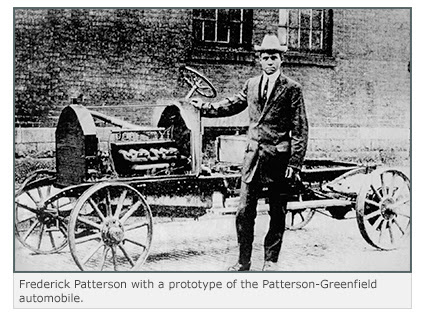
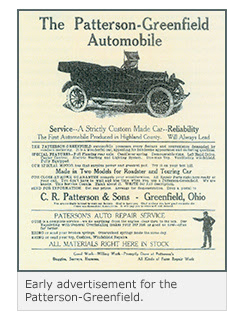 At first, the company offered repair and restoration services for the “horseless carriages” that were beginning to proliferate on the streets of Greenfield. No doubt this gave workers the opportunity to gain some hands-on knowledge about these noisy, smoky and often unreliable contraptions. Like his father, Frederick was a strong believer in advertising and placed his first ad for auto repair services in the local paper in 1913. Initially, the work mostly involved repainting bodies and reupholstering interiors, but as the shop gained more experience with engines and drivetrains, they began to offer sophisticated upgrades and improvements to electrical and mechanical systems as well.
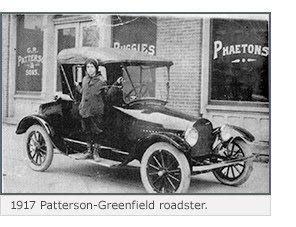 Orders began to come in, and C.R. Patterson & Sons officially entered the ranks of American auto manufacturers. Over the years, several models of coupes and sedans were offered, including a stylish “Red Devil” speedster. Ads featured the car’s 30hp Continental 4-cylinder engine, full floating rear axle, cantilever springs, electric starting and lighting, and a split windshield for ventilation. The build quality of the Patterson-Greenfield automobile was as highly regarded as it had been with their carriages.
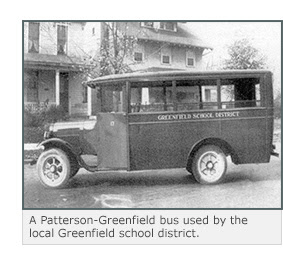 In 1918, having built by some estimates between 30 and 150 vehicles, C.R. Patterson & Sons halted auto production and concentrated once again on the repair side of the business. But they weren’t done yet. In the 1920s, the company began building truck and bus bodies to be fitted on chassis made by other manufacturers. It was in a sense a return to their original skills in building carriage bodies without engines and drivetrains and, for a period of time, the company was quite profitable. Then in 1929, the stock market crashed and the Great Depression set in. As with many small businesses, sales dried up and loans were hard to obtain. The company, now run by the sons of Frederick Patterson, soldiered on until 1939 when, after 74 years, C.R. Patterson & Sons closed its doors forever.


 Be a Seed for Change
You must be logged in to post a comment.