2012•05•29
Though colonialism is generally considered to be a relic of the past, nearly 2 million people in 16 “non-self-governing territories” across the globe still live under virtual colonial rule. In recognition of the United Nations International Week of Solidarity with the Peoples of Non-Self-Governing Territories (25–31 May), we present this analysis of “residual colonialism in the 21st century”.
♦ ♦ ♦
In 2009, the Government of the United Kingdom (UK) suspended parts of the Constitution of the Turks and Caicos Islands (TCI), a British Overseas Territory, in response to allegations of systemic corruption in the territory. Direct rule from London was imposed over the democratically elected local government. This unilateral, top-down action removed the constitutional right to trial by jury, suspended the ministerial government and the House of Assembly, and charged a UK-appointed Governor with the administration of the islands.
A tentative period for elections has been given (fall 2012 at the earliest), but this is subject to the deliberation of the British government and tied to a series of specific milestones that must be met. These announcements provoked protests and demonstrations by the islanders. The suspension of the TCI government over corruption allegations seems to run contrary to the way in which financial and governance crises are handled around the world, including in the UK itself. Scandals are part of political life, but constitutions are not suspended nor are democratically elected governments and institutions disbanded.
How is it that these events have occurred in a world based on a system of supposedly equal sovereign states? The answer lies in the little known fact that colonial structures continue to exist even today in some parts of the world.
Continuing colonialism
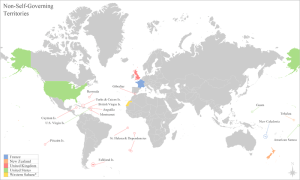
The wave of decolonization that swept around the world in the latter half of the 20th century was once heralded as one of the great liberating movements in history. Yet, few seem to realize that colonialism is still with us. As of 2012, 16 territories are deemed still to be under colonial rule and are labeled by the United Nations as “non-self-governing territories (NSGTs)” — areas in which the population has not yet attained a full measure of self-government.
The 16 NSGTs, home to nearly 2 million people, are spread across the globe. They remain under the tutelage of former colonial powers (currently referred to as “administering powers”), such as the UK, the USA and France.
Most of the NSGTs feature as only small dots on the world map but are in fact prominent players on the world stage. Some act as the world’s leading financial centres, with GDP per capita amongst the world’s top 10 (e.g., the Cayman Islands and Bermuda), some constitute vital bastions for regional security (e.g., Guam), and there are those whose geographical location has made them prone to diplomatic disputes (e.g., Gibraltar and the Falklands/Malvinas).
A UN committee on decolonization does exist (Special Committee of 24 on Decolonization), under the purview of the Fourth Committee of the United Nations General Assembly (Special Political and Decolonization Committee). Its mission is to oversee the implementation of the Declaration on the Granting of Independence to Colonial Countries and Peoples (14 December 1960).
The world underwent a political renovation following the formation of the United Nations in 1945, and the number of sovereign UN Member States has skyrocketed from the original 51 to 193. However, the 50-plus years since the founding of the United Nations have proved to be insufficient to eradicate a centuries-old structure of dominance. This is in spite of the advancement of legal systems based on the notions of the sovereign equality of states and human rights prevalent in the contemporary world.
Decolonization, as bluntly put by UN Secretary General Ban Ki-moon, remains an unfinished business; an unfinished process that has been with the international community for too long. In solidarity with the peoples of the NSGTs, the present decade (2010-2020) has been declared the Third International Decade for the Eradication of Colonialism (as the past two decades have proved inadequate to ensure the disappearance of such an archaic concept).
Independence is not the only option
The doctrine of self-determination and political equality has prevailed as the guiding principle for decolonization ever since the inception of the United Nations. Much progress has been achieved and political autonomy for many former dependent states (micro-states, even) has been realized, but the decolonization process remains stalled. No territory has achieved self-government since East Timor (now Timor-Leste) won full independence from Indonesia in 2002.
The many achievements of decolonization by the United Nations cannot be considered truly global while some peoples continue to live under colonial rule. Administering states such as the UK and France continue to exercise top-down authority through modernized dependency governance models that, while perhaps ensuring sustained economic progress, create a democratic deficit and political vulnerability based on unequal status.
The decolonization agenda championed by the United Nations is not based exclusively on independence. There are three other ways in which an NSGT can exercise self-determination and reach a full measure of self-government (all of them equally legitimate): integration within the administering power, free association with the administering power, or some other mutually agreed upon option for self-rule.
The current impasse is due, in part, to the denial by the administering states of these options, but also to a lack of public awareness on the part of the peoples of the NSGTs that they are entitled to freely determine their territory’s political status in accordance with the options presented to them by the United Nations. It is the exercise of the human right of self-determination, rather than independence per se, that the United Nations has continued to push for.
 The framework against colonialism
International law provides a particularly effective conceptual framework from which to criticize these complex dependency arrangements. In the UN Charter, not only Articles 1 and 55 maintain that one of its fundamental purposes and principles is “to develop friendly relations among nations based on respect for the principle of equal rights and self-determination of peoples”. A further three chapters of the Charter are devoted to the dependent territories, namely Chapter XI (Declaration regarding Non-Self-Governing Territories), Chapter XII (International Trusteeship System) and Chapter XIII (The Trusteeship Council).
Core human rights conventions, such as the International Covenant on Civil and Political Rights (ICCPR) and the International Covenant on Economic, Social and Cultural Rights (ICESCR) both affirm the right of self-determination and that the states parties to the covenants have the responsibility to promote the realization of self-determination, in conformity with the provisions of the Charter of the United Nations. Colonialism has been formally delegitimized as an acceptable international practice, as per the Declaration on the Granting of Independence to Colonial Countries and Peoples (General Assembly Resolution 1514 [XV]) in 1960 and a companion resolution defining the three legitimate models of political equality (General Assembly Resolution 1541 [XV]). Further resolutions, for example, established permanent sovereignty over natural resources (General Assembly Resolution 1803 [XVII]).
In October 1970, UN General Assembly Resolution 2621 (XXV) declared that the further continuation of colonialism in all its forms and manifestations is a crime, and in 1977 General Assembly Resolution 32/14 reaffirmed the legitimacy of the struggle of peoples for independence, territorial integrity, national unity and liberation from colonial and foreign domination and alien subjugation by all available means, including armed struggle.
The road ahead
Colonialism made the political world map look much as it does today, drawing up borders with no regard for local sensibilities and realities. It negated or purposefully misconceived the cultural, economic, political and social conditions under which the colonized led their lives. In the process, colonial powers imposed inappropriate identities on the people they ruled, crippling peoples’ self-esteem, thus diminishing their self-efficacy and potentially stunting their long-term social development.
Given the modern emphasis on the equality of states and inalienable nature of their sovereignty, many people do not realize that these non-self-governing structures still exist. Thus, the world has closed its eyes to continuing colonial dependence.
World media has the potential to play a pivotal role in advancing decolonization by exposing developments that infringe on the exercise of the right of self-determination and that worsen the political vulnerability of the NSGTs. The issue at hand is not that colonialism does not exist in today’s world because the populations of these territories overwhelmingly do not define these territories as colonies. Rather, it is that these populations have not been provided with an opportunity to decide on a legitimate political status through popular consultation in the form of an acceptable act of self-determination. Once this is made sufficiently clear, media coverage and overview can be expected.
In light of the disbandment of an overseas democratically elected government in TCI, the international community, the public in general and the peoples of the NGSTs alike have been reminded that the UN agenda on colonialism is very much relevant and crucial — -not only for the protection of fundamental human rights, but to democratic governance and an international order principled upon the notions of sovereignty and the equality of states.
One of the greatest and most visible achievements of the United Nations has been to pursue the decolonization of the colonized world. However, a successful end to this process cannot be based on simply removing territories from the UN list of NSGTs (de-listing), but rather on the actual achievement of full self-government.
De-listing cannot be perceived as the goal, but rather as a secondary product resulting from clear indicators of self-government, political equality vis-à-vis the administering state, and the promotion and support of genuine political education programmes that allow the populace of those territories to freely choose their status and their future. Not doing so would result in stymieing the legitimate aspirations of peoples whose human rights the United Nations was created to protect.
Colonialism is a concept of an exploitative past that runs counter to the principles of sovereign equality on which the United Nations is grounded. As commonly expressed in General Assembly debates, colonialism is anachronistic, archaic, and outmoded; it contravenes the fundamental tenets of democracy, freedom, human dignity and human rights.
The 21st century deserves better. Most importantly, the nearly 2 million people still living under colonial rule deserve better.
Black History Month





 Lonnie Bunch


 Photo:


 Be a Seed for Change
You must be logged in to post a comment.