Tag Archives: Wind power

The fastest growing source of power in the United States


Check out this wind energy infographic

The White House

Climate Change

The Department of Energy recently released two new reports that make one thing clear: We’re hitting record highs for U.S. wind energy production and manufacturing.

Wind energy is the fastest growing source of power in the United States — representing more than 40 percent of all new U.S. electric generation capacity in 2012. We’ve more than doubled wind and solar power generation in the past four years.

President Obama has made clear that the growth of clean, renewable wind energy is a critical part of his Climate Action Plan, and we’re committed to seeing wind energy production double once again.

Check out the role wind energy is playing in the infographic below, or visit Energy.gov for more.

Let’s Fight Climate Change


We know that you care about the environment, but more than that, you’re
ready to take action to protect it. Please read this important message
from our friends at Pear Energy about how you can support clean energy. Thank you for all you do.
-The Care2 Campaigns Team

blowing

Clean Energy

For Your Home … NOW

~ Did you know you can power your home using 100% clean energy?

~ Did you know you can do it without special hardware, installation, or even increasing your bill by more than the price of one cup of coffee per week?

~ Did you know your utility bill can fund progressive organizations like Campaign for America’s Future and The Nation instead of corporate lobbying that gets oil companies big tax breaks?

Our Commitment

Pear Energy is an easy way to offset all of your dirty coal, nuclear, or natural  gas-based electricity by putting clean wind energy onto the grid

We only deliver friendly, efficient and reliable customer service;

We stick to our Fair Price Promise of transparency and reasonable prices –  buying clean energy costs a little more, but just a little more – around the cost of one cup of coffee per week;

Pear Shares – We donate half of our profits to organizations that share  our dedication to ecological sanity and full employment;

We have a no-hassle satisfaction policy – if you are unhappy, we’’ll switch you back with no switching costs and no service interruptions.

President’s vision for a more secure energy future


The White House Friday, August 16, 2012
Top 10 Things You Didn’t Know About WindThe Department of Energy put together a list of the top ten things most people don’t know about wind energy. Check it out:
10. Human civilizations have harnessed wind power for thousands of years. Early forms of windmills used wind to crush grain or pump water. Now, modern wind turbines use the wind to create electricity. Learn how here.
9. A wind turbine has as many as 8,000 different components.
8. Wind turbines are big. A wind turbine blade can be up to 150 feet long, and a turbine tower can be over 250 feet tall, almost as tall as the Statue of Liberty.
7. Higher wind speeds mean more electricity, and wind turbines are getting taller to reach higher altitudes where it’s even windier. See the Energy Department’s website to find average wind speeds in your state or hometown.
6. Most of the components of wind turbines installed in the United States are manufactured here. Facilities for building wind turbine parts are located in more than 40 states, and the U.S. wind energy industry currently employs 75,000 people.
5. The technical resource potential of the winds above U.S. coastal waters is enough to provide over 4,000 gigawatts of electricity, or approximately four times the generating capacity of the current U.S. electric power system. Although not all of these resources will be developed, this represents a major opportunity to provide power to highly-populated coastal cities. See what the Energy Department is doing to develop offshore wind in the United States.
4. The United States generates more wind energy than any other country except China, and wind accounts for 35 percent of all newly installed U.S. electricity generation capacity over the last four years.
3. The United States’ wind power capacity reached 47,000 megawatts by the end of 2011 and has since grown to 50,000 megawatts. That’s enough electricity to power over 12 million homes annually — as many homes as in the entire state of California — and represents an 18-fold increase in capacity since 2000.
2. Wind energy is affordable. Wind prices for power contracts signed in 2011 are 50 percent lower than those signed in 2009, and levelized wind prices (the price the utility pays to buy power from a wind farm) are as low as 3 cents per kilowatt-hour in some areas of the country.
1. As much as 20 percent of our nation’s electricity could come from wind energy by 2030 but continued support for clean energy tax creditsis critical to achieving this target. That’s why President Obama is calling for an extension on the Production Tax Credit — to support wind producers in the U.S. and continue to help drive the wind industry’s growth.Get Updates

To learn more about the President’s vision for a more secure energy future and sign up to get updates, please visit: WhiteHouse.gov/energy.

Urge congress to support wind power …Union of Concerned Scientists


Union of Concerned Scientists


Show Your Support for Wind Energy!
Let Congress know that a strong production tax creditfor wind power is good for America and good for our economy.

Urge Congress to Support Wind Power!

Dear Carmen,

Using more clean, renewable electricity from sources such as the sun and wind will increase our energy independence, save consumers money, and reduce our global warming emissions. One of the primary drivers of the growth in wind energy in the United States is the federal production tax credit (PTC), which gives developers tax incentives for generating energy from renewable sources.

Despite the PTC being a driving force of wind development, the federal government has allowed it to expire on three separate occasions since 1999. These lapses in the PTC led to a boom-bust cycle that drastically slowed the wind power industry for many months at a time, costing jobs and economic development opportunities.

The current PTC for wind power is set to expire at the end of 2012. The expiration of the PTC threatens one of the country’s fastest growing clean energy industries and could put tens of thousands of Americans out of work.

Please ask Congress to extend the PTC today.
   WWW.UCSUSA.ORG
Extending the production tax credit will help maintain the wind industry’s access to financing, allow developers to begin planning installations for 2013, and ensure that the best and most cost-effective projects are built. Wind power is a clean, homegrown energy source that improves public health and poses little threat to the environment while creating jobs and boosting local economies.

Urge Congress to extend the PTC. The continued growth of the industry can support 54,000 American wind jobs through 2016.

Take Action Today!     WWW.UCSUSA.ORG

Thank you for your continued work to promote the transition to a clean energy economy.

Sincerely,
Megan Rising
Megan Rising
National Field Organizer
UCS Climate & Energy Program

Atlantic Wind Connection …Google


The Official Google Blog - Insights from Googlers into our products, technology and the Google culture
 

The wind cries transmission

10/11/2010 09:17:00 PM

We just signed an agreement to invest in the development of a backbone transmission project off the Mid-Atlantic coast that offers a solid financial return while helping to accelerate offshore wind development—so it’s both good business and good for the environment. The new project can enable the creation of thousands of jobs, improve consumer access to clean energy sources and increase the reliability of the Mid-Atlantic region‘s existing power grid.

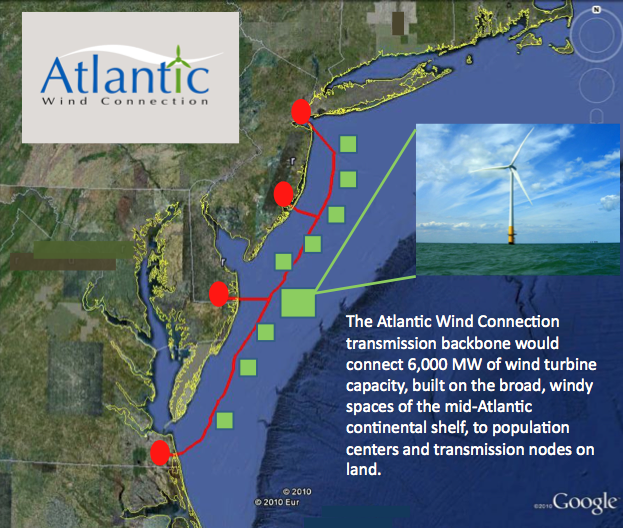
When built out, the Atlantic Wind Connection (AWC) backbone will stretch 350 miles off the coast from New Jersey to Virginia and will be able to connect 6,000MW of offshore wind turbines. That’s equivalent to 60% of the wind energy that was installed in the entire country last year and enough to serve approximately 1.9 million households.


The AWC backbone will be built around offshore power hubs that will collect the power from multiple offshore wind farms and deliver it efficiently via sub-sea cables to the strongest, highest capacity parts of the land-based transmission system. This system will act as a superhighway for clean energy. By putting strong, secure transmission in place, the project removes a major barrier to scaling up offshore wind, an industry that despite its potential, only had its first federal lease signed last week and still has no operating projects in the U.S.

Why offshore wind and why the Mid-Atlantic? Many coastal areas in the United States have large population centers on an overstretched grid but limited access to a high-quality land-based wind resource. These coastal states can take advantage of their most promising renewable resource by using larger wind farms with larger turbines that can take advantage of stronger and steadier winds offshore.

The Mid-Atlantic region is ideally suited for offshore wind. It offers more than 60,000 MW of offshore wind potential in relatively shallow waters that extend miles out to sea. These shallow waters make it easier to install turbines 10-15 miles offshore, meaning wind projects can take advantage of stronger winds and are virtually out-of-sight from land. With few other renewable energy options ideally suited for the Atlantic coast, the AWC backbone helps states meet their renewable energy goals and standards (PDF) by enabling a local offshore wind industry to deploy thousands of megawatts of clean, cost-effective wind energy.

The AWC backbone is critical to more rapidly scaling up offshore wind because without it, offshore wind developers would be forced to build individual radial transmission lines from each offshore wind project to the shore, requiring additional time consuming permitting and environmental studies and making balancing the grid more difficult. As those in the Northeast remember from the 2003 blackout, transmission is severely overstretched on the east coast. The AWC project relieves grid congestion in one of two National Interest Electric Transmission Corridors which were deemed to have significant network congestion and need speedy creation of transmission capacity.

The AWC project is led by independent transmission company Trans-Elect and is financed by Google, Good Energies and Marubeni Corporation. We are investing 37.5% of the equity in this initial development stage, with the goal of obtaining all the necessary approvals to finance and begin constructing the line. Although the development stage requires only a small part of the total estimated project budget, it represents a critical stage for the project.

We believe in investing in projects that make good business sense and further the development of renewable energy. We’re willing to take calculated risks on early stage ideas and projects that can have dramatic impacts while offering attractive returns. This willingness to be ahead of the industry and invest in large scale innovative projects is core to our success as a company.

From the Great Plains to the waters off the coast of Northern Europe, windmills churn out clean power that lights our homes and powers our economies. We are pleased to support this investment that will ultimately enable the Mid Atlantic to benefit from the tremendous wind resource off its coast.

Posted by Rick Needham, Green Business Operations Director