
The Fight Continues


The Supreme Court’s Deadlock On Immigration Leaves Millions In Limbo

An eight-member Supreme Court was unable to address an immigration case that impacts millions of families and our economy, showing just how damaging a short-handed Court can be. In United States v. Texas, the most important immigration case to reach the Supreme Court in decades, the justices split 4-4 leaving millions of immigrant families in limbo with a one-sentence non-decision.

The case was brought to the Supreme Court by a group of politically-motivated Republican governors and attorneys general from 26 states who hoped to block two parts of President Obama’s 2014 executive actions on immigration: expanded Deferred Action for Childhood Arrivals (DACA) and Deferred Action for Parents of Americans and Lawful Permanent Residents (DAPA). DAPA and expanded DACA were created to help parents of U.S. citizens and green card holders, as well as DREAMers who came to the U.S. as children and lived here their entire lives.

Without even issuing an opinion or presenting reasoning, the split Supreme Court today permitted a decision from a single federal court to have a profound impact on the lives of millions across the country. The President’s actions would keep millions of families together and give them with the opportunity to contribute more fully to the economy. But after today, an estimated 4 million immigrants will remain vulnerable to deportation and more than 6 million U.S. citizens will continue to live in fear of the separation of their families.

Blocking DAPA and expanded DACA isn’t just a loss for millions of American families, it is also a loss for the entire U.S. economy. Every day the programs are blocked the U.S. loses $29.9 million in GDP—already delay of the programs has cost the country more than 8.2 billion in lost cumulative GDP.

The split Court means that there is no decision that will bind future court decisions and the case may continue to proceed through the courts until it is heard in front of a full Supreme Court. The split decision also means that the fight for families will continue in November, when voters will choose between two presidential candidates with drastically different views on the future of immigration in the United States.

One bright spot in today’s Supreme Court news was the 4-3 decision to uphold affirmative action in university admissions processes. The decision proved that diversity is a value worth preserving on college campuses and is a win for all Americans. But the immigration decision that immediately followed it proved the fight to preserve and strengthen diversity in the United States will continue.

While the Supreme Court struggles to function and millions of families live in fear of deportation, a highly qualified and respected nominee awaits action from Senate Republicans. Tomorrow marks the 100th day since Chief Judge Merrick Garland was nominated to fill the vacancy and today’s failure to resolve the United States v. Texas case proves just how much we need the vacancy filled. It’s time for Senate Republicans to stop playing political games with our democracy and give him a hearing and a vote.

BOTTOM LINE: Today, a short-handed Supreme Court failed to address one of the most consequential immigration cases in decades, forcing millions of immigrants to continue living in fear of separation. Millions of families were forced into limbo by a group of politically-motivated Republican lawmakers seeking to block President Obama’s immigration actions and they remain in limbo thanks, in part, to another group of politically-motivated Republican lawmakers seeking to obstruct the Supreme Court process.

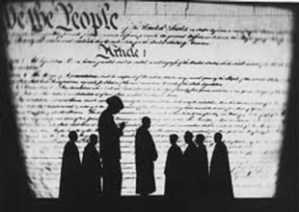
Evenwel v. Abbott (U.S. Sup. Ct.)


 WethePeople

In Evenwel v. Abbott, the Supreme Court considered whether the Equal Protection Clause of the Fourteenth Amendment requires states to draw state legislative districts that contain a substantially equal number of voters.

Evenwel involved a constitutional challenge to the Texas legislature’s 2013 redistricting plan, which drew 31 state senate districts on substantially equal population based on the 2010 census. In 2014, Sue Evenwel filed this lawsuit, claiming that the redistricting plan violated the Equal Protection Clause of the Fourteenth Amendment because the districts did not contain a substantially equal number of voters. A three-judge district court—which was convened because Evenwel challenged the constitutionality of a state legislature’s redistricting plan—dismissed the case, noting that Evenwel is “relying upon a theory never before accepted by the Supreme Court or any circuit court.” Evenwel filed a statement of jurisdiction with the Supreme Court, and on May 26, 2015, the Court noted probable jurisdiction.

On September 25, 2015, Constitutional Accountability Center filed a friend-of-the-court brief in support of the lower court’s ruling, explaining that Evenwel’s radical claim—that it is the population of eligible voters that must be equalized under the Fourteenth Amendment—cannot be squared with the Constitution’s text and history. Both at the Founding and after the Civil War, our Constitution’s Framers decreed that representation in the House of Representatives would be based on the total population, not the number of eligible voters or other less-encompassing metrics. CAC’s brief took a comprehensive look at the text and history of the Fourteenth Amendment and demonstrated that the Amendment affirmed the Constitution’s promise of equal representation for all. The argument that voter equality must be the overriding constitutional concern was rejected again and again, with the Framers of the Fourteenth Amendment declaring that “the whole population is represented; that although all do not vote, yet all are heard. That is the idea of the Constitution.” As our brief demonstrated, Evenwel’s argument is inconsistent with the total population standard reflected in the Constitution’s text and history and with the Supreme Court’s landmark one-person, one-vote cases, which have required states to draw districts on the basis of population and have consistently used total population as the benchmark for evaluating challenges to state redistricting.

The Supreme Court heard oral argument on December 8, 2015. On April 4, 2016, the Court held – by an 8-0 vote – that a state may draw its legislative districts based on total population. Drawing heavily on constitutional history discussed in our brief, as well as Court precedent and practice, Justice Ginsburg’s opinion for the Court, joined by five other Justices, held that use of a total-population baseline serves the principle of representational equality. Indeed, although the Court didn’t reach the question of whether states may draw districts based on voter-eligible population, the Court’s opinion made clear that total population – as the Framers of the Fourteenth Amendment recognized – is “the theory of the Constitution” when it comes to representation.

How Much Of The $889 Million Will Go To Suppress Voters


We celebrate Black History Month and this year the 50th Anniversary of the Voting Rights Act of 1965 – which made disenfranchisement and discriminatory voting qualifications like literacy tests and poll taxes illegal.

But now, 50 years later, the same voting rights that so many fought for – and gave their lives for – are once again under attack by the Koch brothers and their allies.

The Kochs are shamelessly using their millions to support voter ID efforts, going as far as to fund an entire group, True the Vote, to focus on this issue.

Screen_Shot_2015-02-02_at_3.38.35_PM.png

We need you to sign the pledge to out vote the Koch brothers and the $889 million they recently announced they will spend in the 2016 election.

Brave New Films is more committed than ever to spread awareness of these modern-day voter suppression tactics – and the extremists pushing for them.

Help make sure the Koch brothers don’t take away your vote or anyone else’s in 2016!

Thank you for stepping up and being part of our modern-day civil rights fight,

Regina Clemente, Director of Campaigns
Brave New Films

Sign the Pledge Here! 

Everyone has mild memory lapses


memory loss


Everyone has mild memory lapses from time to time. You can’t find your car keys one day or your reading glasses the next.

Lapses such as these are usually just signs of a normal brain that’s constantly prioritizing, sorting, storing, and retrieving all types of information. But how do you know when memory loss is abnormal – and should be evaluated by a health care professional?

Read the Consumer Update to learn more.

Whole Genome Sequencing: Cracking the Genetic Code for Foodborne Illness


whole genome sequencing


Increasingly, FDA has used whole genome sequencing to support investigations of foodborne illness outbreaks. Industry is also starting to use whole genome sequencing to monitor food manufacturing for bacteria and take steps to prevent potential outbreaks.

Read the Consumer Update to learn more.

USFDA_footer