Official Google Blog


One-hundred and fifty years ago today, on October 13, 1860, James Wallace Black shot the earliest still-existing aerial photograph in the U.S. He took the picture from a hot air balloon suspended above Boston Common, and the result, titled “Boston as the Eagle and the Wild Goose See It,” is truly beautiful. The photo is part of the archive at the venerable Boston Public Library, along with other important historical images of the Boston area, and is particularly significant because most of the area visible in the photo was destroyed by the Great Fire of 1872.
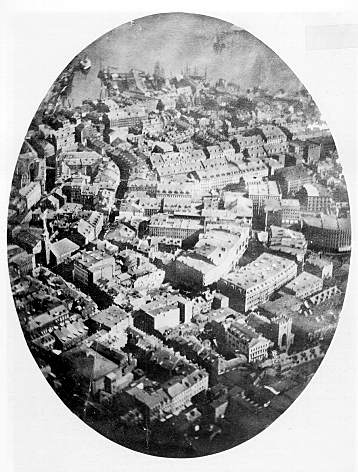
James Wallace Black, Balloon View of Boston, 1860.
From the collections of the Boston Public Library, Print Department, Boston Pictorial Archive.

Flash forward 150 years: Aerial imagery is widely available and used in countless professions, from archaeology to conceptual art. The folks who created Google Earth devised a way to stitch aerial and satellite imagery together into a seamless, searchable map of the world and make it available to anyone with a computer. On top of that basemap of imagery, Google Earth users have contributed to the creation of a 3D, photo-realistic virtual world by using tools like Google Building Maker, which makes it easy for anyone to use aerial imagery to model 3D buildings for display in Google Earth.

We at Google owe James Wallace Black a debt of gratitude; without his early experimentation with aerial imagery, Google Earth may never have come to be.

In a happy coincidence, October 13 is also the first anniversary of Building Maker, and we’re taking the opportunity to celebrate the contributions of a dedicated community of 3D modelers in the 101 cities around the world where Building Maker is available. Here’s a look at two of our top modelers and their creations:

Peter Sih (aka PeterX), lives in San Jose, Calif., but has created models all over the world. He tells us: “Modeling with Building Maker you get almost instant gratification. I learn a lot by modeling places I don’t know as well as places I know well. Modeling for GE ties together my lifelong fascination with geography, architecture, travel, photography and computers.”

Pavilhão Carlos Lopes – Lisbon, Portugal

Grant Firl (aka Grant F) lives in Fort Collins, Colo., but concentrates most of his modeling efforts on Albuquerque, N.M. He tells us: “I choose to model with 3D Building Maker for many reasons. Principally, I think that the 3D buildings layer is a very worthwhile tool and I view it as both a privilege and a kind of duty to help fill in content. Secondly, it is both fun and rewarding to create models of physical buildings, especially given the opportunity to share them to Google’s users for their use and enjoyment. Thirdly, the 3D buildings layer provides a unique way to preserve and share the hard work and inspiration of actual builders and architects.”

Albuquerque Plaza – Albuquerque, N.M.


If you haven’t tried Building Maker yet, it’s very easy and fun. You pick a building and construct a model of it using aerial photos and simple 3D shapes—both of which we provide. When you’re done, we take a look at your model. If it looks right, and if a better model doesn’t already exist, we add it to the 3D Buildings layer in Google Earth. You can make a whole building in a few minutes.

Technology has come a long way since James Wallace Black took his photo of Boston, and glass-plate-negative box cameras in hot air balloons have given way to airplanes with mounted camera arrays. But what hasn’t changed is how technology gives us new ways to look at out world. Check out Google Building Maker and build the picture of your world.

Posted by Nicole Drobeck, Building Maker Community Advocate

Alex Odeh – In Memory


naacpOn October 11, 1985, civil rights activist Alex Odeh was killed in a terrorist attack in Santa Ana, California. As he opened the door to the American-Arab Anti-Discrimination Committee office, a pipe bomb exploded. He died from his injuries.

That’s the tragic part of the story. The deplorable: nearly two decades later, the three chief suspects remain free.

Today is the anniversary of Alex Odeh’s assassination. Join us in calling on the Department of Justice to hold his murderers responsible for their crime.

Demand justice for Alex Odeh

Alex Odeh was living the definition of the American dream.

Having immigrated to the United States from the West Bank, he was a lecturer and a poet. He had started a family and was working for a cause he believed in: protecting and defending the civil rights of Arab Americans.

The lack of action on his case is inexplicable. The FBI almost immediately identified the people behind the bombing, yet no indictments or charges have been made.

As you can imagine, this situation has been heartbreaking for Alex Odeh’s loved ones. But it should also disturb all of us who rely on this country’s criminal justice system. We don’t have to stand for it.

Tell the Department of Justice to demonstrate a strong commitment to justice for all Americans in their stance on terrorism, and bring Alex Odeh’s killers into custody:

http://action.naacp.org

Thank you,

Benjamin Todd Jealous
President and CEO
NAACP

10/9 Celebrate Indigenous Peoples Day 2023


It’s time to recognize that celebrating the life of Christopher Columbus also celebrates the erasure of Indigenous existence.

While there is a growing movement around the country to replace Columbus Day with Indigenous Peoples Day, more work remains to be done.

We are excited to share some local and national events celebrating Indigenous Peoples and Indigenous Peoples Day. 

Source: culturalsurvival.org

So, this year, it was not lost on me how Washington State sort of remained quiet this year. Yes, there are commercials and festive activities locally. However, not only was columbus day absent from School District calendars, but not much was said about Indigenous Day, and it wasn’t on a School calendar either

Nativegrl77

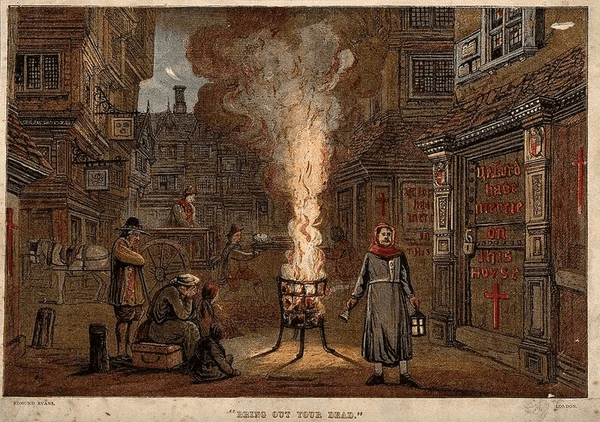
Great Plague of London


Drivers of death carts in London would go street-to-street extolling people to “bring out your dead” at the height of the London plague outbreak in 1665

In 1665 and 1666, the last great outbreak of bubonic plague to hit England swept through the capital, London. The outbreak was much smaller in scale than the Black Death of the 14th century, but was still notable for having killed as many as 100,000 people – about a quarter of the city’s population – in eighteen months.

By July 1665 the plague was spreading rapidly in London. Many fled, including the King Charles II, if they were wealthy enough to afford it. Parliament was moved to Oxford University from Westminster Palace. Many of the city’s businesses closed. Diarist Samuel Pepys wrote much about life in the city during the plague, and of empty streets.

By September, as many as 7,000 people a week were dying, and many were thrown into mass graves. The true toll was likely to be much higher, since the deaths of poor were not recorded.

The University of Cambridge closed down during the outbreak, forcing a young Isaac Newton to continue his studies from home – during this time he expanded significantly on his new idea about the laws of gravity, among other things.

By November the outbreak started to taper off, and the King returned in February the next year when it was considered to be safe enough. Disaster would strike London again in 1666, with much of it being destroyed in the Great Fire of London that September.