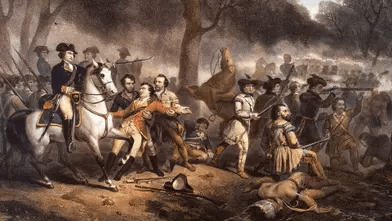
1754 – First Blood on the French and Indian War


In the first engagement of the French and Indian War, a Virginia militia under 22-year-old Lieutenant Colonel George Washington defeats a French reconnaissance party in southwestern Pennsylvania. In a surprise attack, the Virginians killed 10 French soldiers from Fort Duquesne, including the French commander, Coulon de Jumonville, and took 21 prisoners. Only one of Washington’s men was killed.

The French and Indian War was the last and most important of a series of colonial conflicts between the British and the American colonists on one side, and the French and their broad network of Native American allies on the other. Fighting began in the spring of 1754, but Britain and France did not officially declare war against each other until May 1756 and the outbreak of the Seven Years War in Europe.

In November 1752, at the age of 20, George Washington was appointed adjutant in the Virginia colonial militia, which involved the inspection, mustering, and regulation of various militia companies. In November 1753, he first gained public notice when he volunteered to carry a message from Virginia Governor Robert Dinwiddie to the French moving into the Ohio Valley, warning them to leave the territory, which was claimed by the British crown. Washington succeeded in the perilous wilderness journey and brought back an alarming message:

The French intended to stay.

Source: history.com

Amnesty International, a human rights organization, was founded ~5/28/1961


Amnesty International is a global movement of more than 7 million people who take injustice personally. We are campaigning for a world where human rights are enjoyed by all.

We are funded by members and people like you. We are independent of any political ideology, economic interest or religion. No government is beyond scrutiny. No situation is beyond hope.

Few would have predicted when we started that torturers would become international outlaws. That most countries would abolish the death penalty. And seemingly untouchable dictators would be made to answer for their crimes.

WHAT DOES AMNESTY DO?

We investigate and expose the facts, whenever and wherever abuses happen.

We lobby governments, and other powerful groups such as companies. Making sure they keep their promises and respect international law.

By telling the powerful stories of the people we work with, we mobilize millions of supporters around the world to campaign for change and to stand in defence of activists on the frontline.

We support people to claim their rights through education and training.

Watch our videos below

FORTRESS EUROPE A TURNING POINT FOR CHINA? A LETTER FOR ALES AFRICA NOT 4 SALE ACTION FOR TEORORA FAIR PLAY QATAR

Where it all began

In 1961, British lawyer Peter Benenson was outraged when two Portuguese students were jailed just for raising a toast to freedom. He wrote an article in The Observer newspaper and launched a campaign that provoked an incredible response. Reprinted in newspapers across the world, his call to action sparked the idea that people everywhere can unite in solidarity for justice and freedom.

This inspiring moment didn’t just give birth to an extraordinary movement, it was the start of extraordinary social change.

“Only when the last prisoner of conscience has been freed, when the last torture chamber has been closed, when the United Nations Universal Declaration of Human Rights is a reality for the world’s people, will our work be done.”

Peter Benenson, Amnesty International founder
© Amnesty International Togo

Amnesty evolves

Over the years, human rights have moved from the fringes to centre stage in world affairs.

Amnesty has grown from seeking the release of political prisoners to upholding the whole spectrum of human rights. Our work protects and empowers people – from abolishing the death penalty to protecting sexual and reproductive rights, and from combatting discrimination to defending refugees and migrants’ rights. We speak out for anyone and everyone whose freedom and dignity are under threat.


NATIONAL BLACK FARMERS ASSOCIATION STATEMENT ON HOUSE PASSAGE OF BLACK FARMERS SETTLEMENT FUNDS- In Memory


Friday, May 28, 2010

Congress

Friday, May 28,2010

blackfarmers.org

Black Farmers Will Lobby Senate for Quick Action, Seek Meeting with President Obama

WASHINGTON, DC — John W. Boyd, Jr., founder and president of the National Black Farmers Association, released the following statement today after the U.S. House of Representatives approved funding – as part of a larger – for the historic settlement to resolve decades of discrimination against black farmers by the U.S. Department of Agriculture.

“With today’s action, we are one important step closer to bringing justice for the tens of thousands of black farmers in this country whose lives and livelihoods were impacted by discrimination from the U.S. Department of Agriculture.

“It is important to recognize speaker of the House Nancy Pelosi and her colleagues in the House leadership for their work. It is also important to recognize the tireless and ongoing efforts of the Congressional Black Caucus.

“We look forward to working with the Senate, following the holiday recess, to ensure passage of these funds as soon as possible. Every delay means the likelihood of more farm foreclosures and more black farmers who will not live to see the day they receive the payments they have waited for and deserve.

“I would like to extend my request for a meeting with President Obama so I can ask for his personal help in working with the Senate to resolve this matter and the other issues facing the Black farmers.”

Reid: Republicans Blocking Justice For Minority Farmers And Native American Trust Account Holders

May 7, 2010

Washington, D.C.Nevada Senator Harry Reid made the following statement today after Republicans blocked a unanimous consent request to provide funding for the settlement of lawsuits by black farmers and Native American trust account holders:

“Where we see injustices, it is our responsibility to stand up for those who need a voice.  That’s why I am pleased that this morning, Senate Democrats attempted to correct historic injustices for black farmers and Native American trust account holders.  This represents a long-standing commitment on my part to seek a fair resolution to these issues.   Not to mention, we must continue working to resolve other cases of discrimination at the Department of Agriculture against Hispanic and women farmers.  Unfortunately, Republican obstruction denied justice to those who only seek fair settlement of their grievances.

“There is no excuse for Republicans to continue to employ these partisan delay tactics – in this case, as in so many others, they are only hurting those who were wronged and are fighting for what is rightfully theirs.  We will continue to work on this issue until it is resolved.  My view on this is simple: justice delayed is justice denied.”

Obama backs $1.25 billion payment to black farmers who suffered government racism for decades

March 01, 2010

When the record of the Obama administration is written, one major accomplishment will likely be attributed to the president’s race.

The first black president seems determined to make the U.S. government finally settle the claims of 70,000 black farmers, people whose hopes were crushed by government racism. Obama has championed a $1.25 billion settlement that would put these claims to rest.

Termed by some the “last plantation,” the Department of Agriculture for decades systematically denied loans, crop subsidies and other aid to black farmers, at one point bringing them to near extinction.

In the 1920s, blacks operated one of every seven U.S. farms. By 1992, the number had sunk to one in 100.

Meanwhile, many of their white neighbors’ farms prospered. But it wasn’t always because white farmers were harder workers, smarter with agriculture or luckier with the weather. They were given help denied blacks. That’s racism.