| TWO DECISIONS IN THE FIGHT FOR EQUALITY AND JUSTICEPreview |
|
|
|
Lonnie Bunch, museum director, historian, lecturer, and author, is proud to present A Page from Our American Story, a regular on-line series for Museum supporters. It will showcase individuals and events in the African American experience, placing these stories in the context of a larger story — our American story.
A Page From Our American Story
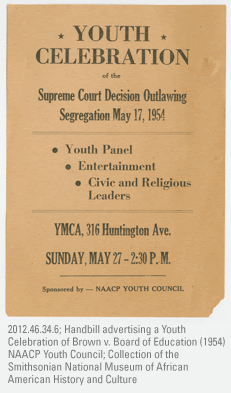 This month, as schoolchildren across the nation look forward to the beginning of summer vacation, the National Museum of African American History and Culture marks the anniversaries of two landmark United States Supreme Court decisions that profoundly impacted access to education – one that legally sanctioned an era of appalling discrimination, and the second that resulted in a major step toward equality and justice for African Americans.
The first case was the 1896 Plessy v. Ferguson decision, which upheld the constitutionality of state laws requiring racial segregation in public facilities. It came about after the state of Louisiana passed the Separate Car Act in 1890, which mandated separate railway cars for blacks and whites. In response, a group of prominent black, white, and creole New Orleans residents formed the Comité des Citoyens (Committee of Citizens) to fight for repeal of the law.
The Comité recruited Homer Plessy, a mixed-race man, to take part in a case challenging the law. On June 7, 1892, Plessy bought a first-class ticket on an East Louisiana Railroad train in New Orleans and took a seat in a “whites only” car. He was asked to move to the blacks-only car, arrested when he refused, and remanded for trial. He was convicted and ordered to pay a $25 fine. Upon appeal, the Supreme Court of Louisiana upheld the ruling, setting the stage for a challenge in the U.S. Supreme Court.
Oral arguments in Plessy v. Ferguson were held before the Supreme Court on April 13, 1896. Plessy’s attorneys built his case upon violation of his rights under the Thirteenth Amendment of the U.S. Constitution, which prohibits slavery, and the Fourteenth Amendment, which guarantees equal rights and the protection of those rights to all U.S citizens.
In the seven-to-one decision handed down on May 18, 1896, the Court rejected Plessy’s arguments, holding that as long as the separate facilities for the separate races were equal, segregation did not violate the Fourteenth Amendment. Justice John Marshall Harlan wrote a scathing dissent in which he predicted the court’s decision would become as infamous as the notorious 1857Dred Scott ruling that no African American, free or slave, could claim U.S. citizenship or petition the court for their freedom.
The impacts of the “separate but equal” doctrine established by Plessy ruling were immediate and far-reaching – erasing legislative achievements of the Reconstruction Era, legitimizing state laws establishing racial segregation in the South (the Jim Crow system), and inspiring the spread of segregation laws and practices northward. These developments exacerbated already vast differences in funding for segregated school systems. As with other segregated facilities and institutions, schools for African Americans were consistently inferior to those for whites, contradicting the claims of “separate but equal” underlying the Plessy decision.
“Separate but equal” remained the standard doctrine in U.S. law until the 1954 U.S. Supreme Court decision in Brown v. Board of Education of Topeka, in which the Court ruled that segregation in public education was unconstitutional. The case began in 1951 as a class action suit filed in the United States District Court for the District of Kansas that called on the city’s Board of Education to reverse its policy of racial segregation. It was initiated by the Topeka chapter of the National Association for the Advancement of Colored People (NAACP), and the plaintiffs were 13 African American parents on behalf of their children. The named plaintiff was Oliver L. Brown, a welder and an assistant pastor at his local church, whose daughter had to walk six blocks to her school bus stop to ride to her segregated black school one mile away, while a white school was located just seven blocks from her house.
Citing the precedent set in Plessy, the District Court ruled in favor of the Board of Education, leading the plaintiffs to mount a U.S. Supreme Court challenge. The Supreme Court case Brown v. Board of Education combined the Brown case and four similar cases from various states, and NAACP Chief Counsel Thurgood Marshall, later appointed to the U.S. Supreme Court, lead the team of attorneys that argued the case for the plaintiffs.
The Court heard the case in spring 1953 but was unable to decide the issue, and asked to rehear the case in fall 1953 at the urging of Associate Justice Felix Frankfurter, who wanted to build a consensus for an opinion outlawing segregation. After the September 1953 death of Chief Justice Fred M. Vinson, who had been a major obstacle to securing such an opinion, President Dwight D. Eisenhower appointed Earl Warren as Chief Justice. Warren told the justices that the Court had to overrule Plessy unanimously to head off massive Southern resistance, eventually convincing the remaining holdouts on the Court. Warren himself drafted the basic opinion, circulating and revising it until all the justices endorsed it.
On May 17, 1954, the Court handed down its unanimous 9-0 decision overturning Plessy as it applied to public education, stating that “separate educational facilities are inherently unequal.” As a result, racial segregation laws were declared in violation of the Equal Protection Clause of the Fourteenth Amendment, paving the way for integration and winning a major victory for the burgeoning Civil Rights Movement.
Many people today may not remember the details of these two landmark cases in the struggle for equality and justice. The National Museum of African American History and Culture was founded to ensure that this story and other important chapters in the African American experience are never forgotten. When the Museum opens its doors on September 24, 2016, we will bring major milestones like Plessy v. Ferguson and Brown v. Board of Education to life through compelling interactive exhibitions and our unsurpassed permanent collection of African American historical artifacts, including an entire Jim Crow-era segregated railway car and the dining room that was used by Brown family and NAACP Legal Defense Fund during preparation for the Brown case.
 All the best,
Lonnie G. Bunch III
Founding Director
P.S. We can only reach our $270 million goal with your help. I hope you will consider becoming a Charter Member today.
To read past Our American Stories, visit our archives.



 1770 – Marie Antoinette, at age 14, married the future King Louis XVI of France, who was 15.


 Be a Seed for Change
You must be logged in to post a comment.