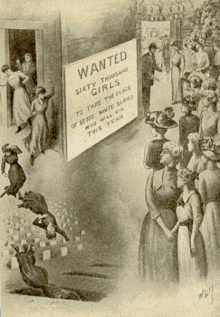
Congress passed the Mann Act, which was ostensibly aimed at keeping young women from being lured into prostitution but really offered a way to make a crime out of many kinds of consensual sexual activity.
The outrage over sex work began with a commission appointed in 1907 to investigate the problem of immigrant prostitutes. Allegedly, women were brought to America for the purpose of being forced into sexual slavery; likewise, immigrant men were allegedly luring American girls into prostitution.
The Congressional committees that debated the Mann Act did not believe that a woman would ever choose to be a prostitute unless she was drugged and held hostage. The law made it illegal to “transport any woman or girl” across state lines “for any immoral purpose.” In 1917, the Supreme Court upheld the conviction of two married California men, Drew Caminetti and Maury Diggs, who had gone on a romantic weekend getaway with their girlfriends to Reno, Nevada, and had been arrested. Following this decision, the Mann Act was used in all types of cases: someone was charged with violating the Mann Act for bringing a woman from one state to another in order to work as a chorus girl in a theater; wives began using the Mann Act against girls who ran off with their husbands. The law was also used for racist purposes: Jack Johnson, heavyweight champion of the world, was prosecuted for bringing a prostitute from Pittsburgh to Chicago, but the motivation for his arrest was public outrage over his marriages to white women.
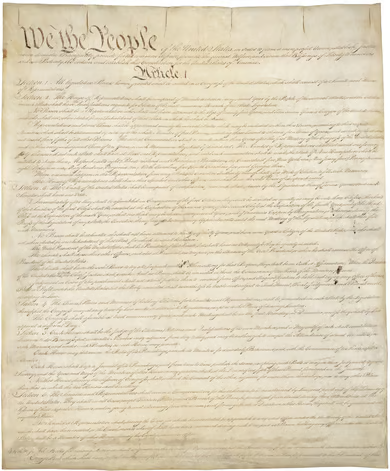
The supreme law of the United States of America, the US Constitution, was drafted by the Philadelphia Constitutional Convention which took place between May 25 and September 17, 1787.
It was the first constitution of its kind, and has influenced the constitutions of many other nations.
Since the Constitution came into force in 1789, it has been amended 27 times.
Republicans in the Senate have BLOCKED a bill that would protect the right to use basic birth control, like IUDs, Plan B, and the pill. Sign the petition to demand representatives sign on to a discharge petition that would force Republicans to bring the Right to Contraception Act to a vote in the House THIS YEAR!
Why is this important?
First, abortion. Then, IVF. Now, conservative lawmakers are putting contraception at risk.
Nearly all voters—Republicans, Democrats, and Independents—support the right to contraception. Millions of people use it to plan their families and manage their health. But instead of protecting this right and enshrining it into law, Republicans in the Senate blocked the Right to Contraception Act.
Every American should have the freedom to use contraception if and when they need it—and the assurance that the government will never take it away from us.
Right now, there’s another path forward. A discharge petition is circulating in the House of Representatives that, if they get enough signatures, would force the Republican majority to bring the Right to Contraception Act to a vote in the House. Sign the petition to urge your representative to support the right to contraception, sign the discharge petition, and fight for our freedom to plan our families and our futures.
Limits on Move-In Fees: The regulations also impose limits on move-in fees. This helps prevent excessive upfront costs for renters when moving into a new rental property.
Late Fee Cap: Late fees are now capped at 1.5% of the rent amount. This ensures that landlords cannot impose disproportionately high penalties for late payments.
Books are being challenged, restricted, removed, or outright banned from schools across the country—including the first-ever National Youth Poet Laureate Amanda Gorman’s “The Hill We Climb.” Students should be encouraged to read books that accurately reflect the diversity and history of our country. Celebrate this history-making piece of literature and make sure students everywhere have the freedom and encouragement to read it.
Why is this important?
It only took one complaint and one week for a school in Miami-Dade County to restrict Amanda Gorman’s book—“The Hill We Climb”—and limit access for younger students. It was one book of several that an individual parent reported, citing that it was “not educational” and contained indirect hate speech. [1]
Schools should not so swiftly censor literature based on the whims of individual parents. This is part of a sweeping trend across the country to ban and restrict books, often targeting authors and content from historically marginalized and underrepresented groups. And because of conservative laws being passed on the local and state level, it’s even easier in many places for a small but loud minority to challenge books—and win.
In response to the incident, Amanda Gorman wrote: “The Hill We Climb is an inaugural poem for the world. Relocating it to older age group library shelves by its nature bars younger and equally deserving generations from accessing said moment in history.” [2]
Amanda Gorman made history when she read “The Hill We Climb” at President Joe Biden’s inauguration—the youngest inaugural poet to date. People of all ages deserve to have access to her work and see themselves not only in the context of that moment, but also in the possibilities of the future. They, too, can make history.
We refuse to allow one parent’s opinion to limit our children’s freedom to read, learn, and imagine. Join us in calling on the Department of Education and State Education Departments to add “The Hill We Climb” to every associated recommended reading list in the country and to reaffirm the values of equality and access espoused in the mission of the DOE. [3]






 Be a Seed for Change
You must be logged in to post a comment.