on this day 9/19


1356 – The Battle of Poitiers was fought between England and France. Edward “the Black Prince” captured France’s King John.

1777 – The Battle of Saratoga was won by American soldiers during the Revolutionary War.

1796 – U.S. President Washington’s farewell address was published.

1819 – John Keats wrote “Ode to Autumn.”

1876 – Melville R. Bissell patented the carpet sweeper.

1891 – “The Merchant of Venice” was performed for the first time at Manchester.

1893 – In New Zealand, the Electoral Act 1893 was consented to giving all women in New Zealand the right to vote.

1942 – The first advertisement to announce Little Golden Books appeared in Publishers Weekly.

1955 – Eva Marie Saint, Frank Sinatra and Paul Newman starred in the “Producer’s Showcase” presentation of “Our Town” on NBC-TV.

1955 – Argentina President Juan Peron was ousted after a revolt by the army and navy.

1957 – The U.S. conducted its first underground nuclear test. The test took place in the Nevada desert. 

1959 – Nikita Khruschev was not allowed to visit Disneyland due to security reasons. Khrushchev reacted angrily.

1960 – Cuban leader Fidel Castro, in New York to visit the United Nations, checked out of the Shelburne Hotel angrily after a dispute with the management.

1982 – Scott Fahlman became the first person to use 🙂 in an online message.

1983 – Lebanese army units defending Souk el-Gharb were supported in their effort by two U.S. Navy ships off Beirut.

1984 – China and Britain completed a draft agreement transferring Hong Kong from British to Chinese rule by 1997.

1986 – U.S. health officials announced that AZT, though an experimental drug, would be made available to AIDS patients.

1988 – Israel successfully launched the Horizon-I test satellite.

1990 – Iraq began confiscating foreign assets of countries that were imposing sanctions against the Iraqi government.

1992 – The U.N. Security Council recommended suspending Yugoslavia due to its role in the Bosnian civil war.

1994 – U.S. troops entered Haiti peacefully to enforce the return of exiled President Jean-Bertrand Aristide.

1995 – The U.S. Senate passed a welfare overhaul bill. 

1995 – The commander of American forces in Japan and the U.S. ambassador apologized for the rape of a schoolgirl committed by three U.S. servicemen.

1996 – The government of Guatemala and leftist rebels signed a peace treaty to end their long war.

2002 – In Ivory Coast, around 750 rebel soldiers attempted to overthrow the government. U.S. troops landed on September 25th to help move foreigners, including Americans, to safer areas.

2003 – It was reported that AOL Time Warner was going to drop “AOL” from its name and be known as Time Warner Inc. The company had announced its merger and name change on January 10, 2000.

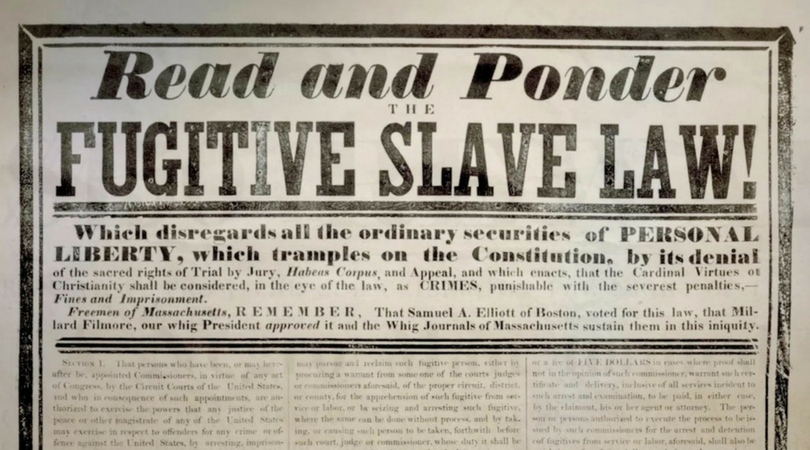
On 9/18/1850 – The Fugitive Slave Act was declared by the U.S. Congress. The act allowed slave owners to claim slaves that had escaped to other states.


On 1/29/1850 – Henry Clay introduced in the Senate a * Compromise of 1850 Bill* on slavery that included the admission of California into the Union as a free state. 1850 Senator Henry Clay drafted the Compromise of 1850 to defuse tensions between slave states and free states over territories won during the Mexican–American War

Image result for When was the Fugitive Slave Act passed and what were the consequences of this law?

Passed on September 18, 1850 by Congress, The Fugitive Slave Act of 1850 was part of the Compromise of 1850. The act required that slaves be returned to their owners, even if they were in a free state. The act also made the federal government responsible for finding, returning, and trying escaped slaves.

Sources: battlefields.org , on-this-day.com

Henry Clay's handwritten draft of one of the bills that formed the Compromise of 1850
Henry Clay’s handwritten draft of one of the bills that formed the Compromise of 1850

The American Civil War devastated much of the country between 1861 and 1865, but the conflict could have actually happened much sooner. In 1850, a major dispute between slave states and free states arose regarding the status of lands acquired after the Mexican-American War (1846-48).

Many Southern states wanted to expand slavery into these new territories, which was opposed by the Northerners. These disputes, and others relating to the territorial expansion of the state of Texas. In early 1850, senator Henry Clay drafted a compromise that included the admission of California as a free state, the cession by Texas of some of its northern and western territorial claims in return for debt relief, the establishment of New Mexico and Utah territories, a ban on the importation of slaves into the District of Columbia for sale, and a more stringent fugitive slave law.

The compromise initially failed to gain wide support, but after President Zachary Taylor died, his successor Millard Fillmore and Democratic senator Stephen Douglas took the lead in passing Clay’s compromise through Congress as a series of five bills. The tensions were diffused, and the risk of conflict in the immediate term ended, but the debate over slavery did not end. Many years of controversy and debate eventually led to the secession of the Southern states and the Civil War in 1861.

Document Info

Author(s): Henry Clay
Location signed: USA

Source: National Archives

Related Events

  • 1850-01-29 Senator Henry Clay drafts the Compromise of 1850 to defuse tensions between slave states and free states over territories won during the Mexican–American War
  • 1850-03-07 Daniel Webster endorses the Compromise of 1850
  • 1850-09-18 US Congress passes Fugitive Slave Law as part of Compromise of 1850

onthisday.com

on this day 9/17


1394 – In France, Charles VI published an ordinance that expelled all Jews from France.

1778 – The United States signed its first treaty with a Native American tribe, the Delaware Nation. 

1787 – The Constitution of the United States of America was signed by delegates at the Constitutional Convention. 

1796 – U.S. President George Washington’s Farewell Address was read before the U.S. Congress. 

1862 – The Battle of Antietam took place during the American Civil War. More than 23,000 men were killed, wounded, or missing. The Rebel advance was ended with heavy losses to both armies.

1872 – Phillip W. Pratt patented a version of the sprinkler system.

1911 – The first transcontinental airplane flight started. It took C.P. Rogers 82 hours to fly from New York City to Pasadena, CA.

1920 – The American Professional Football Association was formed in Canton, OH. It was the precursor to the National Football League (NFL).

1930 – Construction on Boulder Dam, later renamed Hoover Dam, began in Black Canyon, near Las Vegas, NV.

1932 – Sir Malcolm Campbell set a speed record when he reached 276.27 mph over a half mile.

1937 – At Mount Rushmore, Abraham Lincoln’s face was dedicated.

1939 – The Soviet Union invaded Poland. Germany had invaded Poland on September 1.

1944 – Operation “Market Garden” was launched by Allied paratroopers during World War II. The landing point was behind German lines in the Netherlands.

1947 – The first U.S. Secretary of Defense, James V. Forrestal, was sworn in to office.

1953 – Ernie Banks became the first black baseball player to wear a Chicago Cubs uniform. He retired in 1971 known as ‘Mr. Cub’.

1953 – The Ochsner Foundation Hospital in New Orleans, LA, successfully separated Siamese twins. Carolyn Anne and Catherine Anne Mouton were connected at the waist when born.

1955 – “The Perry Como Show” moved to Saturday nights on NBC-TV.

1961 – The Minnesota Vikings were debuted as the new National Football League (NFL) team.

1962 – U.S. space officials announced the selection of Neil A. Armstrong and eight others as new astronauts.

1963 – “The Fugitive” premiered on ABC-TV. The show starred David Janssen.

1964 – “Bewitched” premiered on ABC-TV.

1965 – “Hogan’s Heroes” debuted on CBS-TV.

1966 – “Mission Impossible” premiered on CBS-TV.

1972 – “M*A*S*H” premiered on CBS-TV.

1976 – NASA unveiled the space shuttle Enterprise in Palmdale, CA.

1983 – Vanessa Williams, as Miss New York, became the first black woman to be crowned Miss America.

1983 – Johnny Bench (Cincinnati Reds) retired after 16 years as a catcher.

1983 – Carl Yastrzemski (Boston Red Sox) broke Hank Aaron’s major league record for games played when he started his 3,299th game. (MLB)

1984 – 9,706 immigrants became naturalized citizens when they were sworn in by U.S. Vice-President George Bush in Miami, FL. It was the largest group to become U.S. citizens. 

1984 – Gordon P. Getty was named the richest person in the U.S. His fortune was $4.1 billion.

1984 – Reggie Jackson hit his 500th career home run. It was exactly 17 years from the day he hit his first major league home run.

1988 – Lt. Gen. Prosper Avril declared himself president of Haiti after President Henri Hamphy was ousted.

1991 – The United Nations General Assembly opened its 46th session. The new members were Estonia, Latvia, Lithuania, North and South Korea, Micronesia and the Marshall Islands.

1992 – Lawrence Walsh called a halt to his probe of the Iran-Contra scandal. The investigation had lasted 5 1/2 years.

1995 – Hong Kong held its last legislative election before being taken over by China in 1997.

1997 – Northern Ireland’s main Protestant party joined in peace talks. It was the first time that all of the major players had come together.

1998 – The United States government offered a reward for the capture of Haroun Fazil for his role in the U.S. bombing in Kenya on August 7, 1998.

1998 – The U.S. announced a plan that would compensate victims in the Kenya and Tanzania U.S. Embassy bombings on August 7, 1998.

2014 – The Dow Jones Industrial Average closed at an all time high of 17,156.