
Monthly Archives: October 2024

1985 Angels announce that they will not offer Rod Carew a new contract


on this day … 10/23 1915 – Approximately 25,000 women demanded the right to vote with a march in New York City, NY.
 1775 – Continental Congress approved resolution barring Blacks from the army.
1864 – During the U.S. Civil War, Union forces led by Gen. Samuel R. Curtis defeated the Confederate forces in Missouri that were under Gen. Stirling Price.
1910 – Blanche S. Scott became the first woman to make a public solo airplane flight in the United States.
1915 – The first U.S. championship horseshoe tourney was held in Kellerton, IA.
1915 – Approximately 25,000 women demanded the right to vote with a march in New York City, NY.
1929 – In the U.S., the Dow Jones Industrial Average plunged starting the stock-market crash that began the Great Depression.
1930 – J.K. Scott won the first miniature golf tournament. The event was held in Chattanooga, TN.
1942 – During World War II, the British began a major offensive against Axis forces at El Alamein, Egypt.
1944 – During World War II, the Battle of Leyte Gulf began.
1946 – The United Nations General Assembly convened in New York for the first time.
1956 – Hungarian citizens began an uprising against Soviet occupation. On November 4, 1956 Soviet forces enter Hungary and eventually suppress the uprising.
1956 – NBC broadcasted the first videotape recording. The tape of Jonathan Winters was seen coast to coast in the U.S.
1958 – Russian poet and novelist Boris Pasternak was awarded the Nobel Prize for literature. He was forced to refuse the honor due to negative Soviet reaction. Pasternak won the award for writing “Dr. Zhivago”.
1962 – During the Cuban Missile Crisis, the U.S. naval “quarantine” of Cuba was approved by the Council of the Organization of American States (OAS).
1962 – The U.S. Navy reconnaissance squadron VFP-62 began overflights of Cuba under the code name “Blue Moon.”
1971 – The U.N. General Assembly voted to expel Taiwan and seat Communist China.
1973 – U.S. President Richard M. Nixon agreed to turn over the subpoenaed tapes concerning the Watergate affair.
1978 – China and Japan formally ended four decades of hostility when they exchanged treaty ratifications.
1980 – The resignation of Soviet Premier Alexei N. Kosygin was announced.
1984 – “NBC Nightly News” aired footage of the severe drought in Ethiopia.
1985 – U.S. President Reagan arrived in New York to address the U.N. General Assembly.
1989 – Hungary became an independent republic, after 33 years of Soviet rule.
1992 – Japanese Emperor Akihito became the first Japanese emperor to stand on Chinese soil.
1993 – Joe Carter (Toronto Blue Jays) became only the second player to end the World Series with a homerun.
1995 – Russian President Boris Yeltsin and U.S. President Bill Clinton agree to a joint peacekeeping effort in the war-torn Bosnia.
1998 – Israeli Prime Minister Benjamin Netanyahu and Palestinian Chairman Yasser Arafat reach a breakthrough in a land-for-peace West Bank accord.
1998 – Japan nationalized its first bank since World War II.
2000 – Universal Studios Consumer Products Group (USCPG) and Amblin Entertainment announced an unprecedented and exclusive three-year worldwide merchandising program with Toys “R” Us, Inc. The deal was for the rights to exclusive “E.T. The Extra-Terrestrial” merchandise starting in fall 2001. The film was scheduled for re-release in the spring of 2002.
2001 – NASA’s Mars Odyssey spacecraft began orbiting Mars. In 2010, it became the longest-operating spacecraft ever sent to Mars.
Share this:

1991 – A slave burial site was found by construction workers in lower Manhattan. The “Negro Burial Ground” had been closed in 1790. Over a dozen skeletons were found – Black History –

GSA and the African Burial Ground
GSA’s African Burial Ground project began in 1991, when, during pre-construction work for a new federal office building, workers discovered the skeletal remains of the first of more than 400 men, women and children. Investigations revealed that during the 17th and 18th centuries, free and enslaved Africans were buried in a 6.6 acre burial ground in lower Manhattan outside the boundaries of the settlement of New Amsterdam, which would become New York.
Over the decades, the unmarked cemetery was covered over by development and landfill. The finding deeply impacted the descendant and broader community and, at the same time, renewed awareness in cultural significance and historic preservation.
Managed by GSA, the overall project is a testimonial to a positive and collaborative partnership between many parties, including the Department of the Interior’s National Park Service, the U.S. Army Corps of Engineers, the Advisory Council on Historic Preservation, Howard University, the Schomburg Center for Research in Black Culture, and the African American community.
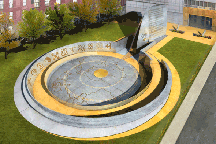
Through the community’s activism and commitment, the African Burial Ground was awarded designation as a National Historic Landmark in 1993 and was named a National Monument in 2006. The African Burial Ground National Monument, located at the corners of Duane and Elk Streets in lower Manhattan, is operated by the National Park Service. For directions to the site, the Visitor Center, and more information, visit nps.gov/afbg.
GSA’s African Burial Ground Project was an extensive mitigation response to the unexpected discovery of the 300-year old burial ground. In 2008 the project was recognized by the White House with a Preserve America Presidential Award. These awards honor exemplary work in the preservation of cultural or national heritage assets. This complex project had several major components:
Scientific research
GSA contracted with Howard University’s Cobb Laboratory to conduct research on the skeletal remains from the burial ground and to produce reports on the history, skeletal biology and archaeology, as well as an integrated and a general audience report on the project. In addition details on the non-mortuary use of the site are in companion reports prepared by John Milner Associates.
Reinterment of human remains
In October 2003 the human remains were reburied in an event that garnered national and international attention. Mindful of the dignity and respect befitting the burial ground, GSA consulted with interested parties, including the New York Public Library – Schomburg Center for Research in Black Culture to plan and coordinate this comprehensive and inclusive ceremony.
Exterior memorial
In 2005 GSA, partnering with the National Park Service in a process that included substantial public outreach, selected architect Rodney Leon to create a permanent memorial at the African Burial Ground that would befit the significance of the discovery and the site. The African Burial Ground Memorial was dedicated in 2007.
https://www.gsa.gov/africanburialground
Share this:

The Chicago Public Schools boycott, also known as Freedom Day

The Chicago Public Schools boycott, also known as Freedom Day, was a mass boycott and demonstration against the segregationist policies of the Chicago Public Schools (CPS) on October 22, 1963.
More than 200,000 students stayed out of school, and tens of thousands of Chicagoans joined in a protest that culminated in a march to the office of the Chicago Board of Education. The protest preceded the larger New York City public school boycott, also known as Freedom Day.
In response to the school segregation enacted by Willis, community members began organizing resistance. Organizers included Chicago activist Albert Raby.[7] The Coordinating Council of Community Organizations (CCCO) took the lead, organizing “Freedom Day,” the mass boycott and protest.[8] According to the chairman of the CCCO, Lawrence Landry, “The boycott is an effort to communicate dissatisfaction on how schools are being run.”[9] The Chicago Defender estimated that forty percent of CPS students would participate in the boycott.[9]
On October 22, 1963, nearly half of all CPS students skipped school, leaving schools on Chicago’s South Side and West Side mostly empty.[3] The Chicago Tribune reported that 224,770 students were absent from CPS, amounting to 47 percent of the student population.[10] Some students opted to attend makeshift Freedom Schools instead.[11] In addition to the boycott, nearly 10,000 protesters marched in Chicago’s downtown, stopping outside the Chicago Board of Education offices. Chicago police kept protesters from entering the building.[5]
While Freedom Day was popular and widely covered, it did not have significant impact in changing the policies of Superintendent Willis. This de facto school segregation was supported by da Mayor Richard J. Daley,[7] who went on to nominate two school board members who did not support the CCCO’s push for integration. Ultimately, CPS was not moved to integrate after Freedom Day, despite the best efforts of Black activists and the CCCO.[8] Use of Willis Wagons prevailed,[4] and Willis himself did not retire until 1966 (albeit four months before the end of his term).[6] However, the size of the first Freedom Day protest inspired subsequent boycotts in Chicago[12] and the United States.[13][14]
The Freedom Day protest inspired Reverend Martin Luther King Jr.‘s move to Chicago in 1966.[4]
for the complete cite … wiki
source: wiki … please let me know if there are alternative facts that need correcting

 Be a Seed for Change
You must be logged in to post a comment.