The Comstock Act


So, among other things, the 1873 Act has been dormant and is now apparently just one silly nudge away from waking up to say boo not only to Women but to anyone that needs what might be considered a controversial drug.

If you would like to read the entire post, please go to encyclopedia.com. I was particularly interested in the highlighted section below, and again, Alito brings back the feeling of something wicked coming!

At the turn of the century, 24 states had enacted their own versions of the Comstock Act, many of which were more stringent than the federal statute.

The Comstock Law itself was recodified and reenacted several times in the twentieth century, and prosecutions for violations of the federal statute continued even as Americans became increasingly diverse and tolerant. As a result, several challenges were made to the constitutionality of the Comstock Law, most of them on first amendment grounds. To the surprise of many observers, the U.S Supreme Court continued to uphold the Comstock Law into the 1960s. United States v. Zuideveld, 316 F.2d 873, 875-76, 881 (7th Cir. 1963).

The fate of the Comstock Law began to change, however, when the Supreme Court announced its decision in miller v. california, 413 U.S. 15, 93 S. Ct. 2607, 37 L. Ed. 2d 419 (1973). In Miller the Supreme Court ruled that material is obscene if (1) the work, taken as a whole by an average person applying contemporary community standards, appeals to the prurient interest; (2) the work depicts sexual conduct in a patently offensive way; and (3) the work, when taken as a whole, lacks serious literary, artistic, political, or scientific value. Although the Comstock Law was never challenged on grounds that it violated the Miller standards for obscenity, the Supreme Court declared the law unconstitutional in 1983.

In Bolger v. Youngs Drug Products Corp., 463 U.S. 60, 103 S. Ct. 2875, 77 L. Ed. 2d 469 (1983), the Supreme Court re-examined the reasons underlying the Comstock Law (then codified at 39 USCA § 3001) in light of the First Amendment standards governing commercial speech, which allow the government to regulate false, deceptive, and misleading advertisements if the regulation is supported by a substantial governmental interest. The Court concluded that the Comstock Law did not meet this burden. The government’s interest in purging all mailboxes of advertisements for contraceptives is more than offset, the Court said, by the harm that results in denying the mailbox owners the right to receive truthful information bearing on their ability to practice birth control or start a family.

“We have previously made clear,” the Court emphasized, “that a restriction of this scope is more extensive than the Constitution permits, for the government may not reduce the adult population … to reading only what is fit for children.”

Source: encyclopedia

on this day 11/3


1507 – Leonardo DaVinci was commissioned by the husband of Lisa Gherardini to paint her. The work is known as the Mona Lisa.
1631 – The Reverend John Eliot arrived in the Massachusetts Bay Colony. He was the first Protestant minister to dedicate himself to the conversion of Native Americans to Christianity.

1793 – Stephen F. Austin was born. He was the principal founder of Texas.

1796 – John Adams was elected the 2nd U.S. President.

1839 – The first Opium War between China and Britain erupted.

1892 – The first automatic telephone went into service at LaPorte, IN. The device was invented by Almon Strowger.

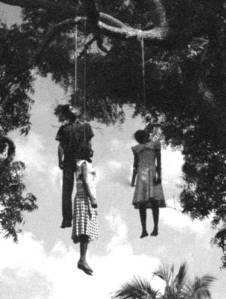
1896 – Seventy-eight Blacks reported lynched in 1896. blackfacts.com

1900 – The first automobile show in the United States opened at New York’s Madison Square Garden.

1903 – Panama proclaimed its independence from Colombia.

1911 – Chevrolet Motor Car Company was founded by Louis Chevrolet and William C. Durant.

1934 – The first race track in California opened under a new pari-mutuel betting law.

1941 – U.S. Ambassador to Japan John Grew warned that the Japanese may be planning a sudden attack on the U.S.

1952 – Frozen bread was offered for sale for the first time in a supermarket in Chester, NY.

1953 – The Rules Committee of organized baseball restored the sacrifice fly. The rule had not been used since 1939.

1957 – Sputnik II was launched by the Soviet Union. It was the second manmade satellite to be put into orbit and was the first to put an animal into space, a dog named Laika.

1973 – The U.S. launched the Mariner 10 spacecraft. On March 29,

1974 it became the first spacecraft to reach the planet Mercury.

1979 – Five members of the Communist Workers’ Party are shot to death in broad daylight at an anti-Ku Klux Klan rally in Greensboro, NC. Eight others were wounded. 

1986 – The Ash-Shiraa, pro-Syrian Lebanese magazine, first broke the story of U.S. arms sales to Iran to secure the release of seven American hostages. The story turned into the Iran-Contra affair.

1987 – China told the U.S. that it would halt the sale of arms to Iran.

1991 – Israeli and Palestinian representatives held their first-ever face-to-face talks in Madrid, Spain.

1992 – Carol Moseley-Braun became the first African-American woman U.S. senator. 

1994 – Susan Smith of Union, SC, was arrested for drowning her two sons. Nine days earlier Smith had claimed that the children had been abducted by a black carjacker.

1995 – U.S. President Clinton dedicated a memorial at Arlington National Cemetery to the 270 victims of the bombing of Pan Am Flight 103.

1998 – Bob Kane, the creator of Batman, died at the age of 83.

1998 – A state-run newspaper in Iraq urged the country to prepare for to battle “the U.S. monster.”

1998 – Minnesota elected Jesse “The Body” Ventura, a former pro wrestler, as its governor.

2002 – At Kai Tak Airport in Hong Kong, 777 people assembled a 58,435 square foot jigsaw puzzle with 21,600 pieces.

2003 – In Kabul, Afghanistan, a post-Taliban draft constitution was unveiled.

2005 – Walt Disney Pictures released “Chicken Little.” It was the first Disney film completely created with computer animation.

2014 – In New York City, One World Trade Center opened for business.

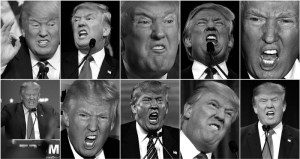
donald trump said it …


  1. 3.5 Million voted illegally, election 2016
  2. President Obama bugged or wiretapped the trump hotel
  3. The Wall will be built and paid for by Mexico 100percent
  4. The Central Park Five are guilty though the DNA test showed they were NOT
  5. Obama may not be an American … fact :Obama is an American by in Hawaii; trump tried to delegitimize Barack Obama
  6. March 29: Trump alleged that when Michelle Fields “found out that there was a security camera, and that they had her on tape, all of a sudden that story changed.”
  7. “122 vicious prisoners, released by the Obama Administration from Gitmo, have returned to the battlefield.”  fact:Only 9 returned to the battle field out of 161
  8. “According to data provided by the Department of Justice, the vast majority of individuals convicted of terrorism and terrorism-related offenses since 9/11 came here from outside of our country.”
  9. “Look at what’s happening last night in Sweden. Sweden, who would believe this? Sweden. They took in large numbers. They’re having problems like they never thought possible.”   – false
  10. trump stated that he could not get enough American workers to staff all the seasonal jobs his resort required during the busy season. When confronted with the fact that he had staffed a wrecking crew with undocumented Polish workers –
  11. “The murder rate in our country is the highest it’s been in 47 years.”   not true
  12. “I have already saved more than $700 million when I got involved in the negotiation on the F-35.” … already saved – Obama wins F-35 engine battle with Congress
  13. Says “109 people out of hundreds of thousands of travelers” were affected by the immigration executive order.  – fact: 90,000 were affected
  14. Terrorism and terrorist attacks in the United States and Europe have “gotten to a point where it’s not even being reported.”  false


resources: politifact dailywire and the internet


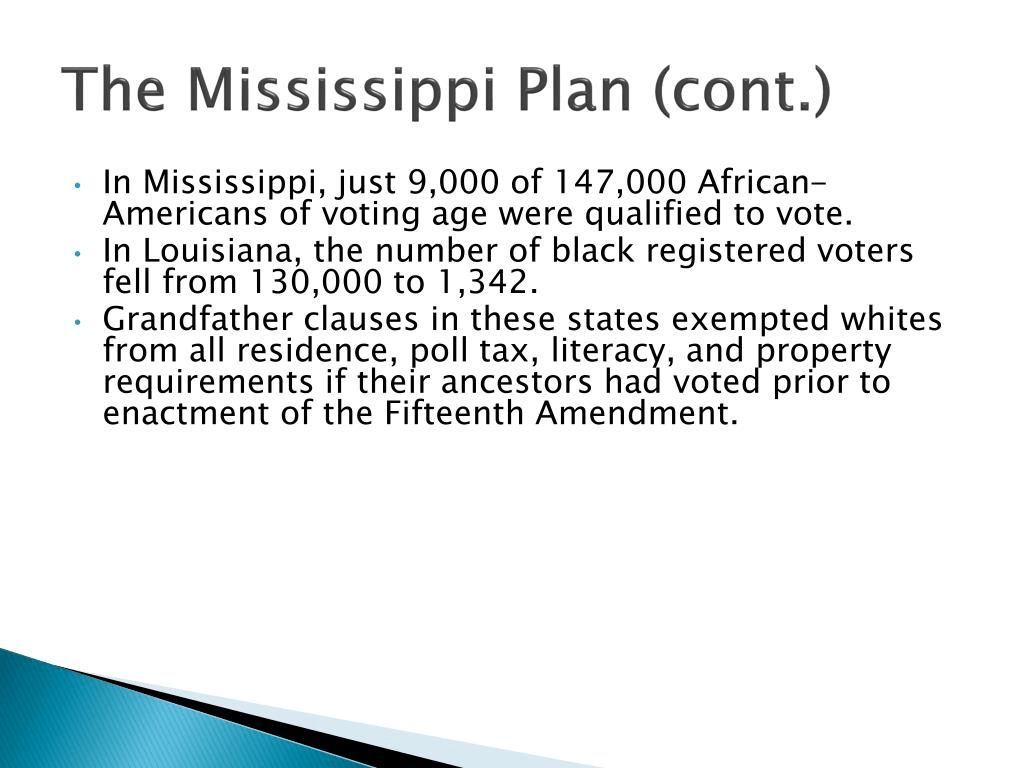
1890 – Mississippi Plan


1890 – African-Americans are disenfranchised. The Mississippi Plan, approved on November 1, used literacy and “understanding” tests to disenfranchise black American citizens. Similar statutes were adopted by South Carolina (1895), Louisiana (1898), North Carolina (1900), Alabama (1901), Virginia (1901), Georgia (1908), and Oklahoma (1910). blackfacts.com

On Nov. 1, 1890, Mississippi adopted a new constitution with a poll tax and arbitrary literacy tests for voting, sections designed to disenfranchise newly-franchised African Americans and some poor whites.

The new constitution was a nail in the coffin for Mississippi Reconstruction and a win for voter suppression. It brought an end to the period of democratic progress that followed the Civil War, when African Americans were the majority of eligible voters in Mississippi. (Learn more about the Reconstruction era.)

In  Five Myths About Reconstruction, James Loewen explains that Mississippi set a precedent for the rest of the South. This was particularly true after the unanimous Supreme Court vote on April 25, 1898, upholding Mississippi’s claim that their constitution was not discriminatory in Williams v. Mississippi.  “Every Southern state instituted literacy tests and poll taxes to effectively remove African Americans from the citizenship they were supposed to have been guaranteed by the 14th Amendment.” This can be seen in the state constitutions with similar voter-suppression statutes adopted by South Carolina (1895), Louisiana (1898), North Carolina (1900), Alabama (1901), Virginia (1901), Georgia (1908), Oklahoma (1910), and more.

Sources: for complete articles, go to URLs below

zinnedproject.org

history.com