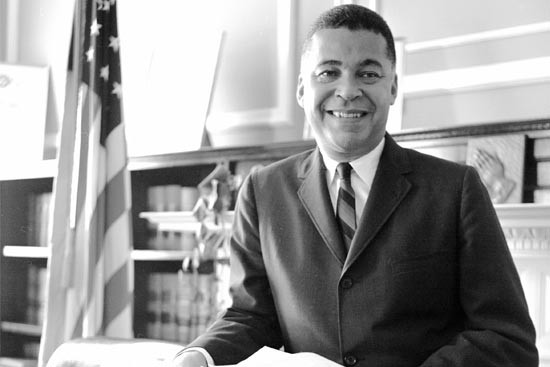
Edward William Brooke III was an American Republican politician. In 1966, he became the first African American popularly elected to the United States Senate. He represented Massachusetts in the Senate from 1967 to 1979.
Brooke was born on October 26, 1919 and raised in Washington, D.C.. He graduated from the Boston University School of Law after serving in the United States Army during World War II. After serving as chairman of the Finance Commission of Boston, Brooke won election as Massachusetts Attorney General in 1962. In 1966, he defeated Democratic Governor Endicott Peabody in a landslide to win election to the Senate.
In the Senate, Brooke aligned with the liberal faction of Republicans. He co-wrote the Civil Rights Act of 1968, which prohibits housing discrimination. Brooke became a prominent critic of President Richard Nixon and was the first Senate Republican to call for Nixon’s resignation in light of the Watergate scandal.
Founded in 1965, the Charles H. Wright Museum of African American History has for over half a century been a leading institution dedicated to the African American experience. Our mission is to open minds and change lives through the exploration and celebration of African American history and culture. Our vision is of a world in which the adversity and achievement of African American history inspire everyone toward greater understanding, acceptance and unity!
The Wright Museum houses over 35,000 artifacts and archival materials and is home to the Blanche Coggin Underground Railroad Collection, Harriet Tubman Museum Collection, Coleman A. Young Collection and the Sheffield Collection, a repository of documents of the labor movement in Detroit. The museum also features: • And Still We Rise: Our Journey Through African American History and Culture, the museum’s 22,000 square foot, interactive core exhibit, which is the largest single exhibition on African American history in existence • The Ford Freedom Rotunda and its 95-foot wide by 65-foot high glass dome; this architectural wonder is more than twice the width of the State Capitol dome and just one foot shy of the width of the U.S. Capitol dome • Ring of Genealogy, a 37-foot terrazzo tile creation by artist Hubert Massey surrounded by bronze nameplates of prominent African Americans in history • Inspiring Minds: African Americans in Science and Technology, a permanent exhibition focused on S.T.E.M. (science, technology, engineering, and mathematics) concepts for children • The Louise Lovett Wright Library and Robert L. Hurst Research Center • The General Motors Theater, a 317-seat facility for live performances, film, presentations and more • Over 300 public events annually including concert performances, theatrical productions, film screenings, lectures, and family and children’s programming. The museum also serves as a facility for countless private functions including weddings, anniversaries, corporate meetings and conferences, memorial services, and community events. All told, The Wright serves over half a million people annually through its exhibitions, programs, and events such as African World Festival.
History
“My legacy was my job. Everything I did was what I was supposed to do. I worked with untold numbers of mothers to deliver 7,000 babies in Detroit, partnered with Margaret Burroughs, founder of the DuSable Museum of African American History in Chicago, to form the African American Museums Association… I was committed to what I defined as ‘one of the most important tasks of our times,’ ensuring that generations, especially young African Americans, are made aware of and take pride in the history of their forbears and their remarkable struggle for freedom. An idea came to me that African Americans needed a museum to collect and preserve our history and culture. And, with the help of many minds and hands, that idea came to fruition.” ~ Dr. Charles H. Wright
Dr. Charles Wright, an obstetrician and gynecologist, envisioned an institution to preserve Black history after visiting a memorial to Danish World War II heroes in Denmark. As a result of this visit, he was convinced that African Americans needed a similar resource center to document, preserve and educate the public on their history, life and culture. On March 10, 1965, Dr. Wright, in partnership with a racially integrated group of 33 community members, established Detroit’s first International Afro-American Museum. The Museum, known by the acronym I AM, opened on January 30, 1966 at 1549 West Grand Boulevard with dozens of exhibits showcasing such items as African masks from Nigeria and Ghana and the inventions of Elijah McCoy. Also in 1966, the I AM traveling museum, housed in a converted mobile home, began touring the state and spreading information about the contributions of African Americans.
In the fall of 1978, the City of Detroit agreed to lease the Museum a plot of land between John R and Brush Streets to build a facility five times larger than its predecessor. In order to raise funds, Detroit Public School students participated in a “Buy a Brick” campaign, raising $80,000 for the new facility. Following the students’ initiative, a group of adults started the Million Dollar Club in which each member pledged at least $1,000. This major fundraiser earned $300,000. In 1985, the Afro-American Museum and the City of Detroit formed a partnership to build a new facility in the city’s University Cultural Center, securing the funding to complete the $3.5 million facility. The name of the International Afro-American Museum was changed to the Museum of African American History and ground was broken for a new facility on May 21, 1985. Two years later, on May 8, 1987, the doors of the Museum of African American History were reopened to the public at 301 Frederick Douglass. The new 28,000-square-foot structure accommodated a range of offerings. Featuring a series of exhibits, lectures, concerts, cultural celebrations, festivals and programs designed especially for children, it preserved the past and strengthened the future.
Once again the museum outgrew its facility and grander ideas for a new museum took shape. In 1992, Detroit voters authorized the City of Detroit to sell construction bonds to finance a larger building and ground was broken for the third generation of the Museum in August of 1993. On April 12, 1997, a 125,000 square-foot, state-of-the-art facility opened, making it the largest African American historical museum in the world. On March 30, 1998, the museum was renamed the Charles H. Wright Museum of African American History in honor of its founder. After a half century of service and with generous support from individuals, foundations, corporations, and government sources, The Wright Museum continues to be a cultural icon in the city of Detroit and throughout the world.
smithsonian.com September 8, 2016 | Updated: December 29, 2016
As America stood on the brink of a Second World War, the push for aeronautical advancement grew ever greater, spurring an insatiable demand for mathematicians. Women were the solution. Ushered into the Langley Memorial Aeronautical Laboratory in 1935 to shoulder the burden of number crunching, they acted as human computers, freeing the engineers of hand calculations in the decades before the digital age. Sharp and successful, the female population at Langley skyrocketed.
Many of these “computers” are finally getting their due, but conspicuously missing from this story of female achievement are the efforts contributed by courageous, African-American women. Called the West Computers, after the area to which they were relegated, they helped blaze a trail for mathematicians and engineers of all races and genders to follow.
“These women were both ordinary and they were extraordinary,” says Margot Lee Shetterly. Her new book Hidden Figures shines light on the inner details of these women’s lives and accomplishments. The book’s film adaptation, starring Octavia Spencer and Taraji P. Henson, is new open in theaters
“We’ve had astronauts, we’ve had engineers—John Glenn, Gene Kranz, Chris Kraft,” she says. “Those guys have all told their stories.” Now it’s the women’s turn.
Growing up in Hampton, Virginia, in the 1970s, Shetterly lived just miles away from Langley. Built in 1917, this research complex was the headquarters for the National Advisory Committee for Aeronautics (NACA) which was intended to turn the floundering flying gadgets of the day into war machines. The agency was dissolved in 1958, to be replaced by the National Aeronautics and Space Agency (NASA) as the space race gained speed.
The West Computers were at the heart of the center’s advancements. They worked through equations that described every function of the plane, running the numbers often with no sense of the greater mission of the project. They contributed to the ever-changing design of a menagerie of wartime flying machines, making them faster, safer, more aerodynamic. Eventually their stellar work allowed some to leave the computing pool for specific projects—Christine Darden worked to advance supersonic flight, Katherine Johnson calculated the trajectories for the Mercury and Apollo missions. NASA dissolved the remaining few human computers in the 1970s as the technological advances made their roles obsolete.
The first black computers didn’t set foot at Langley until the 1940s. Though the pressing needs of war were great, racial discrimination remained strong and few jobs existed for African-Americans, regardless of gender. That was until 1941 when A. Philip Randolph, pioneering civil rights activist, proposed a march on Washington, D.C., to draw attention to the continued injustices of racial discrimination. With the threat of 100,000 people swarming to the Capitol, President Franklin D. Roosevelt issued Executive Order 8802, preventing racial discrimination in hiring for federal and war-related work. This order also cleared the way for the black computers, slide rule in hand, to make their way into NACA history.
Katherine Johnson at her desk at Langley with a “celestial training device.” (NASA)
Exactly how many women computers worked at NACA (and later NASA) over the years is still unknown. One 1992 study estimated the total topped several hundred but other estimates, including Shetterly’s own intuition, says that number is in the thousands.
As a child, Shetterly knew these brilliant mathematicians as her girl scout troop leaders, Sunday school teachers, next-door neighbors and as parents of schoolmates. Her father worked at Langley as well, starting in 1964 as an engineering intern and becoming a well-respected climate scientist. “They were just part of a vibrant community of people, and everybody had their jobs,” she says. “And those were their jobs. Working at NASA Langley.”
Surrounded by the West Computers and other academics, it took decades for Shetterly to realize the magnitude of the women’s work. “It wasn’t until my husband, who was not from Hampton, was listening to my dad talk about some of these women and the things that they have done that I realized,” she says. “That way is not necessarily the norm”
The spark of curiosity ignited, Shetterly began researching these women. Unlike the male engineers, few of these women were acknowledged in academic publications or for their work on various projects. Even more problematic was that the careers of the West Computers were often more fleeting than those of the white men. Social customs of the era dictated that as soon as marriage or children arrived, these women would retire to become full-time homemakers, Shetterly explains. Many only remained at Langley for a few years.
But the more Shetterly dug, the more computers she discovered. “My investigation became more like an obsession,” she writes in the book. “I would walk any trail if it meant finding a trace of one of the computers at its end.”
She scoured telephone directories, local newspapers, employee newsletters and the NASA archives to add to her growing list of names. She also chased down stray memos, obituaries, wedding announcements and more for any hint at the richness of these women’s lives. “It was a lot of connecting the dots,” she says.
“I get emails all the time from people whose grandmothers or mothers worked there,” she says. “Just today I got an email from a woman asking if I was still searching for computers. [She] had worked at Langley from July 1951 through August 1957.”
Langley was not just a laboratory of science and engineering; “in many ways, it was a racial relations laboratory, a gender relations laboratory,” Shetterly says. The researchers came from across America. Many came from parts of the country sympathetic to the nascent Civil Rights Movement, says Shetterly, and backed the progressive ideals of expanded freedoms for black citizens and women.
The phenomenal true story of the black female mathematicians at NASA whose calculations helped fuel some of America’s greatest achievements in space.
But life at Langley wasn’t just the churn of greased gears. Not only were the women rarely provided the same opportunities and titles as their male counterparts, but the West Computers lived with constant reminders that they were second-class citizens. In the book, Shetterly highlights one particular incident involving an offensive sign in the dining room bearing the designation: Colored Computers.
One particularly brazen computer, Miriam Mann, took responding to the affront on as a her own personal vendetta. She plucked the sign from the table, tucking it away in her purse. When the sign returned, she removed it again. “That was incredible courage,” says Shetterly. “This was still a time when people are lynched, when you could be pulled off the bus for sitting in the wrong seat. [There were] very, very high stakes.”
But eventually Mann won. The sign disappeared.
The women fought many more of these seemingly small battles, against separate bathrooms and restricted access to meetings. It was these small battles and daily minutiae that Shetterly strove to capture in her book. And outside of the workplace, they faced many more problems, including segregated busses and dilapidated schools. Many struggled to find housing in Hampton. The white computers could live in Anne Wythe Hall, a dormitory that helped alleviate the shortage of housing, but the black computers were left to their own devices.
“History is the sum total of what all of us do on a daily basis,” says Shetterly. “We think of capital “H” history as being these huge figures—George Washington, Alexander Hamilton and Martin Luther King.” Even so, she explains, “you go to bed at night, you wake up the next morning, and then yesterday is history. These small actions in some ways are more important or certainly as important as the individual actions by these towering figures.”
The book and movie don’t mark the end of Shetterly’s work She continues to collect these names, hoping to eventually make the list available online. She hopes to find the many names that have been sifted out over the years and document their respective life’s work.
The few West Computers whose names have been remembered, have become nearly mythical figures—a side-effect of the few African-American names celebrated in mainstream history, Shetterly argues. She hopes her work pays tribute to these women by bringing details of their life’s work to light. “Not just mythology but the actual facts,” she says. “Because the facts are truly spectacular.”
The National Museum of African American History and Culture (NMAAHC) is proud to present the next page from Our American Story, an online series for Museum supporters. Despite the variety of uncertain news in the world today, one story continues to speak of powerful strength and uplift: the story of the African American experience. This legacy speaks of everyday heroism, profound resiliency, and the binding power of the community. We offer these stories to honor and celebrate an immensely rich history and culture—and to inspire and sustain our community as we move toward the future, together.
Mary Eliza Church Terrell was a renowned educator and speaker who campaigned fearlessly for women’s suffrage and the social equality of African Americans.
Circular desk calendar owned by Mary Church Terrell
Born in Memphis, Tennessee, in 1863, the year of the Emancipation Proclamation, Mary Eliza Church was part of a changing America. She was the daughter of affluent African American parents, both of whom were previously enslaved. Her mother, Louisa Ayers Church, owned a hair salon. Her father, Robert Reed Church, was a successful businessman who would later become one of the South’s first African American millionaires.
Terrell’s parents sent her to Ohio to attend preparatory school at Antioch and later Oberlin College. There she earned her bachelor’s and master’s degrees. At a time when women were not expected to achieve academically, Terrell excelled—and committed herself to pass on what she learned. After teaching for two years at Wilberforce College, she moved to Washington, D.C. to teach high school, where she met lawyer and future judge Robert Terrell. They married in 1891.
“Most girls run away from home to marry; I ran away to teach.”
— Mary Church Terrell
Although Mary Church Terrell’s life focused on education and progress, tragedy would spur her into activism.
In 1892, her childhood friend Thomas Moss was lynched in Memphis. Moss was the owner of People’s Grocery, a successful wholesale grocery outside the city. He, like Terrell, represented progress, which many whites at the time felt was a direct threat to their own commerce and livelihood. The gunshot-riddled bodies of Moss and two of his employees were left on a railroad track just north of Memphis.
Terrell, along with journalist Ida B. Wells, organized anti-lynching campaigns to mobilize advocates and generate awareness. Later she would protest President Theodore Roosevelt’s 1906 discharge of 167 African American soldiers for unfounded conspiracy claims in Brownsville, Texas. She wrote columns and essays espousing the importance of dignity and respect for the soldiers and demanded a fair trial. Her efforts were to no avail at the time, although an Army investigation in 1972 led to the honorable discharges of all the soldiers, only two of whom were still alive.
Pin for the National Association of Colored Women’s Clubs
Terrell held firm to the idea of racial uplift—the belief that blacks would help end racial discrimination by advancing themselves through education, work, and activism. Her words “lifting as we climb” became the motto of the National Association of Colored Women (NACW), the group she co-founded in 1896.
She also would go on to serve as one of the charter members of the NAACP, founded in 1909.
Understanding the intersectionality of race and gender discrimination, she lectured, penned essays, and spoke out on behalf of the women’s suffrage movement—even picketing the Woodrow Wilson White House with members of Howard University’s Delta Sigma Theta sorority.
Terrell was an active member of the National Association of Women’s Suffrage Act (NAWSA), where she worked alongside the organization’s founder, Susan B. Anthony. Terrell was invited to deliver two speeches on the challenges faced by women, and particularly women of color in America, at the International Congress of Women in Berlin in 1904. She was the only woman of African descent invited to speak at the conference. She delivered her speeches in German, French, and English, receiving a standing ovation from the audience.
Terrell’s belief that education and activism would provide a path to equality was demonstrated by her devotion to both pursuits. A self-described “dignified agitator,” Terrell would fight, protest, and work on behalf of social progress for women of color for more than half a century.
While in her 80s, Mary Church Terrell joined efforts to end segregation in restaurants in Washington, D.C., which laid the groundwork for the 1953 court ruling that segregation in D.C. restaurants was unconstitutional. In 1954, two months after the landmark Brown v. Board of Education ruling, she passed away at her home in Highland Beach, Maryland, a Chesapeake Bay resort community for affluent African Americans founded by one of Frederick Douglass’s sons.
From her tireless efforts to pass the Nineteenth amendment 100 years ago to serving as the first black woman on the Washington, D.C. Board of Education, Terrell’s work continues to echo throughout the world today. Her commitment to change opened countless doors of opportunity for those who came after her.
Her legacy endures in the hearts and minds of those continuing the fight for a world with more educated and empowered black women. From Civil Rights leaders and feminists of the 1960s to contemporary activists and trailblazers, many have and will continue to invoke Terrell’s fighting—and dignified—spirit.
The Museum helps connect individuals with a deeper understanding of the African American story by sharing the lives of inspiring pioneers like Mary Church Terrell, who demonstrate the impact one person can make on the world. Please help the Museum continue this important work and consider joining the Museum or making a donation today.



 Be a Seed for Change
You must be logged in to post a comment.