image source: the internet

The U.S. Congress passes an act to “prohibit the importation of slaves into any port or place within the jurisdiction of the United States…from any foreign kingdom, place, or country.”
The first shipload of African captives to the British colonies in North America arrived at Jamestown, Virginia, in August 1619, but for most of the 17th century, European indentured servants were far more numerous in the North American British colonies than were enslaved Africans. However, after 1680, the flow of indentured servants sharply declined, leading to an explosion in the African slave trade. By the middle of the 18th century, slavery could be found in all 13 colonies and was at the core of the Southern colonies’ agricultural economy. By the time of the American Revolution, the English importers alone had brought some three million captive Africans to the Americas.
WATCH: The Middle Passage on HISTORY Vault
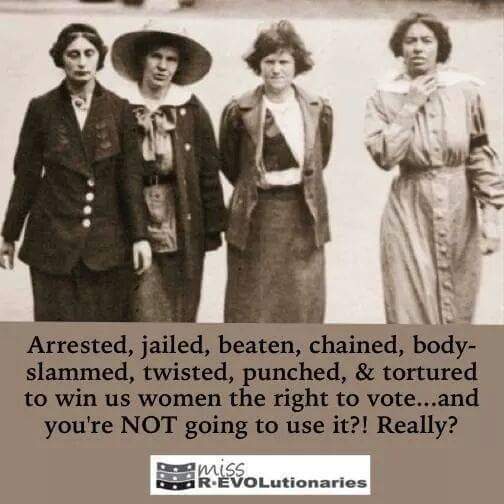
Dorothy Day was described by her fellow suffragists as a “frail girl.” Yet on the night of November 14, 1917, prison guards at the Occoquan Workhouse, did not hold back after she and 32 other women had been arrested several days earlier for picketing outside the White House.
“The two men handling her were twisting her arms above her head. Then suddenly they lifted her up and banged her down over the arm of an iron bench—twice,” recalled 73-year-old Mary Nolan, the oldest of the prisoners, in an account published by Doris Stevens.
As members of the National Woman’s Party, the women and their fellow “Silent Sentinels” had been peacefully demonstrating in the nation’s capital for months, holding banners and placards calling on President Woodrow Wilson to back a federal amendment that would give all U.S. women the right to vote.
Now, these 33 women would endure the most harrowing night in the long history of the suffrage movement.
“Never was there a sentence like ours for an offense such as ours, even in England,” Nolan wrote.

Suffragist Alice Paul, leader of the National Woman’s Party.
Bettmann Archive/Getty Images
In 1913, frustrated by the lack of progress toward a federal women’s suffrage amendment, some younger members of the National American Woman Suffrage Association (NAWSA) decided to step up their efforts. Led by Alice Paul and Lucy Burns, they organized a suffrage parade held in Washington, D.C. on March 3, the day before Wilson’s inauguration as president. Police stood by when spectators attacked the demonstrators as they made their way down Pennsylvania Avenue, and army cavalry troops eventually had to be dispatched to restore order. Some 100 women were hospitalized with injuries.

Suffragists on picket line in front of the White House, circa 1917. One banner reads: “Mr. President How Long Must Women Wait For Liberty”.
Library of Congress
By 1916, nine U.S. states had given women the right to vote. Though he supported suffrage on a state level, President Wilson opposed the federal amendment, and Paul and the NWP decided to aim their protests directly at him. In January 1917, right before Wilson’s second term began, women began gathering outside the White House every day, regardless of the weather. They wore distinctive purple, white and gold sashes and held signs with slogans like “Mr. President, How Long Must We Wait for Liberty?”
“The picketing strategy really unfolds over quite a long time,” says Susan Ware, a feminist biographer and author of the forthcoming book Why They Marched: Untold Stories of the Women Who Fought for the Right to Vote. “By the time you get to that November night, the Silent Sentinels have been picketing outside the White House for more than 10 months.”
At first, Wilson tolerated the women’s protests, smiling at them as he passed and even inviting them in for coffee (they turned him down). But things began to change after the U.S. entered World War I in April 1917, and the NWP chose to continue picketing the White House, even as the mainstream suffrage movement, led by NAWSA’s Carrie Chapman Catt, threw its support behind the war effort.

National Woman’s Party members being arrested as they picket with banners before the White House East Gate, in August 1917.
Library of Congress
Amid the wartime furor, many people began viewing the Silent Sentinels as unforgivably unpatriotic. Onlookers sometimes attacked the women and ripped their signs from their hands, while Wilson himself wrote to his daughter in June that the suffragists “seem bent on making their cause as obnoxious as possible.”
That same month, police began arresting the suffragists for obstructing traffic. At first, the women were released quickly, and without penalty, but soon the courts began handing out prison time. But the women kept coming back.
“One of the things that we need to give them credit for is that they knew, after June, that when they were on the picket line they could be arrested, and they could go to jail,” Ware points out. “This was something that respectable white women didn’t usually do.”
Tensions were running much higher by August, when the Sentinels rolled out a new banner accusing “Kaiser Wilson” of autocracy, followed by three days of attacks by an angry mob and police and the sentencing of six women to 60-day prison terms. When Paul, who had stayed off the picket line for much of that summer, returned in October, she was immediately arrested and given the longest sentence yet: seven months in Occoquan.
“They’re in this kind of cat-and-mouse game with the Wilson administration and with the police,” says Ware. “The arrests keep going on, the prison terms keep getting longer, the stakes keep getting upped.”

Suffragist Lucy Burns in a cell at the Occoquan Workhouse after women’s rights protests in November 1917.
Library of Congress
Faced with brutal treatment by guards and horrendous living conditions at Occoquan, including worm-ridden food and filthy water and bedding, Paul and others began demanding to be treated as political prisoners. After going on a hunger strike, Paul was repeatedly force-fed and transferred in early November to the District Jail’s psychiatric ward.
The 33 women brought to Occoquan on the night of November 14 also demanded to be treated as political prisoners. Instead, prison superintendent William H. Whittaker called on his guards to teach the women a lesson. Bursting into the room where the women were waiting to be booked, the guards dragged them down the hall and threw them into dark, filthy cells.
Burns had her hands shackled to the top of a cell, forcing her to stand all night; the guards also threatened her with a straitjacket and a buckle gag. Day (the future founder of the Catholic Worker Movement) was slammed her down on the arm of an iron bench twice. Dora Lewis lost consciousness after her head was smashed into an iron bed; Alice Cosu, seeing Lewis’ assault, suffered a heart attack, and didn’t get medical attention until the following morning.
Nolan’s account of the Night of Terror, as well as pages from a diary Burns kept while at Occoquan, was later published by Doris Stevens in Jailed for Freedom, her book about the NWP.

Suffragist Mary Winsor holding a banner that reads: “To Ask Freedom for Women is Not a Crime. Suffrage Prisoners Should Not be Treated as Criminals,” circa November 1917.
In the aftermath of the attack, many of the women began hunger strikes, as Whittaker denied them counsel and summoned U.S. Marines to guard the workhouse. But news of their mistreatment reached the suffragists outside Occoquan, as well as well-placed allies like Dudley Field Malone, an attorney who resigned his post in the Wilson administration in solidarity with the suffragists (he later married Doris Stevens).
In late November, under increasing public pressure, federal authorities agreed to release Paul, Burns and the other suffrage prisoners.
In early 1918, the D.C. Court of Appeals ruled that women had been illegally arrested, convicted and imprisoned. Within months, President Wilson had begun publicly calling on Congress to act on the federal suffrage amendment, a change of heart that was probably due not only to the NWP’s protests but also NAWSA’s more traditional lobbying strategies.
Meanwhile, the Silent Sentinels continued their protests. In early 1919, the women started lighting what they called “Watchfires of Freedom” outside public buildings, setting fire to Wilson’s speeches mentioning freedom and democracy. More women were arrested, more went on hunger strikes and were force-fed, though there were no more incidents as dramatic as the Night of Terror.
Finally, in June 1919, the U.S. Senate followed the House’s lead in passing the 19th Amendment. Over the next year, both the NWP and NAWSA worked tirelessly to win ratification in the necessary 36 (out of 48 states). On August 18, 1920, after a down-to-the-wire fight in Nashville, Tennessee became the 36th state to ratify the 19th Amendment.
Though representatives of the NWP and NAWSA were both on hand in Nashville to celebrate the long-awaited victory, the divisions in the women’s rights movement would continue long after the 19th Amendment’s passage. Still, after more than a century, the Night of Terror stands as a potent reminder of female solidarity and resistance, and just how much some women were willing to sacrifice to win the right to vote.
“They’re determined,” Ware says, recalling the Silent Sentinels on that notorious night in November 1917. “It’s pretty amazing what they were willing to go through, and what they had to endure.”
FACT CHECK: We strive for accuracy and fairness. But if you see something that doesn’t look right, click hereto contact us!
Twice a week we compile our most fascinating features and deliver them straight to you.

RELATED CONTENT



1807 – The U.S. Congress passed an act to “prohibit the importation of slaves into any port or place within the jurisdiction of the United States… from any foreign kingdom, place, or country.”
1836 – Texas declared its independence from Mexico and an ad interim government was formed.
1861 – The U.S. Congress created the Territory of Nevada.
1866 – Excelsior Needle Company began making sewing machine needles.
1877 – In the U.S., Rutherford B. Hayes was declared the winner of the 1876 presidential election by the U.S. Congress. Samuel J. Tilden, however, had won the popular vote on November 7, 1876.
1887 – The American Trotting Association was organized in Detroit, MI.
1897 – U.S. President Cleveland vetoed legislation that would have required a literacy test for immigrants entering the country.
1899 – Mount Rainier National Park in Washington was established by the U.S. Congress.
1899 – U.S. President McKinley signed a measure that created the rank of Admiral for the U.S. Navy. The first admiral was George Dewey.
1900 – The U.S. Congress voted to give $2 million in aid to Puerto Rico.
1901 – The first telegraph company in Hawaii opened.
1901 – The U.S. Congress passed the Platt amendment as a condition for withdrawal of U.S. troops.
1903 – The Martha Washington Hotel opened for business in New York City. The hotel had 416 rooms and was the first hotel exclusively for women.
1906 – A tornado in Mississippi killed 33 and did $5 million in damage.
1907 – In Hamburg, Germany, dock workers went on strike after the end of the night shift. British strike breakers were brought in. The issue was settled on April 22, 1907.
1908 – In New York, the Committee of the Russian Republican Administration was founded.
1908 – In Paris, Gabriel Lippmann introduced three-dimensional color photography at the Academy of Sciences.
1911 – Maurice Maeterlinck’s “The Bluebird” opened in Paris.
1917 – The Russian Revolution began with Czar Nicholas II abdicating.
1917 – Citizens of Puerto Rico were granted U.S. citizenship with the enactment of the Jones Act.
1925 – State and federal highway officials developed a nationwide route-numbering system and adopted the familiar U.S. shield-shaped, numbered marker.
1929 – The U.S. Court of Customs & Patent Appeals was created by the U.S. Congress.
1933 – The motion picture King Kong had its world premiere in New York.
1939 – The Massachusetts legislature voted to ratify the Bill of Rights to the U.S. Constitution. These first ten amendments had gone into effect 147 years before.
1946 – Ho Chi Minh was elected President of Vietnam.
1949 – The B-50 Superfortress Lucky Lady II landed in Fort Worth, TX. The American plane had completed the first non-stop around-the-world flight.
1962 – Wilt ‘The Stilt’ Chamberlain scored 100 points against the New York Knicks 169-147. Chamberlain broke several NBA records in the game.
1969 – In Toulouse, France, the supersonic transport Concorde made its first test flight.
1974 – Postage stamps jumped from 8 to 10 cents for first-class mail.
1983 – The U.S.S.R. performed an underground nuclear test.
1984 – The first McDonald’s franchise was closed. A new location was opened across the street from the old location in Des Plaines, IL.
1985 – The U.S. government approved a screening test for AIDS that detected antibodies to the virus that allowed possibly contaminated blood to be kept out of the U.S.’s blood supply.
1986 – Corazon Aquino was sworn into office as president of the Philippines. Her first public declaration was to restore the civil rights of the citizens of her country.
1987 – The U.S. government reported that the median price for a new home had gone over $100,000 for the first time.
1989 – Representatives from the 12 European Community nations all agreed to ban all production of CFCs (chlorofluorocarbons) by the end of the 20th century.
1995 – Russian anti-corruption journalist Vladislav Listyev was killed by a gunman in Moscow.
1995 – Nick Leeson was arrested for his role in the collapse of Britain’s Barings Bank.
1998 – The U.N. Security Council endorsed U.N. chief Kofi Annan’s deal to open Iraq’s presidential palaces to arms inspectors.
1998 – Images from the American spacecraft Galileo indicated that the Jupiter moon Europa has a liquid ocean and a source of interior heat.
2000 – In Great Britain, Chile’s former President Augusto Pinochet Ugarte was freed from house arrest and allowed to return to Chile. Britain’s Home Secretary Jack Straw had concluded that Pinochet was mentally and physically unable to stand trial. Belgium, France, Spain and Switzerland had sought the former Chilean leader on human-rights violations.
2003 – Over the Sea of Japan, there was a confrontation between four armed North Korean fighter jets and a U.S. RC-135S Cobra Ball. No shots were fired in the encounter in international airspace about 150 miles off North Korea’s coast. The U.S. Air Force announced that it would resume reconnaissance flights on March 12.
2004 – NASA announced that the Mars rover Opportunity had discovered evidence that water had existed on Mars in the past.
2011 – Steve Jobs unveiled Apple’s iPad 2.
2016 – The U.N. Security Council unanimously approved sanctions on North Korea that included mandatory inspections of cargo leaving and entering North Korea, a ban on all sales and transfers of small arms and light weapons and expulsion of diplomats that engage in “illicit activities.” The sanctions were in reaction to the latest nuclear test and rocket launch in defiance of a ban on all nuclear-related activity.
2016 – Astronaut Scott Kelly returned to Earth after 340 days in space aboard the International Space Station.
on-this-day.com
On March 1, 1781, the Articles of Confederation are finally ratified. The Articles were signed by Congress and sent to the individual states for ratification on November 15, 1777, after 16 months of debate. Bickering over land claims between Virginia and Maryland delayed final …read more
The Articles of Confederation are ratified after nearly four years
HISTORY
https://www.history.com/this-day-in-history/articles-of-confederation-are-ratified
March 1, 2023
A&E Television Networks
March 1, 2021
November 13, 2009
so, i posted this because it is also a reminder for our Youth…. we are at a crossroads and going back to the bad old days is NOT an option.
Nativegrl77


 Be a Seed for Change
You must be logged in to post a comment.