
Daily Archives: 08/30/2025

Your Rights as a Federal Employee Enforced by the U.S. Office of Special Counsel (OSC)

Prohibited Personnel Practices
Prohibited personnel practices (PPPs) are employment-related activities that are banned in the federal workforce because they violate the merit
system through some form of employment discrimination, whistleblower retaliation, improper hiring practices, or failure to adhere to laws,
rules, or regulations that directly concern the merit system principles. Under 5 U.S.C. § 2302(b)(1)-(b)(14) a federal employee authorized to
take, direct others to take, recommend or approve any personnel action may not:
Discriminate (including discrimination based on
marital status and political affiliation).
Ex: Supervisor Joe refuses to promote Employee Jane
because Jane is a registered Republican; or his refusal is
because she is single. NOTE: OSC does not generally
investigate Title VII discrimination. 5 U.S.C. §
2302(b)(1)
Solicit or consider employment recommendations
based on factors other than personal knowledge or
records of job-related abilities or characteristics.
Ex: Selecting Official Joe hires Applicant Jack based on
Senator Smith’s recommendation that Jack be hired
because Jack is a constituent. 5 U.S.C. § 2302(b)(2)
Coerce the political activity of any person or take
action against any employee as reprisal for refusing
to engage in political activity. Ex: Supervisor Jane
takes away significant job duties of Employee Jack
because Jack will not make a contribution to Jane’s
favorite candidate. 5 U.S.C. § 2302(b)(3)
Deceive or willfully obstruct any person from
competing for employment. Ex: Supervisor Joe,
located in Headquarters, orders that no vacancy
announcements be posted in the field office where
Employee Jack works because he does not want Jack to
get hired for a job in Headquarters. 5 U.S.C. §
2302(b)(4)
Influence any person to withdraw from competition
for a position to improve or injure the employment
prospects of any other person. Ex: Supervisor Jane, in
an effort to hire Employee Joe, tells Employee Jack that
he should not apply for a position because he is not
qualified and will never be selected. Employee Jack is
qualified. 5 U.S.C. § 2302(b)(5)
Give an unauthorized preference to a person to
improve or injure the employment prospects of any
particular employee or applicant. Ex: Supervisor Jane
specifies that Spanish-speaking skills are necessary for
a vacant position, for the purpose of selecting
Employee Jack, who speaks fluent Spanish. The
position, however, does not require Spanish-speaking
skills. 5 U.S.C. § 2302(b)(6)
Engage in nepotism: Ex: Second-level Supervisor Jane
asks First-level Supervisor Joe to hire or promote her
son. Supervisor Denise serves as the first-line
supervisor for her uncle Anthony. 5 U.S.C. § 2302(b)(7)
Take, fail to take, or threaten (to take or fail to take)
a personnel action against an employee for making
protected disclosures. Ex: Supervisor Joe directs the
geographic reassignment of Employee Jill after Jill
reported a gross waste of funds to the Office of Internal
Affairs. 5 U.S.C. § 2302(b)(8)
Take, fail to take, or threaten (to take or fail to take)
a personnel action against an employee for engaging
in protected activity. Ex: Supervisor Jack terminates
Employee John after learning that John reported a gross
waste of funds to the Office of Inspector General; or for
refusing to obey an order that would require John to
violate agency regulations. 5 U.S.C. § 2302(b)(9)
Discriminate against an employee on the basis of
conduct, which does not adversely affect the
performance of the employee. Ex: Jack’s employment
is terminated because he attended a “Gay Pride” march;
or he attended a “Pro-Life” event; or he attended an
animal rights rally; or he attended a gun-owners’ rights
meeting. 5 U.S.C. § 2302(b)(10)
Take or fail to take a personnel action, if such action
would violate a veterans’ preference requirement.
Ex: Supervisor Jane hired Employee Jack, without
considering Veteran Jennifer, who was included on the
list of eligible employees. NOTE: OSC’s jurisdiction is
limited to disciplinary actions only; the Dept. of Labor
has jurisdiction to investigate for corrective actions.
5 U.S.C. § 2302(b)(11)
Take a personnel action against an employee which
violates a law, rule, or regulation which implements
a merit systems principle. Ex: Supervisor Joe
terminates the probationary appointment of Employee
Jack because of Jack’s letter to the editor criticizing
affirmative action – a valid exercise of First amendment
rights, a law implementing a merit system principle.
5 U.S.C. § 2302(b)(12)
Implement or enforce a nondisclosure agreement or
policy lacking notification of whistleblower rights.
Ex: A manager Issues a policy to all employees in his
program that prohibits the employees from discussing
the program in any way and fails to notify employees of
protected channels for making disclosures. 5 U.S.C. §
2302(b)(13)
Access the medical record of an employee or
applicant, as part of, or in furtherance of any of the
above-listed prohibitions. Ex: An employee expresses
interest in an open position to a hiring official, who
wants to hire another applicant. The hiring official
accesses the employee’s medical records provided
under a reasonable accommodation (RA) request and
attempts to influence the employee to withdraw from
competition by telling her that the stress of the new
position will worsen a medical condition noted in her
RA medical records. 5 U.S.C. § 2302(b)(14)
WHAT CAN YOU DO IF YOU BELIEVE THAT A PPP HAS BEEN COMMITTED?
OSC is a federal investigative and prosecutorial agency. Current and former federal employees, including probationary employees, and applicants
for federal employment can submit a complaint electronically to OSC at https://osc.gov. OSC will review the allegations to determine jurisdiction
and investigate allegations of prohibited personnel practices. In complaints where OSC finds a violation, OSC has the authority to seek corrective
and/or disciplinary action and/or file complaints with the Merit Systems Protection Board, where appropriate. 5 U.S.C. §§ 1212, 2302(b)(1)
(b)(14). You can learn more about prohibited personnel practices by watching these short videos.
WHAT CAN YOU DO IF YOU WANT TO REPORT GOVERNMENT WRONGDOING?
Current and former federal employees and applicants can confidentially report information evidencing a violation of any law, rule, or regulation,
gross mismanagement, a gross waste of funds, an abuse of authority, a substantial and specific danger to public health or safety, or censorship
related to scientific integrity or research to OSC. OSC has the authority to require the head of the agency concerned to investigate the matter.
While OSC does not have independent investigative authority in these cases, Congress has given OSC an important oversight role in reviewing
government investigations of potential wrongdoing.
HOW DOES OSC ENFORCE THE HATCH ACT?
The Hatch Act Unit (HAU) enforces compliance with the Hatch Act, which limits certain political activities of federal executive branch
employees. All employees, except for the President and Vice President, are prohibited from: (1) using their official authority or influence to affect
the result of an election; (2) soliciting, accepting, or receiving political contributions from any person; (3) being candidates in partisan elections;
(4) soliciting or discouraging the political activity of persons with business pending before their employing office; and (5) engaging in political
activity while on duty or in the federal workplace. See 5 U.S.C. §§ 7323-7324. HAU investigates complaints to determine whether a Hatch Act
violation has occurred. In cases where HAU concludes that an employee has violated this law, it will either issue a warning letter or seek
disciplinary action by negotiating a settlement or prosecuting the case before the Merit Systems Protection Board. HAU also is responsible for a
nation-wide program that provides federal, state, and local employees, as well as the public at large, with legal advice on the Hatch Act, enabling
individuals to determine their coverage under the Act and whether their contemplated activities are permitted under the Act. To further its
advisory and enforcement role, HAU is very active in OSC’s outreach program and operates a hotline and dedicated email address for individuals
to request and receive timely Hatch Act advice. In addition, HAU launched its own webinar series tailored to various audiences to address
specific Hatch Act topics. You can learn more about the Hatch Act’s prohibitions by watching these short videos.
For more information on filing a complaint or making a disclosure: 202-804-7000, 800-872-9855, or submit a question at info@osc.gov.
Please note that OSC may not provide advice regarding merit of a complaint or whether the allegation meets the statutory definitions.
Updated and detailed information on OSC and its procedures can be found on OSC’s website at https://osc.gov.
For information about training and the 2302c Certification Program please contact OSC’s Outreach Unit via email at certification@osc.gov.
Source: the PDF/Word copied and pased here
Share this:

1645 – American Indians and the Dutch made a peace treaty at New Amsterdam. New Amsterdam later became known as New York.

1965 – Thurgood Marshall was confirmed by the U.S. Senate as a Supreme Court justice. Marshall was the first black justice to sit on the Supreme Court.


August … a month full of historic events
 just another rant …
August~
remember Katrina … remind folks what happened on the Gulf Coast as the people fled, some were forced out into the streets some died in the Katrina disaster trying to get out safely; while others faced excessive force violence and death
August 1, 1838 – Slavery was abolished in Jamaica. It had been introduced by Spanish settlers 300 years earlier in 1509.
August 2, 1776 – In Philadelphia, most of the 55-56 members of the Continental Congress signed the parchment copy of the Declaration of Independence.
August 3
1936 – Jesse Owens won the first of his four Olympic gold medals.
1943 – Gen. George S. Patton verbally abused and slapped a private. Later, Gen. Dwight D. Eisenhower ordered him to apologize for the incident.
1981 – U.S. traffic controllers with PATCO, the Professional Air Traffic Controllers Organization, went on strike. They were fired just as U.S. President Reagan had warned.
1992 – The U.S. Senate voted to restrict and eventually end the testing of nuclear weapons.
2004 – NASA launched the spacecraft Messenger. The 6 1/2 year journey was planned to arrive at the planet Mercury in March 2011. On April 30, 2015, Messenger crashed into the surface of Mercury after sending back more than 270,000 pictures.
August 4, 1962 – Apartheid opponent Nelson Mandela was arrested by security police in South Africa. He was then tried and sentenced to five years in prison. In 1964, he was placed on trial for sabotage, high treason and conspiracy to overthrow the government and was sentenced to life in prison. A worldwide campaign to free him began in the 1980s and resulted in his release on February 11, 1990, at age 71 after 27 years in prison. In 1993, Mandela shared the Nobel Peace Prize with South Africa’s President F.W. de Klerk for their peaceful efforts to bring a nonracial democracy to South Africa. In April 1994, black South Africans voted for the first time in an election that brought Mandela the presidency of South Africa.
August 4, 1964 – Three young civil rights workers, James Chaney, Andrew Goodman and Michael Schwerner, were found murdered and buried in an earthen dam outside Philadelphia, Mississippi. They had disappeared on June 21 after being detained by Neshoba County police on charges of speeding. They were participating in the Mississippi Summer Project organized by the Student Nonviolent Coordinating Committee (SNCC) to increase black voter registration. When their car was found burned on June 23, President Lyndon Johnson ordered the FBI to search for the men.
August 5, 1861 – President Abraham Lincoln signed into law the first Federal income tax, a 3 percent tax on incomes over $800, as an emergency wartime measure during the Civil War. However, the tax was never actually put into effect.
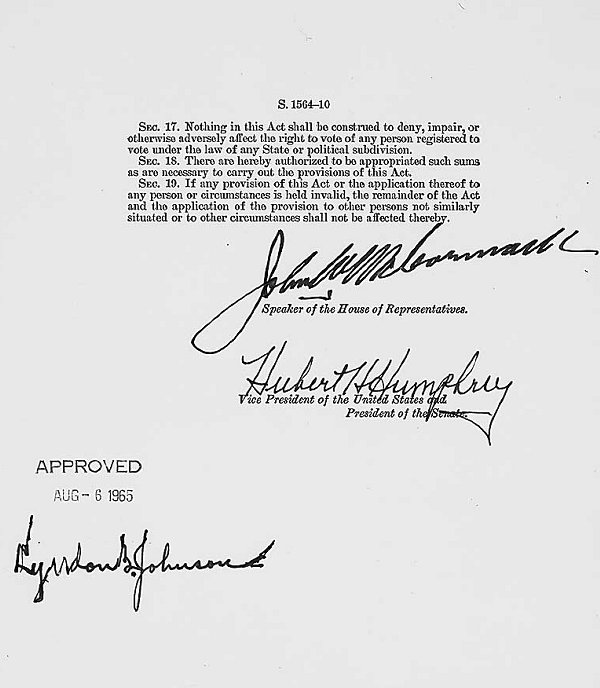
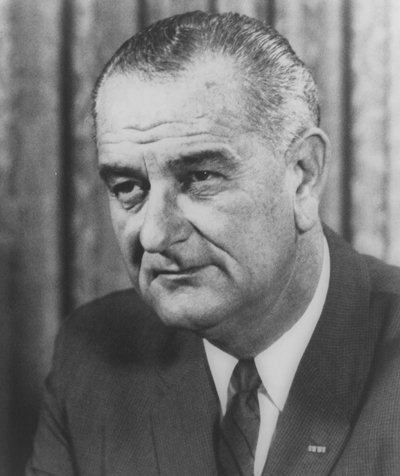
August 6, 1965 – The Voting Rights Act of 1965 was signed into law by President Lyndon B. Johnson. The Act suspended literacy, knowledge and character tests designed to keep African Americans from voting in the South. It also authorized the appointment of Federal voting examiners and barred discriminatory poll taxes. The Act was renewed by Congress in 1975, 1984 and 1991.
August 6-10, 1787 – The Great Debate occurred during the Constitutional Convention. Outcomes included the establishment of a four-year term of office for the President, granting Congress the right to regulate foreign trade and interstate commerce, and the appointment of a committee to prepare a final draft of the Constitution.
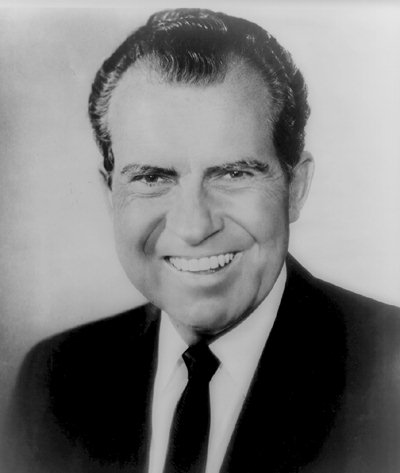
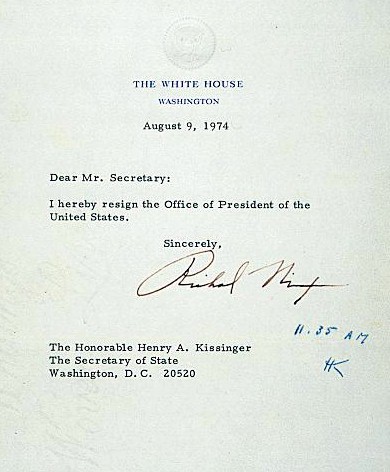
August 9, 1974 – Effective at noon, Richard M. Nixon resigned the presidency as a result of the Watergate scandal. Nixon had appeared on television the night before and announced his decision to the American people. Facing possible impeachment by Congress, he became the only U.S. President ever to resign.
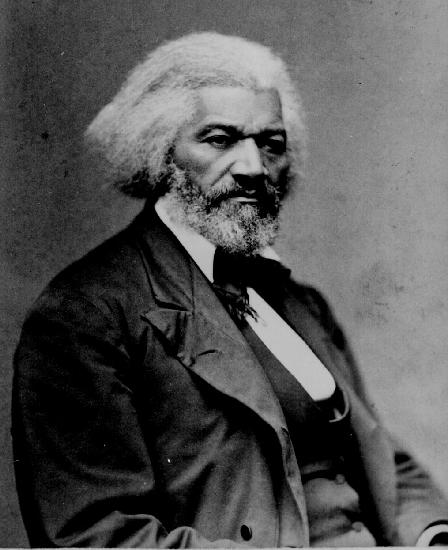
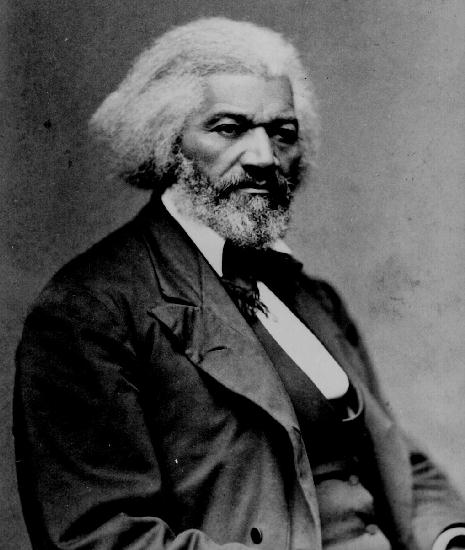
August 10, 1863 – The President meets with abolitionist Frederick Douglass who pushes for full equality for Union ‘Negro troops.’
August 11, 1841 – Frederick Douglass, an escaped slave, spoke before an audience in the North for the first time. During an anti-slavery convention on Nantucket Island, he gave a powerful, emotional account of his life as a slave. He was immediately asked to become a full-time lecturer for the Massachusetts Antislavery Society.
August 11-16, 1965 – Six days of riots began in the Watts area of Los Angeles, triggered by an incident between a white member of the California Highway Patrol and an African American motorist. Thirty-four deaths were reported and more than 3,000 people were arrested. Damage to property was listed at $40 million.
On August 14, 1862, Abraham Lincoln did something unprecedented in presidential history up to that point: he met with a small delegation of black leaders (all free: 5 black clergymen). But the meeting did not auger a decision to give African Americans a voice in government. In essence, Lincoln sought to lobby these men in essence to agree to a divorce. In other words, the President wanted to get black Americans behind his plan to colonize them abroad. –Source http://quod.lib.umich.edu/l/lincoln/lincoln5/1:812?rgn=div1;singlegenre=All;sort=occur;subview=detail;type=simple;view=fulltext;q1=August+14
August 14, 1935 – President Roosevelt signed the Social Security Act establishing the system which guarantees pensions to those who retire at age 65. The Social Security system also aids states in providing financial aid to dependent children, the blind and others, as well as administering a system of unemployment insurance.
August 15, 1969 – Woodstock began in a field near Yasgur’s Farm at Bethel, New York. The three-day concert featured 24 rock bands and drew a crowd of more than 300,000 young people. The event came to symbolize the counter-culture movement of the 1960’s.
August 18, 1920 – The 19th Amendment to the U.S. Constitution was ratified, granting women the right to vote.
August 24-
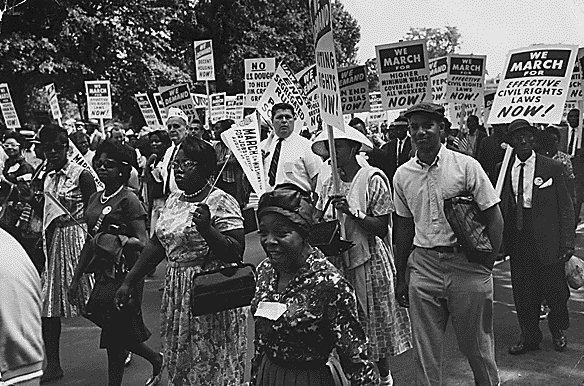
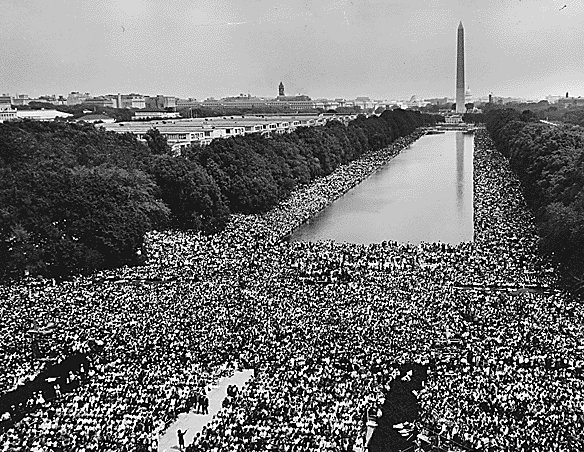
August 28, 1963 – The March on Washington occurred as over 250,000 persons attended a Civil Rights rally in Washington, D.C., at which Rev. Dr. Martin Luther King, Jr. made his now-famous I Have a Dream speech.
August 28, 1955 The death of Emmett Till
August 29, 2005 Hurricane Katrina slams into Gulf Coast
August 30 1967 Thurgood Marshall confirmed as Supreme Court justice
1983 U.S. Air Force Lieutenant Colonel Guion S. Bluford becomes the first African American to travel into space when the space shuttle Challenger
August 31
Resource: http://www.historyplace.com
~Nativegrl77

 Be a Seed for Change
You must be logged in to post a comment.