

on this day … 8/3 1992 – The U.S. Senate voted to restrict and eventually end the testing of nuclear weapons. 


1492 – Christopher Columbus left Palos, Spain with three ships. The voyage led him to what is now known as the Americas. He reached the Bahamas on October 12.

1750 – Christopher Dock completed the first book of teaching methods. It was titled “A Simple and Thoroughly Prepared School Management.”

1777 – During the Siege of Fort Stanwix the first U.S. flag was officially flown during battle.

1880 – The American Canoe Association was formed at Lake George, NY.

1900 – Firestone Tire & Rubber Co. was founded.

1914 – Germany declared war on France. The next day World War I began when Britain declared war on Germany.

1922 – WGY radio in Schenectady, NY, presented the first full-length melodrama on radio. The work was “The Wolf”, written by Eugene Walter.

1923 – Calvin Coolidge was sworn in as the 30th president of the U.S. after the sudden death of President Harding.

1933 – The Mickey Mouse Watch was introduced for the price of $2.75.

1936 – The U.S. State Department advised Americans to leave Spain due to the Spanish Civil War.

1936 – Jesse Owens won the first of his four Olympic gold medals.

1943 – Gen. George S. Patton verbally abused and slapped a private. Later, Gen. Dwight D. Eisenhower ordered him to apologize for the incident.

1949 – The National Basketball Association (NBA) was formed. The league was formed by the merger between the Basketball Association of America and the National Basketball League.

1956 – Bedloe’s Island had its name changed to Liberty Island.

1958 – The Nautilus became the first vessel to cross the North Pole underwater. The mission was known as “Operation Sunshine.”

1979 – Johnny Carson, the “Tonight Show” host, was on the cover of the Burbank, CA, telephone directory.

1981 – U.S. traffic controllers with PATCO, the Professional Air Traffic Controllers Organization, went on strike. They were fired just as U.S. President Reagan had warned. 

1984 – Mary Lou Retton won a gold medal at the Los Angeles Summer Olympics.

1985 – Mail service returned to a nudist colony in Paradise Lake, FL. Residents promised that they’d wear clothes or stay out of sight when the mailperson came to deliver.

1988 – The Iran-Contra hearings ended. No ties were made between U.S. President Reagan and the Nicaraguan Rebels.

1988 – The Soviet Union released Mathias Rust. He had been taken into custody on May 28, 1987 for landing a plane in Moscow’s Red Square.

1989 – Hashemi Rafsanjani was sworn in as the president of Iran.

1990 – Thousands of Iraqi troops pushed within a few miles of the border of Saudi Arabia. This heightened world concerns that the invasion of Kuwait could spread.

1992 – The U.S. Senate voted to restrict and eventually end the testing of nuclear weapons. 

1992 – Russia and Ukraine agreed to put the Black Sea Fleet under joint command. The agreement was to last for three years.

1995 – Eyad Ismoil was flown from Jordan to the U.S. to face charges that he had driven the van that blew up in New York’s World Trade Center.

2004 – In New York, the Statue of Liberty re-opened to the public. The site had been closed since the terrorist attacks on the U.S. on September 11, 2001.

2004 – NASA launched the spacecraft Messenger. The 6 1/2 year journey was planned to arrive at the planet Mercury in March 2011. On April 30, 2015, Messenger crashed into the surface of Mercury after sending back more than 270,000 pictures. 

2009 – Bolivia became the first South American country to declare the right of indigenous people to govern themselves.

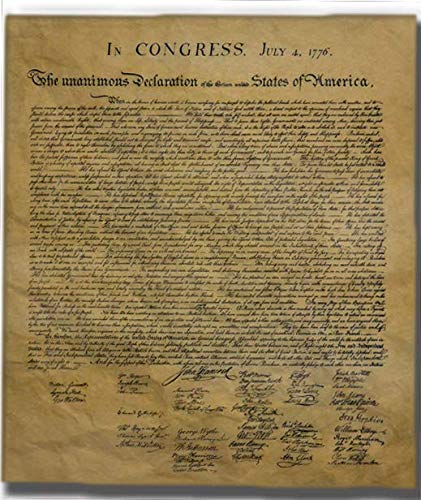
1776 Formal signing of the US Declaration of Independence by 56 people (date most accepted by modern historians)


The Declaration of Independence, Authentic Full Size Replica Printed on Antiqued Genuine Parchment. 23 x 29

Fate of the Signers of the Declaration of Independence

The following is often published and cited concerning the fate of the Signers, but its accuracy is doubtful, and should only be taken as “traditional” rather than historical. See the end for links to other sources on the subject.

Have you ever wondered what happened to the 56 men who signed the Declaration of Independence?

Five signers were captured by the British as traitors, and tortured before they died.

Twelve had their homes ransacked and burned. Two lost their sons serving in the Revolutionary Army; another had two sons captured.

Nine of the 56 fought and died from wounds or hardships of the Revolutionary War.

They signed and they pledged their lives, their fortunes, and their sacred honor. What kind of men were they?

Twenty-four were lawyers and jurists. Eleven were merchants, nine were farmers and large plantation owners; men of means, well educated. But they signed the Declaration of Independence knowing full well that the penalty would be death if they were captured.

Carter Braxton of Virginia, a wealthy planter and trader, saw his ships swept from the seas by the British Navy. He sold his home and properties to pay his debts, and died in rags.

Thomas McKeam was so hounded by the British that he was forced to move his family almost constantly. He served in the Congress without pay, and his family was kept in hiding. His possessions were taken from him, and poverty was his reward.

Vandals or soldiers looted the properties of Dillery, Hall, Clymer, Walton, Gwinnett, Heyward, Ruttledge, and Middleton.

At the battle of Yorktown, Thomas Nelson, Jr., noted that the British General Cornwallis had taken over the Nelson home for his headquarters. He quietly urged General George Washington to open fire. The home was destroyed, and Nelson died bankrupt.

Francis Lewis had his home and properties destroyed. The enemy jailed his wife, and she died within a few months.

John Hart was driven from his wife’s bedside as she was dying. Their 13 children fled for their lives. His fields and his gristmill were laid to waste. For more than a year he lived in forests and caves, returning home to find his wife dead and his children vanished. A few weeks later he died from exhaustion and a broken heart.

Norris and Livingston suffered similar fates. Such were the stories and sacrifices of the American Revolution. These were not wild-eyed, rabble-rousing ruffians. They were soft-spoken men of means and education. They had security, but they valued liberty more. Standing tall, straight, and unwavering, they pledged: “For the support of this declaration, with firm reliance on the protection of the divine providence, we mutually pledge to each other, our lives, our fortunes, and our sacred honor.”

They gave you and me a free and independent America. The history books never told you a lot about what happened in the Revolutionary War. We didn’t fight just the British.

We were British subjects at that time and we fought our own government!

Some of us take these liberties so much for granted, but we shouldn’t. So, take a few minutes while enjoying your 4th of July holiday and silently thank these patriots. It’s not much to ask for the price they paid. Remember: freedom is never free!

I hope you will show your support by please sending this to as many people as you can. It’s time we get the word out that patriotism is NOT a sin, and the Fourth of July has more to it than beer, picnics, and baseball games.

constitution.org

on this day … 8/2 1939 – U.S. President Roosevelt signed the Hatch Act. The act prohibited civil service employees from taking an active part in political campaigns. 


1776 – Members of the Continental Congress began adding their signatures to the Declaration of Independence.

1791 – Samuel Briggs and his son Samuel Briggs, Jr. received a joint patent for their nail-making machine. They were the first father-son pair to receive a patent.

1824 – In New York City, Fifth Avenue was opened.

1858 – In Boston and New York City the first mailboxes were installed along streets.

1861 – The United States Congress passed the first income tax. The revenues were intended for the war effort against the South. The tax was never enacted. 

1887 – Rowell Hodge patented barbed wire.

1892 – Charles A. Wheeler patented the first escalator.

1921 – Eight White Sox players were acquitted of throwing the 1919 World Series.

1926 – John Barrymore and Mary Astor starred in the first showing of the Vitaphone System. The system was the combining of picture and sound for movies.

1938 – Bright yellow baseballs were used in a major league baseball game between the Brooklyn Dodgers and the St. Louis Cardinals. It was hoped that the balls would be easier to see.

1939 – Albert Einstein signed a letter to President Roosevelt urging the U.S. to have an atomic weapons research program.

1939 – U.S. President Roosevelt signed the Hatch Act. The act prohibited civil service employees from taking an active part in political campaigns.

1943 – The U.S. Navy patrol torpedo boat, PT-109, sank after being attacked by a Japanese destroyer. The boat was under the command of Lt. John F. Kennedy.

1945 – The Allied conference at Potsdam was concluded.

1964 – The Pentagon reported the first of two North Vietnamese attacks on U.S. destroyers in the Gulf of Tonkin.

1983 – U.S. House of Representatives approved a law that designated the third Monday of January would be a federal holiday in honor of Dr. Martin Luther King, Jr. The law was signed by President Reagon on November 2.

1987 – “Snow White and the Seven Dwarfs” was re-released. The film was 50 years old at the time of its re-release.

1990 – Iraq invaded the oil-rich country of Kuwait. Iraq claimed that Kuwait had driven down oil prices by exceeding production quotas set by OPEC.

1995 – China ordered the expulsion of two U.S. Air Force officers. The two were said to have been caught spying on military sights.