Reminder: Ending DACA could have cost states billions in GDP ~ reminder


While several groups on both sides of the political aisle have posted how much they believe ending DACA will cost, the trump admin didn’t seem to care.  As Americans, some of us believe in the lowercase c for capitalism, so the idea that it would cost approximately $290 billion-plus to end DACA and Deport the Dreamers as well seems like an obvious wtf moment. The logical response would seem to be Nah, we can’t afford to do this, so working this ish out in a reasonable bipartisan way seems much saner… right?

So, the demand to end DACA was heard and being pushed worldwide by the now-former AG Jeff Sessions in what seemed like an exciting press conference, at least to him. Yet, those who understood the gravity of the decision fought back.

 Luckily, the courts stepped in then, but the struggle, fight, and best efforts for a perfect union continues.

~Nativegrl77

New York Committee of Vigilance founded


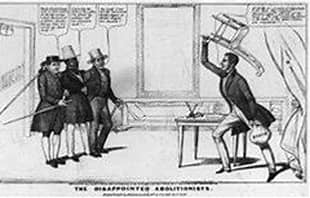
On November 20, 1835, David Ruggles, a Black abolitionist living in New York City, founds the New York Committee of Vigilance, an interracial collective working to protect free Black New Yorkers and fugitive former slaves from kidnappers and police. Its stated goal: to “protect unoffending, defenseless and endangered persons of color, by securing their rights as far as practicable.”

Though New York State had abolished slavery in 1827, the city’s economy depended on its trade with the Southern plantation economy. Wall Street financiers and merchants, who depended on the shipping of slave-grown cotton, encouraged New York Police Department officers to operate “kidnapping clubs,” which sought to arrest as many Black men, women and children as possible and ship them south for sale without even a trial by jury. They were enabled by corrupt judges, politicians, highly paid bounty hunters and others.

Ruggles and the NYCV believed that forceful confrontation with slave owners was often necessary in the pursuit of abolition and the emancipation of Black New Yorkers. With the support of an organized network of Black and white New Yorkers, he and his comrades boarded ships in the New York harbor to rescue Black captives and guide them to safety, and petitioned for jury trials for Black New Yorkers arrested as fugitives. They assembled a network of safe houses and churches that became stops on the Underground Railroad. Funds were raised to shelter, clothe and feed fugitives, as well as to pay for lawyers in the aforementioned jury trials. All the while, members of this network acted as informants, providing the NYCV with tips about suspicious activities and people.

By 1838, Ruggles and the NYCV had reportedly rescued over 500 individuals from being sold into slavery, including escaped-slave-turned-abolitionist-icon Frederick Douglass. While Ruggles was forced to retire from his activist work due to his declining health, the NYCV inspired abolitionists in cities across the northern United States to create similar groups to defend Black Americans seeking freedom from slavery.

Source: history.com for more information

1863 – President Lincoln delivers Gettysburg Address


On November 19, 1863, at the dedication of a military cemetery at Gettysburg, Pennsylvania, during the American Civil War, President Abraham Lincoln delivers one of the most memorable speeches in American history. In fewer than 275 words, Lincoln brilliantly and movingly reminded a war-weary public why the Union had to fight, and win, the Civil War.

WATCH: Abraham Lincoln on HISTORY Vault

The Battle of Gettysburg, fought some four months earlier, was one of the single bloodiest battle of the Civil War. Over the course of three days, more than 45,000 men were killed, injured, captured or went missing. The battle also proved to be the turning point of the war: General Robert E. Lee’s defeat and retreat from Gettysburg marked the last Confederate invasion of Northern territory and the beginning of the Southern army’s ultimate decline.

Source: history.com

READ MORE: 8 Surprising Facts About the Gettysburg Address

Citation Information

Article Title

President Lincoln delivers Gettysburg Address

AuthorHistory.com Editors

Website Name

HISTORY

URL

https://www.history.com/this-day-in-history/lincoln-delivers-gettysburg-address

Access Date

November 18, 2022

Publisher

A&E Television Networks

Last Updated

November 18, 2022

Original Published Date

March 10, 2010

on this day … 11/19


1863
Lincoln delivers Gettysburg Address
On November 19, 1863, at the dedication of a military cemetery at Gettysburg, Pennsylvania, during the American Civil War, President Abraham Lincoln delivers one of the most memorable speeches in American history. In just 272 words, Lincoln brilliantly and movingly reminded a war-weary public why… read more »
1776
Congress pleads for soldiers »
1993
Chevy Cavalier heads to Japan »
1863
Lincoln’s Gettysburg Address »
COLD WAR
1985
Reagan and Gorbachev hold their first summit meeting »
1976
Patty Hearst out on bail »
1824
Thousands perish in St. Petersburg flood »
1942
Soviet counterattack at Stalingrad »
1969
Pele scores 1,000th goal »
1977
Sadat visits Israel »
1975
One Flew Over the Cuckoo’s Nest debuts »
1899
Poet and critic Allen Tate is born »
1907
Shane author Jack Schaefer is born »
1831
James A. Garfield is born »
1966
Notre Dame and MSU play to a classic tie »
1967
Chaplain Charles Watters receives Medal of Honor »
1971
Cambodians appeal for help »
1915
British pilot makes heroic rescue »
1940
Hitler urges Spain to grab Gibraltar »