WA ~ New Rules 2026 ~ State


 The new laws going into effect in Washington on Jan. 1, and how they may impact you.

Expanded protections under Paid Family and Medical Leave (HB 1213)

Starting in 2026, workers will receive job protection after 180 days on the job, instead of the current requirement of 12 months and 1,250 hours worked. The law also lowers the employer size threshold for those protections. In 2025, the current threshold for those protections. The measure also aims to prevent employees from taking separate blocks of protected leave under both the federal Family and Medical Leave Act and the state program. The update creates a process that allows employers to count FMLA leave at the same time as state PFML for job-protection purposes. State officials are expected to release guidance on notice requirements by late 2025.

Updated unemployment benefits eligibility for workers affected by strikes and lockouts (SB 5041)

Beginning in 2026, Washington will limit unemployment benefits for workers who lose work because of a strike. Striking employees will be ineligible for benefits until either the second Sunday after the strike begins or the day the strike ends. After that, they may receive up to six weeks of benefits following the standard one-week waiting period, unless the strike is later ruled unlawful, in which case the benefits must be repaid. 

Workers must also repay any benefits that overlap with retroactive wages they receive. For employers, any benefits paid to striking workers will be charged only to that employer’s experience rating, but businesses may be able to lower their unemployment tax rate by making a voluntary contribution to the state trust fund if they qualify under SB 5041. 

New minimum wage in WA in 2026

The minimum wage for Washington will increase in 2026. 

Right now, for 2025, the minimum wage sits at $16.66, one of the highest in the nation. In 2026, that number will rise to $17.13, beginning on Jan. 1.

Employers must update payroll and notice postings per Washington Labor & Industries.

WA’s new luxury vehicle tax law (ESSB 5801)

The law creates two luxury taxes on high-value vehicles and noncommercial aircraft beginning Jan. 1, 2026, including an 8% tax on the portion of a vehicle’s sale, lease or transfer price above $100,000. Commercial vehicles and those weighing more than 10,000 pounds — except motor homes — are exempt.

WA’s new B&O surtax/surcharge on very large businesses

A 0.5% temporary surcharge will apply to taxpayers with taxable income over $250 million from Jan. 1, 2026, to December 30, 2029, per the Washington State Legislature page.

Washington will also increase the business and occupation (B&O) tax rate for manufacturing, retailing, and wholesaling to 0.5% starting Jan. 1, 2027, and adjust other rate categories. Beginning Oct. 1, 2025, the B&O tax rate for services rose for businesses with gross receipts over $1 million.

The surcharge on financial institutions went into effect at 1.5% starting Oct. 1, 2025, and the advanced computing surcharge will rise to 7.5% with a $75 million annual cap beginning Jan. 1. The legislation also clarifies the B&O tax deduction for investment income.

Retail and consumer protections 

New statutes going into effect next month will include the following: 

  • Service Contracts
  • Solicited Real Estate
  • Sodium Nitrite
  • Medical Cannabis Database
  • Alcohol Service in Public
  • Insurance/Affordable Units
  • Liquor Food Service Options
  • Wine & Spirit Sales Limits
  • Liquor Permits & Licensing
  • Manufactured Homes/Organizations Sale
  • Disability Insurer Filings
  • Cannabis Advertising
  • Insurance Statutes
  • Cannabis Industry Agreements
  • Reports of Fire Losses
  • Medical Debt
  • Mobility Equipment Repair
  • Bail Bond Agents/Immigration

Other Tobacco Product Tax expansion 

Senate Bill 5814 will expand the definition of tobacco products in order to categorize them under the Other Tobacco Tax. Beginning on Jan. 1, this tax will also apply to products containing nicotine, whether they are produced from tobacco or synthetically. 

The OTP tax is in addition to retail sales and use, B&O, and “litter taxes” that may apply, according to Alvarez & Marsal.

Expanded leave rights for employees affected by hate crimes (SB 5101)

Updated Safety Standards for Isolated employees (HB 1524)

On Jan. 1, 2026, Washington will strengthen safety rules for employees who work alone. The law applies to hotels, motels, retail stores, security firms and property service companies that have at least one isolated worker, such as a janitor, housekeeper or security guard. The update expands what counts as an “isolated” work situation and adds new requirements for panic buttons, incluing training and record keeping. Employers who break the rules can face fines of up to $1,000 for a willful violation and up to $10,000 for repeated violations.

Updated workplace violence laws in healthcare settings (HB 1162)

Under this new Washington state law, healthcare facilities will be legally required to promptly investigate all incidents of workplace violence, rather than reviewing them on a periodic basis. Facilities will be required to annually update their workplace violence prevention plan based on data and incident analysis, implement safety improvements and report to their safety or workplace-violence committees.

Plastic carryout bag fee changes

Starting Jan. 1, Washington will increase the minimum cost of plastic film carry out bags at restaurants and retailers from 8 cents to 12 cents per bag, as part of a 2020 law aimed at reducing single-use plastics. The law encourages shoppers to bring their own bags, while the minimum charge for paper carry out bags will remain at 8 cents. 

Implemented in 2021, Washington’s single-use plastic bag ban prohibits thin, .5 mil disposable plastic bags and sets standards for thicker, 2.25 mil reusable plastic film bags. Additionally, the law mandates that both plastic and paper carryout bags contain at least 40% recycled content.

Source(s) Good Day Seattle, Washington Labor & Industries, Full information is available through the 2025 Washington Legislative session review,

Check back for updates

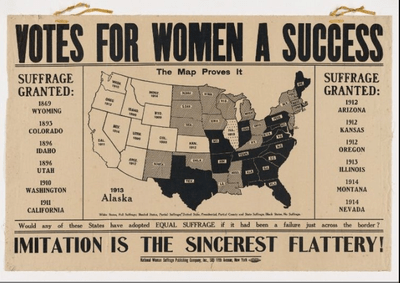
1869 – Wyoming grants Women the Right to Vote


Motivated more by interest in free publicity than a commitment to gender equality, Wyoming territorial legislators pass a bill that is signed into law granting women the right to vote.

Western states led the nation in approving women’s suffrage, but some of them had rather unsavory motives. Though some men recognized the important role women played in frontier settlement, others voted for women’s suffrage only to bolster the strength of conservative voting blocks. In Wyoming, some men were also motivated by sheer loneliness–in 1869, the territory had over 6,000 adult males and only 1,000 females, and area men hoped women would be more likely to settle in the rugged and isolated country if they were granted the right to vote.

Some of the suffrage movement’s leaders did have more respectable reasons for supporting women’s right to vote. William Bright, a territorial legislator who was in his mid-forties, had a persuasive young wife who convinced him that denying women the vote was a gross injustice. The other major backer, Edward M. Lee, the territorial secretary who had championed the cause for years, argued that it was unfair for his mother to be denied a privilege granted to African-American males.

Ultimately, though, appeals to justice and equality did not pass the legislation–most Wyoming legislators supported Bright and Lee’s bill because they thought it would win the territory free national publicity and might attract more single marriageable women to the region. Territorial Governor John A. Campbell appreciated the publicity power of the policy and signed the bill into law, making Wyoming the first territory or state in the history of the nation to grant women this fundamental right of citizenship.

Source: history.com

2003 – The U.S. Supreme Court upheld new restrictions on political advertising in the weeks before an election. The court did strike down two provisions of the new law that involved a ban on political contibutions from those too young to vote and a limitation on some party spending. (McConnell v. FEC, 02-1674)


WA. Wind – Advisory


Wed, Dec 10, 3:19 AM PST to Wed, Dec 10, 10:00 PM PST

What

Southwest winds 20 to 30 mph with gusts up to 40 mph expected.

Where

Portions of northwest and west central Washington.

When

Until 10 PM PST this evening.

Impacts

Gusty winds could blow around unsecured objects. Tree limbs could be blown down, and a few power outages may result.

Summary

Use extra caution when driving, especially if operating a high-profile vehicles. Secure outdoor objects. Secure outdoor objects.

Issued By

NWS Seattle WA