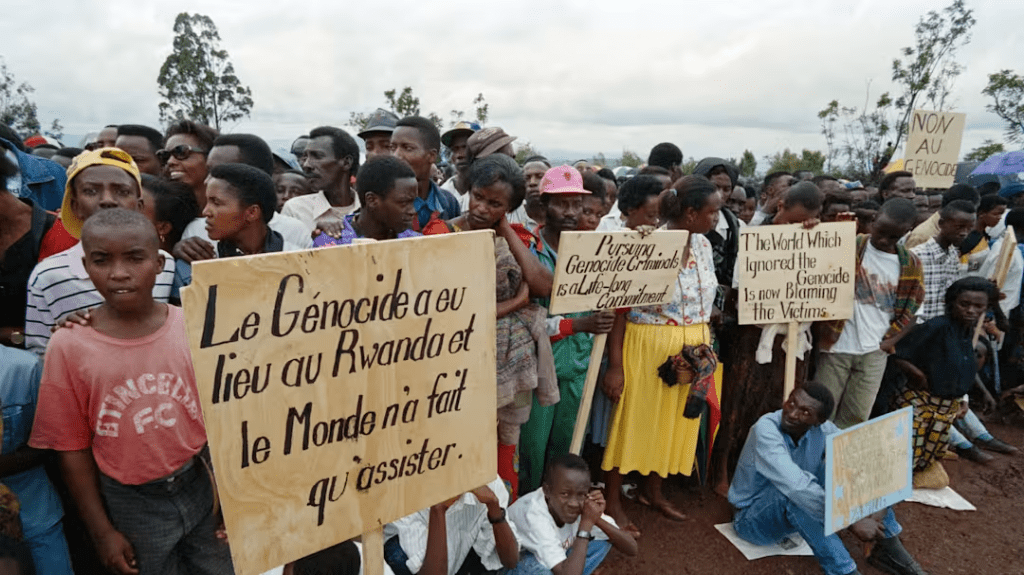
On April 7, 1994, violence fuels the launch of what would become the worst episode of genocide since World War II: the massacre of an estimated 500,000 to 1 million innocent civilian Tutsis and moderate Hutus. Following the first wave of massacres, Rwandan forces manage to discourage international intervention with the murder of 10 Belgian peacekeeping officers. The Tutsis, a minority group that made up about 10 percent of Rwanda’s population, received no assistance from the international community, although the United Nations later conceded that a mere 5,000 soldiers deployed at the outset would have stopped the wholesale slaughter.
The immediate roots of the 1994 genocide dated back to the early 1990s, when President Juvenal Habyarimana, a Hutu, began using anti-Tutsi rhetoric to consolidate his power among the Hutus. Beginning in October 1990, there were several massacres of hundreds of Tutsis. Although the two ethnic groups were very similar, sharing the same language and culture for centuries, the law required registration based on ethnicity. The government and army began to assemble the Interahamwe (meaning “those who attack together”) and prepared for the elimination of the Tutsis by arming Hutus with guns and machetes. In January 1994, the United Nations forces in Rwanda warned that larger massacres were imminent.
For the complete article… use the link below
Source: history.com
Citation Information
Article Title
Violence erupts in Rwanda, foreshadowing genocide AuthorHistory.com Editors
The FDA has issued an Advisory without batch numbers or expiration dates. At the request of the FDA, RAW FARM is issuing a Voluntary Recall of the batches of cheese below and any batches produced prior to these dates.
The U.S. Department of Agriculture’s Food Safety and Inspection Service (FSIS) is issuing a public health alert for frozen, dinosaur-shaped, ready-to-eat chicken nuggets that may be contaminated with unsafe levels of lead. A recall was not requested because the products are no longer available for purchase. However, FSIS is concerned that some products may still be in consumers’ freezers.
Microbial contamination was the leading cause of Finnish recalls in 2025. There were 299 recalls in Finland this past year, down slightly from 305 in 2024.
** FOR IMMEDIATE RELEASE – March 19, 2026– West Sacramento, CA, Gear Isle is voluntarily recalling the following products to the consumer level. The products have been found to contain undeclared active pharmaceutical ingredients, sildenafil and tadalafil.
Gold Lion Aphrodisiac Chocolate Sachet, UPC 795847916279, LOT# no lot number, Expires: 06/2027 ilum Sex Chocolate, UPC 1002448578911, LOT# no lot number, Expires: 12/25/2027.
** The E. coli O157:H7 outbreak linked to raw cheddar cheese from Raw Farm LLC continues to grow. Out of nine cases so far, more than half are in children younger than 5 years old. Although the FDA has reported that raw milk cheese from Raw Farm dairy is the most likely source of the bacteria, the company has refused to recall its product.
Falcon Trading Company Inc. is recalling organic black bean products because they contain pesticide residue. The Royal Oaks, CA, company is recalling the three items listed below. Because these items
Auricchio brand Gorgonzola D.O.P dolce is being recalled in Canada because of contamination with Listeria monocytogenes. This recall was triggered by Canadian Food Inspection Agency test results.
Falcon Trading Company Inc. is recalling organic black bean products because they contain pesticide residue. The Royal Oaks, CA, company is recalling the three items listed below. Falcon Trading Company, Inc. of Royal Oaks CA is recalling the three items listed below. Because these items are sold in bulk, the lot numbers can be mixed in the sales bin. Therefore, we are recalling all lot numbers of the following items:
Tuskegee Institute founder Booker T. Washington becomes the first Black American to be honored with a postage stamp. It will take nearly four decades for a Black woman to receive a similar honor: Harriet Tubman in 1978.
On April 7, 1961, President John F. Kennedy sends a letter to Congress in which he recommends the U.S. participate in an international campaign to preserve ancient temples and historic monuments in the Nile Valley of Egypt. The campaign, initiated by UNESCO, was designed to save sites threatened by the construction of the Aswan High Dam.
JFK believed that America’s participation in the project would reflect “the interests of the United States,” as well as the country’s interest in ancient Egyptian culture “from which many of our own cultural traditions have sprung” and the U.S.’s “deep friendship for the people who live in the valley of the Nile.” Kennedy possessed a personal interest in the sciences and history and, from the beginning of his presidency, set out to promote American scholarship in these areas. His administration also wanted to develop diplomatic ties with the Arab nations in the Middle East and North Africa.
Citation Information
Article Title: JFK lobbies Congress to help save historic sites in Egypt
Six days after the death of Hu Yaobang, the deposed reform-minded leader of the Chinese Communist Party, some 100,000 students gather at Beijing’s Tiananmen Square to commemorate Hu and voice their discontent with China’s authoritative communist government. The next day, an official memorial service for Hu Yaobang was held in Tiananmen’s Great Hall of the People, and student representatives carried a petition to the steps of the Great Hall, demanding to meet with Premier Li Peng. The Chinese government refused such a meeting, leading to a general boycott of Chinese universities across the country and widespread calls for democratic reforms.
Ignoring government warnings of violent suppression of any mass demonstration, students from more than 40 universities began a march to Tiananmen on April 27. The students were joined by workers, intellectuals, and civil servants, and by mid-May more than a million people filled the square, the site of communist leader’s Mao Zedong’s proclamation of the People’s Republic of China in 1949. On May 20, the government formally declared martial law in Beijing, and troops and tanks were called in to disperse the dissidents. However, large numbers of students and citizens blocked the army’s advance, and by May 23 government forces had pulled back to the outskirts of Beijing.
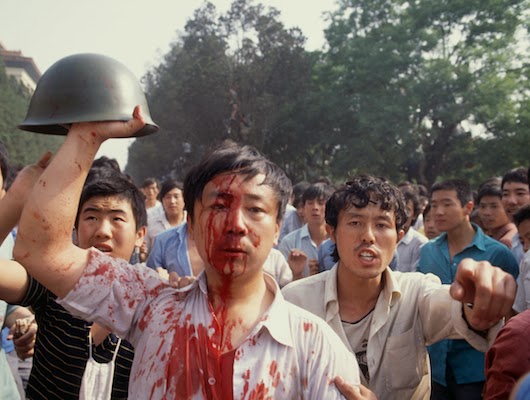
On June 3, with negotiations to end the protests stalled and calls for democratic reforms escalating, the troops received orders from the Chinese government to reclaim Tiananmen at all costs. By the end of the next day, Chinese troops had forcibly cleared Tiananmen Square and Beijing’s streets, killing hundreds of demonstrators and arresting thousands of protesters and other suspected dissidents. In the weeks after the government crackdown, an unknown number of dissidents were executed, and communist hard-liners took firm control of the country.
The international community was outraged at the incident, and economic sanctions imposed by the United States and other countries sent China’s economy into decline. However, by late 1990, international trade had resumed, thanks in part to China’s release of several hundred imprisoned dissidents.
Citation Information
Article Title
Chinese students begin protests at Tiananmen Square
Author
History.com Editors
Website Name
HISTORY
On June 4, 1989, however, Chinese troops and security police stormed through Tiananmen Square, firing indiscriminately into the crowds of protesters. Turmoil ensued, as tens of thousands of the young students tried to escape the rampaging Chinese forces. Other protesters fought back, stoning the attacking troops and overturning and setting fire to military vehicles. Reporters and Western diplomats on the scene estimated that at least 300, and perhaps thousands, of the protesters had been killed and as many as 10,000 were arrested.
The savagery of the Chinese government’s attack shocked both its allies and Cold War enemies. Soviet leader Mikhail Gorbachev declared that he was saddened by the events in China. He said he hoped that the government would adopt his own domestic reform program and begin to democratize the Chinese political system.









 Be a Seed for Change
You must be logged in to post a comment.