The Bristol Bay Protection Act is a U.S. federal bill introduced in 2024 (H.R. 8193) by Rep. Mary Sattler Peltola (D-AK) to prohibit and restrict certain actions in the Bristol Bay watershed to protect its salmon resources and ecological integrity While the bill has not yet been enacted into law, it is part of the broader legislative and legal fight over the proposed Pebble Mine in Alaska.
Purpose and Scope
The Act:
Prohibits the specification of the Pebble Mine project area as a disposal site under the Clean Water Act.
Restricts actions that could discharge dredged or fill material into waters of the United States, including wetlands, in the Bristol Bay watershed.
Addresses the EPA’s 2023 veto of the Pebble Mine, which cited unacceptable adverse effects on salmon streams, wetlands, and fisheries
Key Environmental Concerns
The bill’s findings highlight:
Loss of ~8.5 miles of documented anadromous fish streams.
Loss of ~91 miles of additional streams supporting salmon.
Loss of ~2,108 acres of wetlands and other waters supporting salmon.
Adverse impacts on ~29 miles of salmon streams from greater than 20% changes in streamflow
Legislative and Legal Context
Introduced: May 1, 2024, in the House, referred to the Committee on Transportation and Infrastructure
Not enacted: As of now, the bill remains in the legislative process and has not passed both chambers or been signed into law
Parallel legal action: The Pebble Mine case (Northern Dynasty Minerals Ltd. v. EPA) is ongoing in federal court, with a major DOJ response deadline in February 2026 and oral arguments in June 2026
Alaska Legislature: In Juneau, lawmakers are also debating the Bristol Bay Forever Act, which aims to provide permanent protections for the watershed
Why It Matters
The Bristol Bay watershed is home to the world’s largest sockeye salmon run and is central to Alaska Native cultures. The Act and related measures seek to prevent irreversible damage from mining-related discharges, which could threaten salmon populations, municipal water supplies, shellfish beds, and subsistence livelihoods
In summary: The Bristol Bay Protection Act of 2026 is not yet law, but it is a key legislative tool in the ongoing battle to protect Bristol Bay’s salmon and ecosystems from the Pebble Mine. Its fate will depend on congressional action, while the federal court case could set a precedent regarding the EPA’s authority to block such projects.
1. The Declaration of Independence wasn’t signed on July 4, 1776.
On July 1, 1776, the Second Continental Congress met in Philadelphia, and on the following day 12 of the 13 colonies voted in favor of Richard Henry Lee’s motion for independence. The delegates then spent the next two days debating and revising the language of a statement drafted by Thomas Jefferson.
On July 4, Congress officially adopted the Declaration of Independence, and as a result the date is celebrated as Independence Day. Nearly a month would go by, however, before the actual signing of the document took place.
First, New York’s delegates didn’t officially give their support until July 9 because their home assembly hadn’t yet authorized them to vote in favor of independence. Next, it took two weeks for the Declaration to be “engrossed”—written on parchment in a clear hand.
Most of the delegates signed on August 2, but several—Elbridge Gerry, Oliver Wolcott, Lewis Morris, Thomas McKean and Matthew Thornton—signed on a later date. (Two others, John Dickinson and Robert R. Livingston, never signed at all.) The signed parchment copy now resides at the National Archives in the Rotunda for the Charters of Freedom, alongside the Constitution and the Bill of Rights.
2. More than one copy exists.
After the adoption of the Declaration of Independence, the “Committee of Five”—Thomas Jefferson, John Adams, Benjamin Franklin, Roger Sherman and Robert R. Livingston—was charged with overseeing the reproduction of the approved text. This was completed at the shop of Philadelphia printer John Dunlap. On July 5, Dunlap’s copies were dispatched across the 13 colonies to newspapers, local officials and the commanders of the Continental troops. These rare documents, known as “Dunlap broadsides,” predate the engrossed version signed by the delegates. Of the hundreds thought to have been printed on the night of July 4, only 26 copies survive. Most are held in museum and library collections, but three are privately owned.
3. When news of the Declaration of Independence reached New York City, it started a riot.
By July 9, 1776, a copy of the Declaration of Independence had reached New York City. With hundreds of British naval ships occupying New York Harbor, revolutionary spirit and military tensions were running high. George Washington, commander of the Continental forces in New York, read the document aloud in front of City Hall. A raucous crowd cheered the inspiring words, and later that day tore down a nearby statue of George III. The statue was subsequently melted down and shaped into more than 42,000 musket balls for the fledgling American army.
4. Eight of the 56 signers of the Declaration of Independence were born in Britain.
While the majority of the members of the Second Continental Congress were native-born Americans, eight of the men voting for independence from Britain were born there. Gwinnett Button and Robert Morris were born in England, Francis Lewis was born in Wales, James Wilson and John Witherspoon were born in Scotland, George Taylor and Matthew Thornton were born in Ireland and James Smith hailed from Northern Ireland.
5. One signer later recanted.
Richard Stockton, a lawyer from Princeton, New Jersey, became the only signer of the Declaration of Independence to recant his support of the revolution. On November 30, 1776, the hapless delegate was captured by the British and thrown in jail. After months of harsh treatment and meager rations, Stockton repudiated his signature on the Declaration of Independence and swore his allegiance to King George III. A broken man when he regained his freedom, he took a new oath of loyalty to the state of New Jersey in December 1777.
6. There was a 44-year age difference between the youngest and oldest signers.
The oldest signer was Benjamin Franklin, 70 years old when he scrawled his name on the parchment. The youngest was Edward Rutledge, a lawyer from South Carolina who was only 26 at the time. Rutledge narrowly beat out fellow South Carolinian Thomas Lynch Jr., just four months his senior, for the title.
7. Two additional copies have been found in the last 25 years.
In 1989, a Philadelphia man found an original Dunlap Broadside hidden in the back of a picture frame he bought at a flea market for $4. One of the few surviving copies from the official first printing of the Declaration, it was in excellent condition and sold for $8.1 million in 2000. A 26th known Dunlap broadside emerged at the British National Archives in 2009, hidden for centuries in a box of papers captured from American colonists during the Revolutionary War. One of three Dunlap broadsides at the National Archives, the copy remains there to this day.
8. The Declaration of Independence spent World War II in Fort Knox.
On December 23, 1941, just over two weeks after the Japanese attack on Pearl Harbor, the signed Declaration, together with the Constitution, was removed from public display and prepared for evacuation out of Washington, D.C. Under the supervision of armed guards, the founding document was packed in a specially designed container, latched with padlocks, sealed with lead and placed in a larger box. All told, 150 pounds of protective gear surrounded the parchment. On December 26 and 27, accompanied by Secret Service agents, it traveled by train to Louisville, Kentucky, where a cavalry troop of the 13th Armored Division escorted it to Fort Knox. The Declaration was returned to Washington, D.C., in 1944.
9. There is something written on the back of the Declaration of Independence.
In the movie “National Treasure,” Nicholas Cage’s character claims that the back of the Declaration contains a treasure map with encrypted instructions from the founding fathers, written in invisible ink. Unfortunately, this is not the case. There is, however, a simpler message, written upside-down across the bottom of the signed document: “Original Declaration of Independence dated 4th July 1776.” No one knows who exactly wrote this or when, but during the Revolutionary War years the parchment was frequently rolled up for transport. It’s thought that the text was added as a label.
Lonnie Bunch, museum director, historian, lecturer, and author, is proud to present A Page from Our American Story, a regular on-line series for Museum supporters. It will showcase individuals and events in the African American experience, placing these stories in the context of a larger story — our American story.
A Page From Our American Story
On July 5, 1852 approximately 3.5 million African Americans were enslaved — roughly 14% of the total population of the United States. That was the state of the nation when Frederick Douglass was asked to deliver a keynote address at an Independence Day celebration.
He accepted and, on a day white Americans celebrated their independence and freedom from the oppression of the British crown, Douglass delivered his now-famous speech What to the Slave is the Fourth of July. In it, Douglass offered one of the most thought provoking and powerful testaments to the hypocrisy, bigotry and inhumanity of slavery ever given.
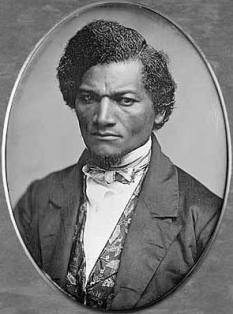
Daguerreotype of Frederick Douglass
(1847-1852) by Samuel J. Miller.
The Art Institute of Chicago
Douglass told the crowd that the arguments against slavery were well understood. What was needed was “fire” not light on the subject; “thunder” not a gentle “shower” of reason. Douglass would tell the audience:
The feeling of the nation must be quickened; the conscience of the nation must be roused; the propriety of the nation must be startled; the hypocrisy of the nation must be exposed; and its crimes against God and man must be denounced.
Frederick Douglass was born into slavery, most likely in February 1818 — birth dates of slaves were rarely recorded. He was put to work full-time at age six, and his life as a young man was a litany of savage beatings and whippings. At age twenty, he successfully escaped to the North. In Massachusetts he became known as a voice against slavery, but that also brought to light his status as an escaped slave. Fearing capture and re-enslavement, Douglass went to England and continued speaking out against slavery.
He eventually raised enough money to buy his freedom and returned to America. He settled in Rochester, New York in 1847 and began to champion equality and freedom for slaves in earnest. By then, his renown extended far beyond America’s boundaries. He had become a man of international stature.
One suspects that Rochester city leaders had Douglass’ fame and reputation as a brilliant orator in mind when they approached him to speak at their Independence Day festivities. But with his opening words, Douglass’ intent became clear — decry the hypocrisy of the day as it played out in the lives of the slaves:
Fellow citizens, pardon me, and allow me to ask, why am I called upon to speak here today? What have I or those I represent to do with your national independence? Are the great principles of political freedom and of natural justice, embodied in that Declaration of Independence, extended to us? And am I, therefore, called upon to bring our humble offering to the national altar, and to confess the benefits, and express devout gratitude for the blessings resulting from your independence to us?
You can easily imagine the wave of unease that settled over his audience. The speech was long, as was the fashion of the day. A link to the entire address can be found at the end of this Our American Story. When you read it you will discover that, to his credit, Douglass was uncompromising and truthful:
This Fourth of July is yours, not mine. You may rejoice, I must mourn … What to the American slave is your Fourth of July? … a day that reveals to him more than all other days of the year, the gross injustice and cruelty to which he is the constant victim. To him your celebration is a sham … your shouts of liberty and equality, hollow mock; your prayers and hymns, your sermons and thanksgivings … hypocrisy — a thin veil to cover up crimes which would disgrace a nation of savages.
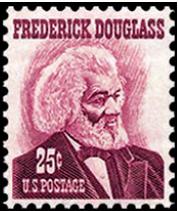
US Stamp honoring
Frederick Douglass, 1967.
US Postal Service
Reaction to the speech was strong, but mixed. Some were angered, others appreciative. What I’ve always thought most impressive about Douglass’ speech that day was the discussion it provoked immediately and in the weeks and months that followed.
Certainly much has changed since Douglass’ speech. Yet the opportunity to discuss and debate the important impact of America’s racial history is very much a part of the National Museum of African American History and Culture. Douglass’ words remind us that many have struggled to ensure that the promise of liberty be applied equally to all Americans — regardless of race, gender or ethnicity. And that the struggle for equality is never over.
So, as we gather together at picnics, parades, and fireworks to celebrate the 4th of July, let us remember those, like Frederick Douglass, who fought and sacrificed to help America live up to its ideals of equality, fair play and justice.
Frederick Douglass’ life and words have left us a powerful legacy. His story, and the African American story, is part of us all.
To you and your family, have a joyous and safe Fourth of July and thank you for your interest in the National Museum of African American History and Culture.







You must be logged in to post a comment.