
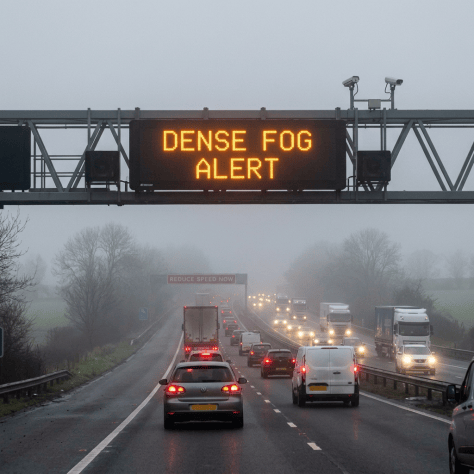
Official update
What: Visibility one-quarter mile or less in dense fog.
Where: Eastern Kitsap County, City of Seattle, Downtown Everett / Marysville Area, Eastside, Lowlands of Lewis and Southern Thurston Counties, Lowlands of Pierce and Southern King Counties, Olympia and Southern Puget Sound, and Shoreline / Lynnwood / South Everett Area.
When: Until 11 AM PST in some areas this morning.
Impacts: Low visibility could make driving conditions hazardous.
Additional Details: Localized freezing fog may also occur as temperatures fall into the 30s for many locations.
Summary: If driving, slow down, use your headlights, and leave plenty of distance ahead of you.
Issued By: NWS Seattle WA
Safety tips
Driving in Fog:
Slow down and allow extra time.
Use low-beam headlights and fog lights if available.
Avoid high-beam lights to prevent glare.
Maintain a safe distance from other vehicles.
Follow road lines to stay in your lane.
In extremely dense fog, turn on hazard lights and pull into a safe location. If not possible, pull off the road, turn off all lights except hazard lights, set the emergency brake, and take your foot off the brake pedal.
Marine Navigation in Fog:
Fog is dense if visibility is less than 1 mile (1.6 kilometers).
Visibility categories
Very Poor: Less than 0.5 nautical miles (0.93 kilometers)
Poor: 0.5 to less than 2 nautical miles (0.93 to 3.7 kilometers)
Moderate: 2 to 5 nautical miles (3.7 to 9.3 kilometers)
Good: Greater than 5 nautical miles (9.3 kilometers)
Slow down to avoid collisions.
Turn on all running lights, even during the day.
Listen for sounds of other boats, fog horns, and bells from buoys.
Use radar and GPS or navigation charts to locate your position.
If disoriented, stay put until the fog lifts, ensuring you are in a safe location.
Know the horn and bell sounds to warn others in dense fog.
Have a compass to determine your direction.
Stay out of shipping lanes as large ships cannot see you.
Hazard information
Fog, particularly when dense, can be hazardous to drivers, mariners and aviators. Fog contributes to numerous travel accidents every year. Restrictions in visibility resulting from fog can also impact takeoff and landing procedures and requirements for pilots, and can be the cause of weather-related aviation delays.
Radiation Fog
Forms at night when the ground cools rapidly, causing the air above it to cool and reach its dew point. This type of fog is common in valleys and low-lying areas.
Advection Fog
Occurs when warm, moist air moves over a cooler surface, causing the air to cool to its dew point. This type of fog is often seen along coastlines.
Valley Fog
Forms in valleys, typically during the winter, when cold air settles in the valley and cools the air to its dew point.
Upslope Fog
Develops when moist air is forced to ascend a slope, cooling as it rises and forming fog.
Freezing Fog
Occurs when the temperature is below freezing, and the fog droplets freeze upon contact with surfaces, creating a layer of ice.
Ice Fog
Found in polar and Arctic regions, this fog consists of tiny ice crystals rather than water droplets.
Steam Fog
Forms when cold air moves over warmer water, causing the water to evaporate and then condense into fog as it mixes with the cold air.


