All posts by Nativegrl77

Who’s Up and Who’s Down


By

Corporations Are Doing Great. Workers, Not So Much.

Burger King is the latest American-born company that is ditching corporate patriotism in favor of exploiting a tax loophole by moving its headquarters abroad. Companies like this and others insist that they make these decisions because America’s corporate tax rate is too much of a burden for them to be competitive. But the reality is that America’s corporations have never done better. It is America’s workers, with wages stagnating and prices increasing, that are having a harder and harder time to make ends meet.

Let’s look at corporations first. Corporations are capturing a greater share of the national income overall. In 1946, corporate profits accounted for 4.5 percent of all the money earned over the course of the year. Now they have more than doubled that share to 11.2 percent.

corps1

Meanwhile, corporate tax obligations make up a smaller share of federal revenue. In 1946, 30.2 percent of all taxes collected by the federal government came from corporations; now corporate income taxes only cover 9.9 percent of federal revenue.

corps2

Center for American Progress fiscal policy expert Harry Stein explains the backward logic of corporations complaining that taxes are too high: “The claim that taxes are somehow ‘crushing’ corporations gets it backward—corporations could not survive without taxes. To list just a few examples, federal taxes fund education and training for the American workforce, a national transportation network to deliver products to market, a navy to keep shipping lanes safe from piracy around the world, and a legal system to protect copyrights and patents.”

While corporations have been doing better than ever, workers have not been capturing their fair share of these profits. Simply put, trickle-down isn’t trickling. In 2013, the share of corporate income that went to workers hit its lowest point since 1950, according to an analysis from the Economic Policy Institute.

corpincome

Workers aren’t earning less because they’re working less. Oppositely, their productivity increased 8 percent between 2007 and 2012 while their wages actually fell.

BOTTOM LINE: These new economic numbers are more proof that our economy is not working for most Americans. Companies may point to the tax code as a reason for their corporate desertion, but the fact is they are doing better than ever. It’s middle and working class families, the real engines of the economy, that are left with less. We need an economy that works for them.

5 reasons to vote Democratic


I know we spend a lot of time talking about how Republicans’ plans will hurt the middle class.

So today, I’m going to change things up a bit. There are so many reasons voters should vote Democratic in November. Here are 5 reasons that I wanted you to focus on to demonstrate why everyone should vote Democratic this November:

1. We’re trying to overturn Citizens United.
2. We’re fighting the Koch brothers.
3. We’re refusing to end Medicare as we know it.
4. We’re refusing to privatize Social Security.
5. We’re defending a woman’s right to choose.

If those sound like good reasons to you, I hope you’ll consider pitching in $5 to help my team reach our $200,000 goal before the FEC deadline at the end of the month.

Climate March … Join the Largest Climate March in History


Earth Day Network Logo
This Sunday, hundreds of thousands of people and over 1,400 organizations will come together for the largest climate rally in human history.

Please join Earth Day Network at the People’s Climate March to make your voice be heard!

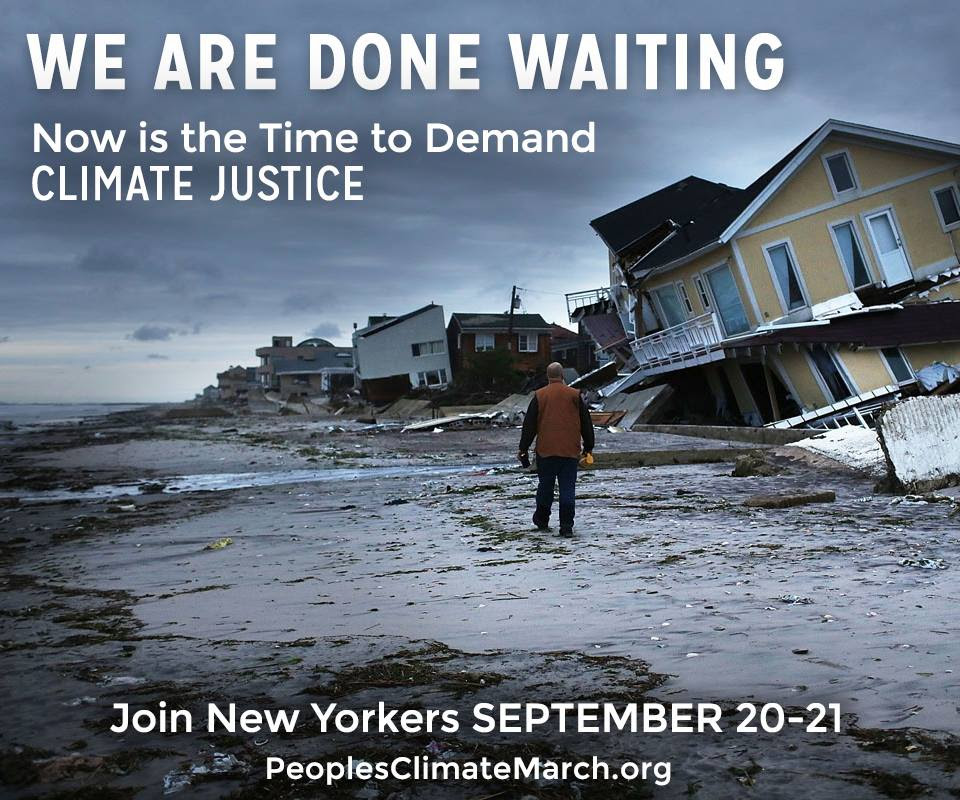
We are done waiting! We’ve reached a tipping point in the struggle to fight climate change. Immediate, aggressive international action must be taken or the entire world will face grave consequences. That is why UN Secretary General Ban Ki-moon has called together world leaders for a climate summit this September. While they are debating, we will march in historic numbers demanding that they make aggressive commitments to fight climate change now.

As a major partner of the People’s Climate March, Earth Day Network will be there en force. Join us to take a stand and change the course of history by demanding a world with an economy that works for people and planet; a world safe from the ravages of climate change; a world with good jobs, clean air and water, and healthy communities. Beyond the march, there are dozens of events planned for the weekend of the People’s Climate March, to plan your climate action weekend, the the schedule of events here.

The march will begin at 11:30 am in Central Park on Sunday September 21st. The route of the march and staging information can be found at the March’s website. Join the largest climate rally in history and help to ensure history moves in the right direction. Show up, bring your best sign and change the future!

If you can’t be there in person, be there in spirit and support Earth Day Network’s delegation. $100 will cover the cost of one person on our team. Donate now and help us show the world we need climate action NOW!

— The Earth Day Network Team

Lisa Donner, Americans for Financial Reform


cfpbThe Consumer Financial Protection Bureau (CFPB) is doing invaluable work to make the markets for credit cards, mortgages and other financial products and services fairer and more transparent. And once again, the financial industry is going all-out to block those efforts.

The industry’s latest threat involves a proposal to make the CFPB’s complaint system more useful and user-friendly by giving consumers the right to include the specifics of their complaints in a searchable public database.

Please join us in telling the CFPB: Don’t back down from your proposal to let consumers share their stories publicly.

Hundreds of thousands of people have used the CFPB’s complaint system, and more than 30,000 cases have already resulted in monetary relief. Complaint data also helps the CFPB detect and respond to broader patterns of industry error or misconduct. The complaint system could be far more valuable, though, if consumers had the option of publicly describing their bad experiences. That way, consumers would be able to learn about the experiences of others and make more informed choices, and financial companies would have an added incentive to compete by actually trying to satisfy their customers, not by trying to put something over on them.

But financial companies, just as they fought the creation of the CFPB in the first place, are fighting its complaint proposal tooth and nail – through the press, through lobbying, and through a highly deceptive advertising campaign in which the industry falsely claims that businesses would not have an equal right to post their responses.

That’s why we need to fight back.  Urge the CFPB to stand firm and help consumers share their experiences and hold big banks accountable.

Speak up today, because the big banks are working feverishly hard to take away our chance to speak up in the future.

Thank you for your continued support for real financial reform.

Sincerely,


Lisa Donner
Executive Director
Americans for Financial Reform

save the Honey Bees ~~ Kristin Brown, League of Conservation Voters


LCV
Tell Congress to save the honeybees!
Stop the Bee-pocalypse! You can help save our nation’s honeybees >>Could you imagine a fall without fresh apples, Carmen? Thanksgiving without cranberry sauce or pumpkin pie?If we don’t take actionright now to protect honeybees, our favorite fall foods — and the U.S. economy — will be at risk.Honeybees, our number one food security guard, are dying at an alarming rate due in part to pesticides being used across America. In recent years, nearly one-third of commercial bee colonies in the U.S. have been dying over the winter, and 50,000 honeybees died in Oregon last year alone!

We need Congress to take action and protect the honeybee. Tell them to ban the pesticides that are killing honeybees off. Speak out now!

Why should Congress care about losing the honeybee? It would be a crushing blow to our economy. One-third of the foods produced in North America, including nearly 100 varieties of fruits and vegetables like apples and pumpkins, rely on honeybees for pollination — that means we could lose more than $15 billion a year in agricultural production in the U.S.

The good news is that some in Congress have taken notice. A bill to save honeybees by temporarily banning certain pesticides, H.R. 2692, recently reached 71 co-sponsors.

Let’s tell Congress that we want to pass this bill! Tell your member of Congress to support H.R. 2692 and save our honeybees!

www.lcv.org/SaveTheBees

We can save the bees, our economy, and our favorite fall foods.

Thanks for taking action,

Kristin Brown
Director of Digital Strategy
League of Conservation Voters