
All posts by Nativegrl77

NEW ORLEANS DOCKWORKERS RIOT (1894-1895)
CONTRIBUTED BY: WILL MACK
on October 26 after black workers were hired to replace striking white workers on some docks. In December, 1894, the original 50/50 compromise was re-instated. But racial antagonisms remained as
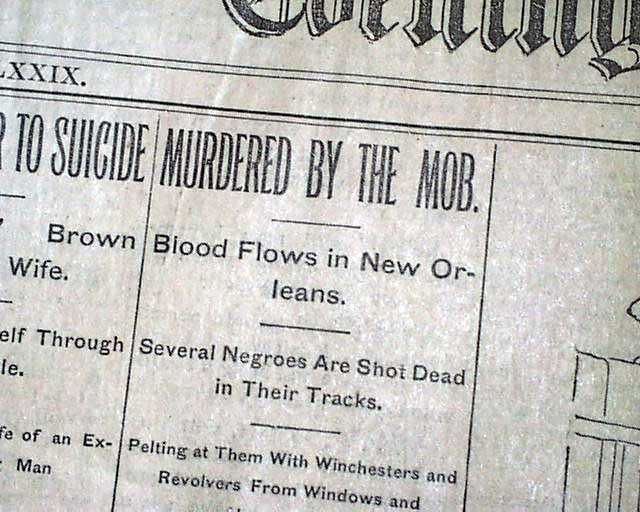
The 1895 New Orleans Dockworkers Riot was a racially motivated attack on non-union black dockworkers by white dockworkers and their sympathizers. The riot occurred in New Orleans, Louisiana from March 9 through 12, 1895 and marked the end of nearly 15 years of bi-racial union cooperation and union power in New Orleans. The riot also left six black laborers dead and many other wounded.
Throughout the 1880s and into the 1890s, black and white dockworker unions worked together to promote fair working conditions and wages for their workers along the New Orleans waterfront. In 1892, the year of the New Orleans general strike, black and white dockworker unions agreed to share work equally between white and black workers.
Following the economic panic of 1893 and the onset of a national depression, New Orleans commerce suffered tremendously from diminished trade, low cotton prices, smaller crops, and a decline in profits. Economic concerns intensified racial tensions and black dockworkers as white dockworkers began to discuss withdrawing from the equal share agreement.
In 1894, white dockworkers specifically accused black dockworkers of breaking the 1892 agreement by undercutting wages and agreeing to work for less money. By October of 1894, the white dockworkers’ union used that charge to formally expel the black unions from their alliance, terminating the brief bi-racial union association. White dockworkers also dock owners and merchants into hiring white workers only by refusing to work alongside black dockworkers. Rioting first erupted on October 26 after black workers were hired to replace striking white workers on some docks.
In December, 1894, the original 50/50 compromise was re-instated. But racial antagonisms remained as white unions, attempting to maintain their racially dominant position, did not give black dockworkers an equal number of jobs. And black workers, fearful of racial violence and unemployment, and encouraged by Booker T. Washington to abandon their interests in unions and strikes, became increasingly disillusioned. Many of them were now willing to work non-unions jobs both on and away from the docks that paid far less. As a result, an all-black, low-wage enclave developed that competed in a “race to the bottom” bidding war in wages with white unions.
In March 1895, the bidding war between white and black laborers erupted into violence. On March 9, nearly 500 armed white men looted a black dockworkers’ storage house destroying half of their equipment. Two days later two coordinated attacks by several hundred armed white men on black laborers left six black dockworkers dead and many more wounded. On March 13, Louisiana Governor Murphy J. Foster dispatched the state militia to protect commerce and property and allow the black dockworkers to continue working. Although peace prevailed, racial tensions along the New Orleans docks remained strained for years.
SUBJECTS:African American History, EventsTERMS:19th Century (1800-1899), United States – Louisiana, Racial Conflict – Race Riots
blackpast.org
Share this:

1853 ~ Native Americans attack transcontinental railroad survey crew in Utah

On October 25, 1853, members of the Paiute Indian Tribe attack U.S. Army Captain John W. Gunnison and his party of 37 soldiers and railroad surveyors near Sevier Lake, Utah. Gunnison and seven other men were killed, but the survey party continued with its work and eventually reported its findings to the United States Congress.
U.S. officials touted the transcontinental railroad as a project that, once complete, would provide critical infrastructure for 19th-century America.
But for many Native Americans, the railroad threatened hunting grounds, sacred sites and ancestral homelands, and it wiped out populations of buffalo, which were essential to tribal life. Attacks like the October 25 one by members of the Paiute Indian tribe, were one way Indigenous people tried to resist the intrusion.
Gunnison was a West Point graduate who had led several previous topographical surveys before being assigned to conduct this survey of potential railroad routes across central Colorado and Utah. Gunnison’s mission was only one of four surveys dispatched by the U.S. Congress in an attempt to break a sectional deadlock over which route the proposed transcontinental railroad should follow
Share this:

Seattle, WA ~ Wind Advisory ~Issued: National Weather Service
Alert is through Sunday
Update: Wind Advisory
From Sat 1:00 pm until Sun 5:00 am PDT

Issued By
Seattle/Tacoma – WA, US, National Weather Service
Affected Area
Puget Sound and Hood Canal
Description
…GALE WARNING IN EFFECT FROM 2 PM THIS AFTERNOON, Saturday TO 5 AM PDT SUNDAY… WHAT…South winds 25 to 35 kt. WHERE…Puget Sound and Hood Canal.
WHEN…From 2 PM this afternoon, Saturday to 5 AM PDT Sunday. IMPACTS… Strong winds will cause hazardous seas, which could capsize or damage vessels and reduce visibility. PRECAUTIONARY/PREPAREDNESS ACTIONS… A Gale Warning means winds of 34 to 47 knots are imminent or occurring. Operating a vessel in gale conditions requires experience and properly equipped vessels. It is highly recommended that mariners without the proper experience seek safe harbor prior to the onset of gale conditions.
...WIND ADVISORY IN EFFECT FROM 9 AM SATURDAY TO MIDNIGHT PDT
SATURDAY NIGHT...

* WHAT...Southeast to southwest winds 10 to 20 mph with gusts up to
35 to 40 mph expected at times.

* WHERE...Portions of northwest and west central Washington.

* WHEN...From 9 AM Saturday to midnight PDT Saturday Night.

* IMPACTS...Gusty winds could blow around unsecured objects.
Tree limbs could be blown down and a few power outages may result.

PRECAUTIONARY/PREPAREDNESS ACTIONS...

Use extra caution when driving, especially if operating a high profile vehicles. Secure outdoor objects.

Secure outdoor objects.
wunderground.com
Share this:

The White House Was, in Fact, Built by Slaves
SmartNews Keeping you current

Along with the Capitol and other iconic buildings in Washington, D.C.
By Danny Lewis
smithsonian.com

The first-known photograph of the White House, by John Plumbe, Jr. Library of Congress via The White House Historical Association Continue reading The White House Was, in Fact, Built by Slaves


You must be logged in to post a comment.