
All posts by Nativegrl77

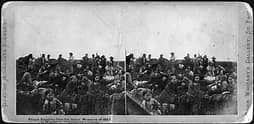
1862 – 300 Santee Sioux sentenced to hang in Minnesota


In Minnesota, more than 300 Santee Sioux are found guilty of raping and murdering Anglo settlers and are sentenced to hang.

A month later, President Abraham Lincoln commuted all but 39 of the death sentences. One of the Native Americans was granted a last-minute reprieve, but the other 38 were hanged simultaneously on December 26 in a mass execution witnessed by a large crowd of Minnesotans.

The Santee Sioux were found guilty of joining in the so-called “Minnesota Uprising,” which was actually part of the wider Indian wars that occurred throughout the West during the second half of the nineteenth century.

For nearly half a century, Anglo settlers invaded the Santee Sioux territory in the Minnesota Valley, and government pressure gradually forced the Native peoples to relocate to smaller reservations along the Minnesota River.

At the reservations, the Santee were badly mistreated by corrupt federal Indian agents and contractors; during July 1862, the agents pushed the Native Americans to the brink of starvation by refusing to distribute stores of food because they had not yet received their customary kickback payments. The contractors callously ignored the Santee’s pleas for help.

Outraged and at the limits of their endurance, the Santee struck back, killing Anglo settlers and taking women as hostages. The initial efforts of the U.S. Army to stop the Santee warriors failed, and in a battle at Birch Coulee, Santee Sioux killed 13 American soldiers and wounded another 47 soldiers. However, on September 23, a force under the leadership of General Henry H. Sibley finally defeated the main body of Santee warriors at Wood Lake, recovering many of the hostages and forcing most of the Native Americans to surrender. 

The subsequent trials of the prisoners gave little attention to the injustices the Native Americans had suffered on the reservations and largely catered to the popular desire for revenge. However, President Lincoln’s commutation of the majority of the death sentences clearly reflected his understanding that the Minnesota Uprising had been rooted in a long history of Anglo abuse of the Santee Sioux.

Ask yourself, what would be your response?

Don’t get it twisted… Abe’s momentary reflection of the abuse of Native Americans by “Anglo” people didn’t reduce the number of deaths on either side then or in the future, frankly. History, on this Heritage Month day.

The info is only as good as the facts and we have no idea if that video above is…

please correct the narrator if you can

-Nativegrl

November 5 – National Doughnut Day


National Doughnut Day started in 1939 as a fundraiser for Chicago’s Salvation Army, honoring the group’s “Lassies” of World War I who served doughnuts to soldiers. Doughnuts dates to mid to the mid 19th century though many places lay claim to inventing the breakfast (or anytime) favorite.

 And there will be another National Donut Day on Sunday, November 5, 2023. This recognized day of doughy goodness is thought to coincide with the “birthday” of the United States Marine Corps, which is on November 10.

Here are some of the best deals National Doughnut Deals we’ve found. Be sure to check ahead with your favorite spot to make sure they are participating. And don’t forget to check with local doughnut spots – many will be offering their own deals.

Dunkin’ Donuts

1950 – Earl Lloyd, first Black player in the NBA


On October 31, 1950, 21-year-old Earl Lloyd becomes the first African American to play in an NBA game when he takes the court in the season opener for the Washington Capitols.

Lloyd grew up in Jim Crow Virginia and went to West Virginia State, where he was the star of the school’s championship basketball team. He didn’t know he’d been drafted by the NBA until he ran into a friend on campus who told him she’d heard a rumor that he’d be moving to Washington. It turned out that the Capitols had picked him in the ninth round of the draft. Two other Black players joined the NBA that season—the Celtics drafted Chuck Cooper in the second round and the New York Knicks got Nat “Sweetwater” Clifton from the Harlem Globetrotters—but the Knicks and the Celts didn’t start their seasons until November. As a result, Lloyd became a coincidental pioneer: the first Black player to make his debut in the NBA.

Joining an all-white team was intimidating, Lloyd remembered, but his teammates—most of whom had played on integrated college teams—were immediately welcoming. Some fans, however, were less kind. As the announcer read the Capitols’ lineup on that first night of the season, a white man in the front row used a racial slur

history.com

1974 – Muhammad Ali wins the Rumble in the Jungle


On October 30, 1974, 32-year-old Muhammad Ali becomes the heavyweight champion of the world for the second time when he knocks out 25-year-old champ George Foreman in the eighth round of the “Rumble in the Jungle,” a match in Kinshasa, Zaire. Seven years before, Ali had lost his title when the government accused him of draft-dodging and the boxing commission took away his license. His victory in Zaire made him only the second dethroned champ in history to regain his belt.

The “Rumble in the Jungle” (named by promoter Don King, who’d initially tagged the bout “From the Slave Ship to the Championship!” until Zaire’s president caught wind of the idea and ordered all the posters burned) was Africa’s first heavyweight championship match. The government of the West African republic staged the event—its president, Mobutu Sese Seko, personally paid each of the fighters $5 million simply for showing up—in hopes that it would draw the world’s attention to the country’s enormous beauty and vast reserves of natural resources. Ali agreed. “I wanted to establish a relationship between American blacks and Africans,” he wrote later. “The fight was about racial problems, Vietnam. All of that.” He added: “The Rumble in the Jungle was a fight that made the whole country more conscious.”

history.com