All posts by Nativegrl77

1924 The Indian Citizenship Act ~ June 2


With Congress’ passage of the Indian Citizenship Act, the government of the United States confers citizenship on all Native Americans born within the territorial limits of the country.

Before the Civil War, citizenship was often limited to Native Americans of one-half or less Indian blood. In the Reconstruction period, progressive Republicans in Congress sought to accelerate the granting of citizenship to friendly tribes, though state support for these measures was often limited.

In 1888, most Native American women married to U.S. citizens were conferred with citizenship, and in 1919 Native American veterans of World War I were offered citizenship.

The Indian Citizenship Act of 1924, an all-inclusive act, was passed by Congress. The privileges of citizenship, however, were largely governed by state law, and the right to vote was often denied to Native Americans in the early 20th century.

… no words for this, sigh

Summer Solstice 2026: When Is the First Day of Summer?


Written By:Catherine Boeckmann, Executive Digital Editor and Master Gardener

December 11, 2025

Summer Days are here! Summer begins with the solstice on Sunday, June 21, 2026, marking the astronomical first day of summer in the Northern Hemisphere. What exactly IS the summer solstice? Is it really the longest day of the year? Welcome the solstice with some interesting facts and folklore.

The June Solstice

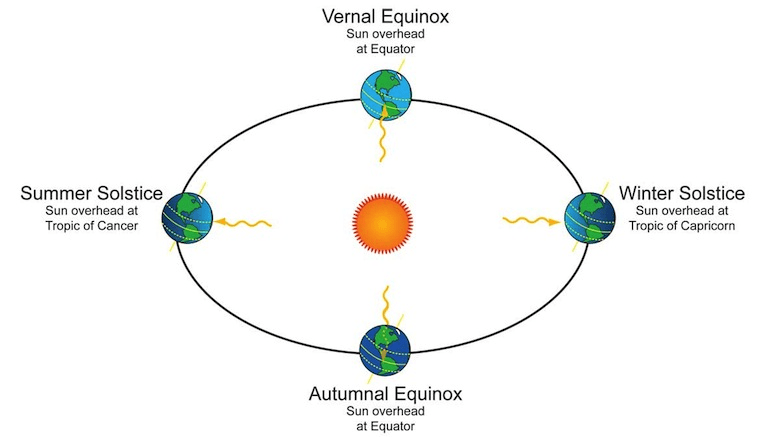
In the Northern Hemisphere, the June solstice (aka summer solstice) occurs when the Sun travels along its northernmost path in the sky. This marks the astronomical start of summer in the northern half of the globe. (In the Southern Hemisphere, it’s the opposite: the June solstice marks the astronomical start of winter when the Sun is at its lowest point in the sky.)

When is the Summer Solstice?

The June solstice occurs on Sunday, June 21, at 4:24 A.M. EDT. Curious what time 4:24 A.M. EDT is where you live? Try our Time Zone Converter.

This solstice marks the official beginning of summer in the Northern Hemisphere, occurring when Earth arrives at the point in its orbit where the North Pole is at its maximum tilt (about 23.5 degrees) toward the Sun, resulting in the longest day and shortest night of the calendar year. (By longest “day,” we mean the longest period of sunlight hours.) On the day of the June solstice, the Northern Hemisphere receives sunlight at the most direct angle of the year. 

In the Southern Hemisphere, the June solstice marks the beginning of winter. 

Source: almanac.com for the complete article

Tulsa… a massacre that still needs investigating! May 30th – June 1st


Today, some so-call Republicans want to say that the riot was NOT based on or because of their skin

CONTENTS

  1. Tulsa’s Black Wall Street
  2. What Caused the Tulsa Race Massacre?
  3. Greenwood Burns
  4. of the Tulsa Race Massacre
  5. News Blackout
  6. Tulsa Race Riot Commission Established, Renamed
  7. Sources

history.com

During the Tulsa Race Massacre, which occurred over 18 hours from May 31 to June 1, 1921, a white mob attacked residents, homes and businesses in the predominantly Black Greenwood neighborhood of Tulsa, Oklahoma. The event remains one of the worst incidents of racial violence in U.S. history, and, for a period, remained one of the least-known: News reports were largely squelched, despite the fact that hundreds of people were killed and thousands left homeless.

1851 Sojourner Truth delivers powerful speech on African American women’s rights


Why is there more than one version of Sojourner Truth’s famous 1851, “Ain’t I a Woman” speech?

Sojourner’s Speech, Transcribed by Marius Robinson; Anti-slavery bugle. volume (New-Lisbon, Ohio), 21 June 1851. Chronicling America: Historic American Newspapers. Lib. of Congress. Click here to Zoom in >

Most people are familiar with the 1863 popular version of Sojourner Truth’s famous, “Ain’t I a woman” speech but they have no idea that this popular version, while based off of Sojourner’s original 1851 speech, is not Sojourner’s speech and is vastly different from Sojourner’s original 1851 speech. I must acknowledge Nell Irvin Painter, a professor at Princeton University, specializing in American history and notable for her works on southern history of the nineteenth century. Professor Painter was the scholar who first rang the bell on this historical mistake. This site would not be possible with out relying on her brilliant work.

The popular but inaccurate version was written and published in 1863, (12 years after Sojourner gave the “Ain’t I a woman” speech), by a white abolitionist named Frances Dana Barker Gage. Curiously, Gage not only changed all of Sojourner’s words but chose to represent Sojourner speaking in a stereotypical ‘southern black slave accent’, rather than in Sojourner’s distinct upper New York State low-Dutch accent. Frances Gage’s actions were well intended and served the suffrage and women’s rights movement at the time; however, by today’s standards of ethical journalism, her actions were a gross misrepresentation of Sojourner Truth’s words and identity. By changing Truth’s words and her dialect to that of a stereotypical southern slave, Frances Gage effectively erased Sojourner’s Dutch heritage and her authentic voice. As well as unintentionally adding to the oversimplification of the American slave culture and furthering the eradication of our nation’s Northern slave history. Frances Gage admitted that her amended version had “given but a faint sketch” of Sojourner’s original speech, but she felt justified and believed her version was stronger and more palatable to the American public than Sojourner’s original version. 

— You have got to read the complete article!

Source: thesojournertruthproject.com