
Category Archives: Black History
Pioneers, Activists, Black People, Black History

The Birth of a Nation – Full Movie – (1915) HD – The Masterpiece of Racist Cinema

James Baldwin
James Baldwin, in full James Arthur Baldwin, (born August 2, 1924, New York, New York—died December 1, 1987, Saint-Paul, France), American essayist, novelist, and playwright whose eloquence and passion on the subject of race in America made him an important voice, particularly in the late 1950s and early 1960s, in the United States and, later, through much of western Europe.
The eldest of nine children, he grew up in poverty in the Black ghetto of Harlem in New York City. From age 14 to 16 he was active during out-of-school hours as a preacher in a small revivalist church, a period he wrote about in his semi-autobiographical first and finest novel, Go Tell It on the Mountain (1953), and in his play about a woman evangelist, The Amen Corner (performed in New York City, 1965).
After graduation from high school, he began a restless period of ill-paid jobs, self-study, and literary apprenticeship in Greenwich Village, the Bohemian quarter of New York City. He left in 1948 for Paris, where he lived for the next eight years. (In later years, from 1969, he became a self-styled “transatlantic commuter,” living alternatively in the south of France and in New York and New England.) His second novel, Giovanni’s Room (1956), deals with the white world and concerns an American in Paris torn between his love for a man and his love for a woman. Between the two novels came a collection of essays, Notes of a Native Son (1955).
In 1957 he returned to the United States and became an active participant in the civil rights struggle that swept the nation. His book of essays, Nobody Knows My Name (1961), explores Black-white relations in the United States. This theme also was central to his novel Another Country (1962), which examines sexual as well as racial issues.
The New Yorker magazine gave over almost all of its November 17, 1962, issue to a long article by Baldwin on the Black Muslim separatist movement and other aspects of the civil rights struggle. The article became a best seller in book form as The Fire Next Time (1963). His bitter play about racist oppression, Blues for Mister Charlie (“Mister Charlie” being a Black term for a white man), played on Broadway to mixed reviews in 1964.
Though Baldwin continued to write until his death—publishing works including Going to Meet the Man (1965), a collection of short stories; the novels Tell Me How Long the Train’s Been Gone (1968), If Beale Street Could Talk (1974), and Just Above My Head (1979); and The Price of the Ticket (1985), a collection of autobiographical writings—none of his later works achieved the popular and critical success of his early work.
The Editors of Encyclopaedia Britannica
Share this:

Honoring Trayvon – In memory
 |
|
|

Share this:

1968 – Black Soldiers stage sit-in at Fort Hood – Black History
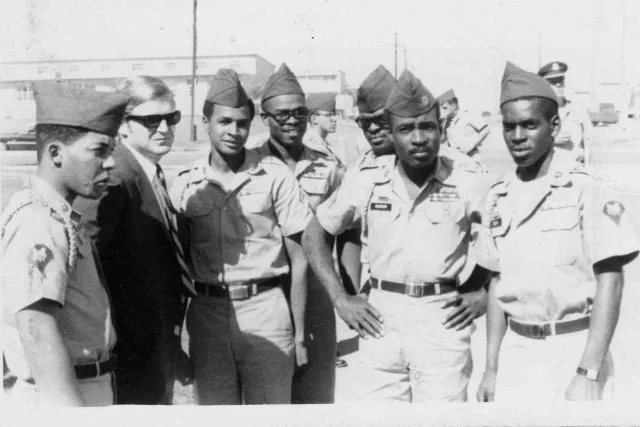
On the morning of August 23, 1968, a group of Black soldiers at Fort Hood, Texas stage one of the largest acts of civil disobedience ever recorded among members of the United States military. Adopting the non-violent tactics of the civil rights movement, the soldiers stage a sit-in to protest their impending deployment to Chicago to defend the Democratic National Convention from protesters.
By 1968, sit-ins were a well-established, peaceful way to protest segregation and demand racial equality. But even as the war in Vietnam escalated and more Americans were sent to fight there, dissent by active-duty military personnel remained rare. Tensions all over the country were peaking in August of 1968 in the wake of the assassinations of the Rev. Dr. Martin Luther King Jr. and Sen. Bobby Kennedy, who was seeking the Democratic nomination. As protesters headed to Chicago to demand aggressive action on civil rights and an anti-war plank in the Democratic Party’s platform, law enforcement geared up for what would turn out to be a brutal crackdown.
The convention had not yet begun when the troops at Fort Hood received word that they would be deployed to Chicago. The night before they were slated to ship out, 60 Black soldiers sat down at an intersection on the grounds of the fort and began their sit-in. “The people we are supposed to control, the rioters, are probably our own race,” one of them reportedly said. “We shouldn’t have to go out there and do wrong to our own people.” Others stated that they had served honorably and done everything the Army asked, but drew the line at a treating their fellow citizens as “hostiles.”
Source: for the complete article, go to history.com

 Be a Seed for Change
You must be logged in to post a comment.