Category Archives: Black History

Pioneers, Activists, Black People, Black History

James Baldwin


James Baldwin, in full James Arthur Baldwin, (born August 2, 1924, New York, New York—died December 1, 1987, Saint-Paul, France), American essayist, novelist, and playwright whose eloquence and passion on the subject of race in America made him an important voice, particularly in the late 1950s and early 1960s, in the United States and, later, through much of western Europe.

The eldest of nine children, he grew up in poverty in the Black ghetto of Harlem in New York City. From age 14 to 16 he was active during out-of-school hours as a preacher in a small revivalist church, a period he wrote about in his semi-autobiographical first and finest novel, Go Tell It on the Mountain (1953), and in his play about a woman evangelist, The Amen Corner (performed in New York City, 1965).

After graduation from high school, he began a restless period of ill-paid jobs, self-study, and literary apprenticeship in Greenwich Village, the Bohemian quarter of New York City. He left in 1948 for Paris, where he lived for the next eight years. (In later years, from 1969, he became a self-styled “transatlantic commuter,” living alternatively in the south of France and in New York and New England.) His second novel, Giovanni’s Room (1956), deals with the white world and concerns an American in Paris torn between his love for a man and his love for a woman. Between the two novels came a collection of essays, Notes of a Native Son (1955).

In 1957 he returned to the United States and became an active participant in the civil rights struggle that swept the nation. His book of essays, Nobody Knows My Name (1961), explores Black-white relations in the United States. This theme also was central to his novel Another Country (1962), which examines sexual as well as racial issues.

The New Yorker magazine gave over almost all of its November 17, 1962, issue to a long article by Baldwin on the Black Muslim separatist movement and other aspects of the civil rights struggle. The article became a best seller in book form as The Fire Next Time (1963). His bitter play about racist oppression, Blues for Mister Charlie (“Mister Charlie” being a Black term for a white man), played on Broadway to mixed reviews in 1964.

Though Baldwin continued to write until his death—publishing works including Going to Meet the Man (1965), a collection of short stories; the novels Tell Me How Long the Train’s Been Gone (1968), If Beale Street Could Talk (1974), and Just Above My Head (1979); and The Price of the Ticket (1985), a collection of autobiographical writings—none of his later works achieved the popular and critical success of his early work.

The Editors of Encyclopaedia Britannica

2020 Ahmaud Arbery is shot dead while out jogging


Ahmaud Arbery, a 25-year-old Black man, is shot dead by a white father and son while out for a jog in a suburb of Brunswick, Georgia on February 23, 2020.  On May 7, following the release of a video of the killing that spurred national attention from the media, civil rights …read more

Image from improvethenews.org

1868 – WEB Du Bois


W.E.B. Du Bois
Born: February 23, 1868
Died: August 27, 1963
Age: 95 years old
Birthplace: Great Barrington, MA, United States
Occupation: Educator, Civil Rights Activist, Journalist

Read W.E.B. Du Bois’s biography >>

On February 23, 1868, William Edward Burghardt (W.E.B.) Du Bois is born in Great Barrington, Massachusetts. A brilliant scholar, Du Bois was an influential proponent of civil rights.

Du Bois’ childhood was happy, but during adolescence he became aware of a “vast veil” separating him from his white classmates. He devoted most of his life to studying the position of Black Americas from a sociological point of view. He took his doctorate at Harvard but was unable to get a job at a major university, despite his impressive academic achievements and the publication of his doctoral thesis, about the slave trade to the United States in the mid-1800s. He taught at Wilberforce College in Ohio, then spent a year at the University of Pennsylvania, where he wrote his first major book, The Philadelphia Negro: A Social Study (1899). The book was the first sociological case study of a Black community.

Source: history.com

African Americans in Full Color – in memory of Black History – a repost


NMAAHC -- National Museum of African American History and Culture

Lonnie Bunch, museum director, historian, lecturer, and author, is proud to present A Page from Our American Story, a regular on-line series for Museum supporters. It will showcase individuals and events in the African American experience, placing these stories in the context of a larger story — our American story.A Page From Our American Story

African Americans in Full Color

In the first half of the twentieth century, Americans became fascinated with photo journalism. Pictures were literally “worth a thousand words” as full-color magazines and tabloid newspapers became the rage.

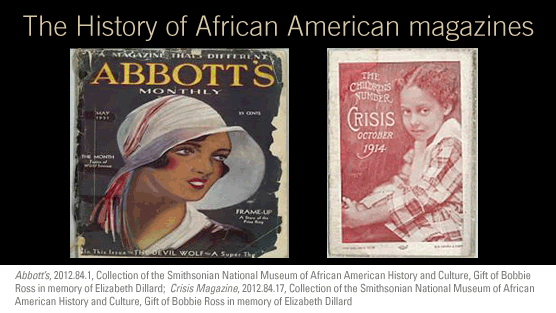
Publications targeted to African American audiences that featured illustrations and photographs began appearing in the early 1900s. One of the earliest to effectively use illustrations and photography was The Crisis, the official publication of the NAACP. Seeking to educate and inform its readers with scholarly articles, the covers of the journal and its entertainment section were designed to appeal to the masses of African Americans.

In the 1930s, we see pictorial magazines such as Abbott’s Monthly, published by Robert Sengstacke Abbott, the founder of the Chicago Defender newspaper, and Flash, which billed itself as a “weekly newspicture magazine.” Published in Washington, D.C., Flash contained a mixture of news, gossip and advertisements and articles on racial issues, providing an overview of the highs and the lows of Black life in the 1930’s.

In 1942, African American businessman John H. Johnson founded the Johnson Publishing Company, a corporation that would go on to publish the well-known magazines Ebony, Jet, Tan, and Ebony Jr. The magazines promoted African American achievements and affirmative black imagery in popular culture, which appealed to readers … and to advertisers. Mr. Johnson was a savvy businessman and used the statistics of a rising black middle class to persuade companies and businesses that it was in their economic “self-interest” to advertise in his magazines to reach African American consumers.

With the success of the Johnson Publishing Company’s magazines, other magazines targeted to African Americans quickly came on the scene. For example, in 1947 Horace J. Blackwell published Negro Achievements, a magazine highlighting African American success articles and featuring reader-submitted true confessions stories. After Blackwell died in 1949, a white businessman named George Levitan bought the company and renamed the publication Sepia. This publication featured columns by writer John Howard Griffin, a white man who darkened his skin and wrote about his treatment in the segregated South, that eventually became the best-selling book Black Like Me.

Whether featuring positive images of African Americans, inspiration stories, news features or commentaries on racism, the rise of African American magazines defied long-held racial stereotypes through rich storytelling, in-depth reporting, and stunning photography.

Due to a variety of economic, editorial, and other factors, most of these magazines have ceased being published. Yet today some African American magazines are still a thriving part of popular culture. Johnson Publishing Company’s Ebony and its digital sites reach nearly 72% of African Americans and have a following of over 20.4 million people.

 dd-enews-temp-lonnie-bunch-2.jpg All the best,

Lonnie Bunch
Director

P.S. We can only reach our $250 million goal with your help. I hope you will consider making a donation or becoming a Charter Member today.

To read past Our American Stories, visit our archives.