Mexico declared its independence from mother Spain at midnight, the 15th of September, 1810. It took 11 years before the first Spanish soldiers were told and forced to leave Mexico.
So, why Cinco de Mayo? And why would Americans savor this day as well?
Because 4,000 Mexican soldiers smashed the French and traitor Mexican army of 8,000 at Puebla, Mexico, 100 miles east of Mexico City on the morning of May 5 1862.
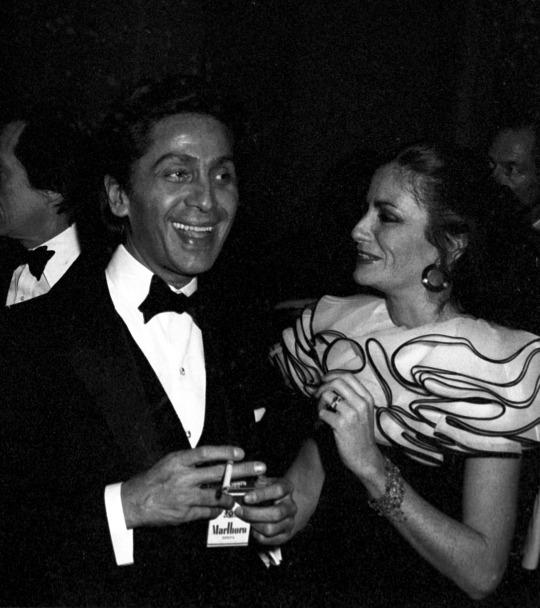
Designer Valentino at the 1980 gala, celebrating the opening of The Manchu Dragon-Costumes of China exhibition at the Metropolitan Museum of Art. Photo: Getty Images
On May 4, 2015, fashion’s elite will walk the red carpet at the Metropolitan Museum of Art’s annual Costume Institute Benefit, known to the world at large as the Met Ball.
The ultra-exclusive event—often referred to as “The Party of the Year”—generates millions of dollars for the institute’s popular exhibitions, which have in recent years included “Charles James: Beyond Fashion,” “Schiaparelli and Prada: Impossible Conversations,” and “Alexander McQueen: Savage Beauty.”
Fashion has never been more ingrained in popular culture than it is today, and the Costume Institute’s most important shows—which typically attract between and 500,000 and 600,000 people over a three-month period—have played a significant role in introducing clothes-as-art to the masses.
Irene Lewisohn founded what was first known as the Museum of Costume Art in 1937. An heiress and philanthropist who spent much of her time in the theater, Lewisohn’s own closet of costumes was the starting point. (The collection now boasts more than 35,000 pieces.) In 1946, the museum moved from Lewisohn’s home library to the Met. The first exhibit, organized by executive director Polaire Weissman, was a series of nine tableaux: the 49 costumes were paired with furniture and accessories from the Met and the Museum of the City of New York.
The parties began in 1948, as the Costume Institute has always relied on the fashion industry’s financial and vocal support in order to thrive. Legendary fashion publicist Eleanor Lambert, who also curated the opening exhibition, chaired the first event. The tickets were $50, a bargain compared to the purported $25,000 it cost to attend the benefit in 2014.
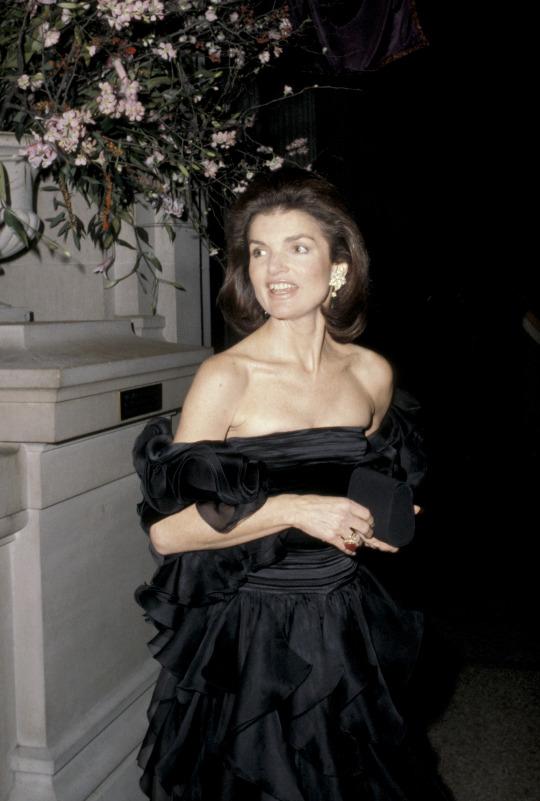
Jackie Kennedy Onassis at the 1979 gala, Fashions of the Hapsburg Era. Photo: Getty Images
Over the years, displaying clothes alongside other sorts of objects and art distinguished the Costume Institute’s exhibitions. In 1972, the already-popular department was set to rise in profile even further, thanks to the appointment of former Harper’s Bazaar and Vogue editor-in-chief Diana Vreeland as special consultant. “She was the ultimate storyteller,” says Lisa Immordino Vreeland, director of Diana Vreeland: The Eye Has to Travel.
Immordino Vreeland is married to Diana Vreeland’s grandson, although she never met the editor. She did, however, spend three years researching her life’s work for the aforementioned 2012 documentary. The director recalls Vreeland traveling with her friend Jacqueline Kennedy Onassis to Russia in order to procure Peter the Great’s boots. They were for her 1976 exhibit, The Glory of Russian Costume. “A similar iteration of the show went to Paris and London, but Mrs. Vreeland was able to get things these other exhibitions never could,” says Harold Koda, chief curator at the Costume Institute, who first worked there as an assistant under Vreeland. For example, Catherine the Great’s silver wedding dress was exclusive to the Met’s exhibition. Vreeland understood that, while there is historical significance in every type of garment, a piece worn by a grand figure would add the layer of showmanship needed attract a wider breadth of visitors. “She merchandised clothing and history through the lens of privilege,” Koda says.
Through her years at the Met, Vreeland spotlighted Balenciaga, the costumes of the Ballet Russes, and put together a 25-year retrospective of Yves Saint Laurent’s career. She was notoriously late, and used to physically try on the clothes herself, according to fashion insider Simon Doonan’s 2012 memoir The Asylum: Tales of Madness from a Life in Fashion. Along the way, Vreeland managed to make fashion exciting to the general public.
Legendary fashion editor Diana Vreeland with designer Bill Blass at the 1981 gala, in celebration of the 18th Century Woman exhibit. Photo: Getty Images
Vreeland passed away in 1989, and that same year Richard Martin became the Costume Institute’s chief curator. Martin joined from the Fashion Institute of Technology and brought Koda—who had left the Met in 1979 to work at F.I.T.—with him. “He was the intellect behind the interpretation,” Koda says of their relationship. Koda would choose many of the objects, while Martin did all of the writing, putting each piece into context for the viewer. Martin and Koda’s Costume Institute was different from Vreeland’s. She would borrow dozens of pieces from outside museums and keep them on display for nine months at time. As concerns about wear increased—light damage is particularly destructive to clothing—the loans decreased. Instead of hosting one nine-month exhibit per year, Martin chose to create three themed exhibits so that clothes from the archive were not used as often.
According to Koda, the 1993 exhibition, “Infra-Apparel”, was a defining moment for the duo. In many ways, it was a history of lingerie, but it was also an examination of cultural mores. For instance, they showed a Jean-Paul Gaultier bustier outfit next to a 1780s gown made of lightweight, ultra-fine cotton. The latter is called a chemise à la reine, named after Marie Antoinette, who was scandalized for wearing what many felt looked too much like lingerie. Fast forward more than 200 years, and Madonna was making similar headlines by arriving onstage in Gautier’s cone bra.
“We realized that if you just showed the Marie Antoinette dress, no one would come,” Koda says. “By comparing it to something contemporary and familiar, it makes the [Marie Antoinette dress] more relevant.”
When Martin passed away in 1999, Koda was appointed curator in charge. (Andrew Bolton, the institute’s other curator, joined in 2002.) During Koda’s time at the helm, the museum’s hosted some of the most captivating and well-attended costume exhibitions in the history of the medium, from 2001’s “Jacqueline Kennedy: The White House Years”—guest curated by Vogue international editor at large Hamish Bowles—to “Savage Beauty,” which attracted more than 660,000 visitors, placing it among the top ten most viewed exhibitions in the museum’s history.
Over the years, the institute has also played a role in the careers of fashion luminaries including Vogue editors Tonne Goodman and Andre Leon Talley, both of whom worked under Vreeland, as well as Doonan and even designer Zac Posen, who interned there as a high school student in the late ‘90s.
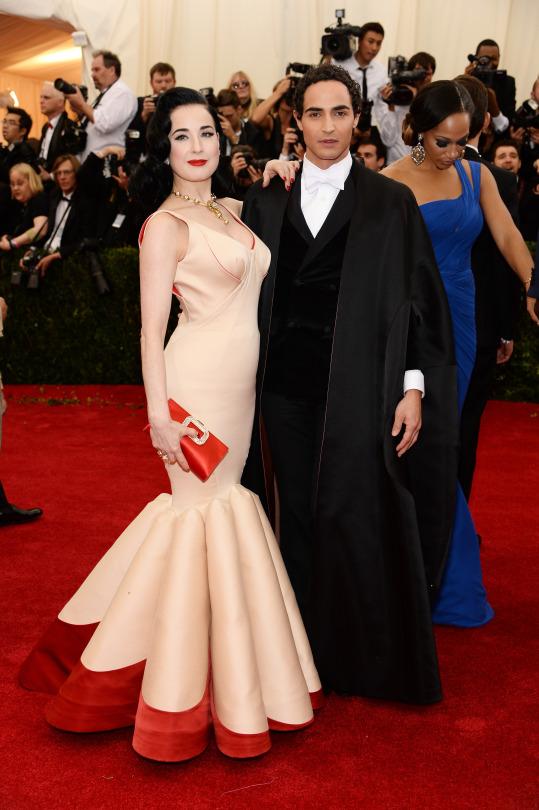
Designer Zac Posen with Dita Von Teese, in one of his gowns, at the 2014 gala, Charles James: Beyond Fashion. Photo: Getty Images
Posen landed at the Met by introducing himself to Martin during a visit to the Costume Institute in 1997. While much of his time was spent clipping newspaper articles and doing other sorts of basic research, it was not entirely without glamour. Once, he was allowed to skip school so that he could be at the museum when John Galliano, who’d just been installed at the house of Dior, came in to research the archives with muse Vanessa Bellanger and business partner Steven Robinson. “Vanessa was wearing a bias-cut dress in grey jersey, and I thought, ‘Wow, this is a muse,’” Posen recalls. He was even invited to eat lunch with them. “It was a privilege and honor, and also one of my greatest memories.”
It was also around that time that Posen attended his first Met Ball after party. (He bought a staff ticket, and made his own outfit: a grey velvet suit with emerald green lining.) Nearly two decades later, his own gowns are regularly worn to the Met Ball, an event with increasing significance to those outside of the fashion world. That’s much in thanks to Vogue editor in chief and co-chair Anna Wintour, who has used her influence to persuade A-list celebrities to pepper the red carpet. For this year’s event, which celebrates the latest exhibition, “China: Through the Looking Glass,” co-chairs include Jennifer Lawrence and Yahoo ceo Marissa Mayer. In fact, Wintour’s efforts have been so great that in 2014, the museum’s redesigned Costume Institute space was renamed the Anna Wintour Costume Center in her honor.
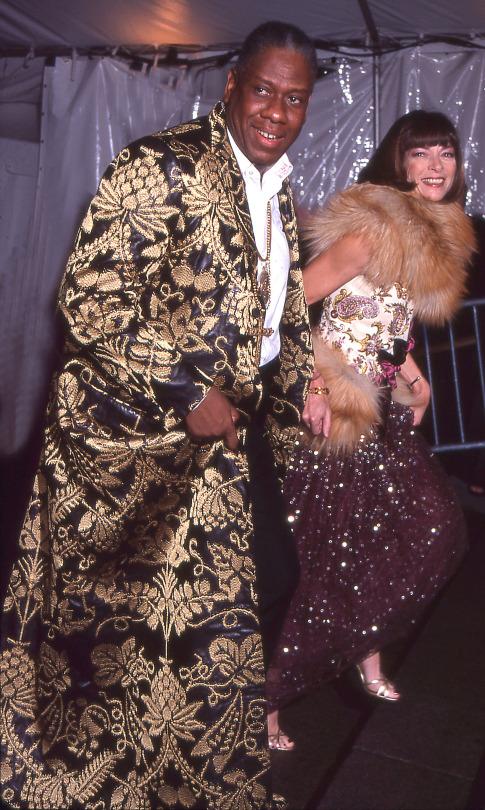
Vogue’s former editor at large, Andre Leon Talley, and the magazine’s editor in chief, Anna Wintour, at the gala in 1999. Photo: Getty Images
The Costume Institute’s gravitas is undeniable, but what might be most incredible about the organization is its longevity. While attendance at museums and other cultural institutions has been in decline for two decades, the Costume Institute’s three-month shows draw numbers comparable to what Vreeland’s exhibits drew over the course of nine months. Its success has also spurred more fashion exhibitions around the world, from the Victoria and Albert’s recent revitalization and expansion of “Alexander McQueen: Savage Beauty,” to the Alaia and Jeanne Lanvin exhibitions at the Musée Galliera in Paris. “If you’re the only game in town, what do you have to measure yourself against? We’re not the only 500 lb. gorilla anymore, and that’s good,” says Koda. “It shows a cultural investment in fashion as phenomenon.”
From 1946, the poet and novelist Vita Sackville-West wrote a gardening column in the Observer. The columns were later collected into a set of books published between 1951 and 1958. Vita’s extensive gardening knowledge, her intense passion for her subject and her lively literary flair make these classics of garden writing essential for any serious gardener’s bookshelf. Volume 1 in a series of four anthologies reproducing the lively gardening columns by Vita Sackville-West. This volume covers 1946–1950.
Prohibited seeking or imposing the death penalty on the basis of race. The act identified types of evidence that might be considered by the court when considering whether race was a basis for seeking or imposing the death penalty and established a process by which relevant evidence might be used to establish that race was a significant factor in seeking or imposing the death penalty. The defendant had the burden of proving that race was a significant factor in seeking or imposing the death penalty, and the state was allowed to offer evidence to rebut the claims or evidence of the defendant. If race was found to be a significant factor in the imposition of the death penalty, the death sentence would automatically be commuted to life imprisonment without the possibility of parole.[1]
North Carolina General Assembly Repeal Attempts [edit]
Under pressure from a group of 43 district attorneys, who expressed opposition to the act citing the clog of the court system in the state, the North Carolina Senate passed a bill by a 27-14 vote on November 28, 2011, that would have effectively repealed the Racial Justice Act.[2]
However, on December 14, GovernorBev Perdue, a Democrat, vetoed the bill, saying that while she supports the death penalty, she felt it was “simply unacceptable for racial prejudice to play a role in the imposition of the death penalty in North Carolina.”[3] The state legislature did not have enough votes to override Perdue’s veto.
The North Carolina General Assembly passed a major revision of the law in 2012 authored by Rep. Paul Stam (R-Wake). The rewrite “severely restricts the use of statistics to only the county or judicial district where the crime occurred, instead of the entire state or region. It also says statistics alone are insufficient to prove bias, and that the race of the victim cannot be taken into account.” The bill was vetoed by Gov. Perdue, but this time, the legislature overrode the governor’s veto.[4]
The North Carolina General Assembly voted to effectively repeal the entire law in 2013 and Gov. Pat McCrory, a Republican, signed the repeal into law.[5]
On April 20, 2012, in the first case appealed under the Racial Justice Act, the then-Senior Resident Superior Court Judge in Cumberland County (Fayetteville), Judge Greg Weeks, threw out the death sentence of Marcus Raymond Robinson, automatically commuting his sentence to life without parole. Robinson contended that when he was sentenced to death in 1994, prosecutors deliberately kept blacks off the jury. Robinson’s lawyers cited a study from Michigan State University College of Law indicating that prosecutors across North Carolina improperly used their peremptory challenges to systemically exclude qualified black jurors from jury service.[6][7][8]
Goodwill in Tacoma is beginning to sell African artifacts valued at more than $11,000.
The 55 artifacts, from the mid-19th to mid-20th century, were used in tribal life and for tribal ceremonies. An anonymous donor left the 55 artifacts at the Port Townsend Goodwill store last month.
The items will be sold online at Shopgoodwill.com, a site used to produce the highest prices for items. The site uses competitive bidding to sell high-end fashion, jewelry, art and other items.
Go to the search portion of the site, pick Tacoma in the drop-down menu of sellers, then search for the items.
Goodwill wants the public to know about the online sales. Officials figure if people know valuable goods can fetch a good price, they might be more willing to donate.
“Many people hesitate to donate their high-end furniture, jewelry, clothing, art and collectibles because they assume their treasures will end up for $4 in our thrift stores,” said Dylan Lipert, manager of online sales, in a news release. “My job is to make sure that doesn’t happen.”
(The gallery above shows some of the artifacts, as well as other items that have or will be sold online.)
More than 140 Goodwill agencies provide items for sale online. In the past six years, Tacoma online operations have more than doubled in size and sales from $2.1 million in FY 2008 to $4.5 million in FY 2013.
SEATTLE — Someone recently donated an old vest to Goodwill, and while that could happen everyday, this one was unusual.
By old, we mean a century old. It’s a beaded Native American vest that’s so valuable, Goodwill couldn’t bear to sell it.
Instead, the non-profit decided to make its own donation. Now, curators from the Burke Museum are analyzing the vest.
It’s an exquisitely detailed piece from the early 1900s. Everything from the color of the beads to the geometric designs to the velvet lining is a clue pointing to the vest’s history.
“Whoever gave it to Goodwill probably knew more about it. They probably knew their grandfather got it while on a train ride through Glacier. That’s the kind of information we’d love to have,” said Robin Wright, Curator of Native American Art.
The vest was inside a trunk, donated to Goodwill in 2006. Someone recognized its value, and instead of going up for sale, the vest went into storage.
Katherine Boury of Goodwill explained, “We have to make the decision, what’s the best use of the donation. In this case because it’s of cultural significance, it seems it would be best to be accessible to everyone.”
Assessors pinpointed it as Native American work from the northern plains.
“There’s been some discussion with various experts about which particular tribe and we’re not able to say precisely which tribe it might be,” said Wright.
It might have been regalia for a pow wow, but at some point, it seems it was sold to a tourist.
Written on the lining – a price tag of $18 – for a vest that probably took several months to make. There is no price on the vest now, and while there are still questions about where it came from, there’s no question where it’s going.
The museum will keep the vest in its collection for the public to see and treasure.
Do you think you have an artifact in your home? Take up to three objects to the annual Artifact ID Day at the Burke on Feb. 9.
The Hopi tribe of northeastern Arizona and supporters including the U.S. ambassador to France and actor Robert Redford had urged the Paris auction house to suspend the sale due to the masks’ cultural
The gavel came down on 70 sacred Hopi Indian masks at the Drouot auction house in Paris on Friday, generating $1.2 million for the owners and auctioneers – and anger and emotional cries from
wonder if there are updates on any of these stories and hopefully progress on stopping this from happening… return them to their place of origin


 Happy Cinco de Mayo






 Be a Seed for Change
You must be logged in to post a comment.