James Warren – James Warren is a journalist who worked for the
Chicago Tribune, writes columns for the
New York Times and
Business Week and is a political analyst for MSNBC.
Jun 7 2010, 12:21 PM ET |  Comment
Mistreatment of Indians is America’s Original Sin, and the narrative is consistent. They lose their land, get portrayed as caricatures of social maladies, and are ripped off by the likes of Jack Abramoff. So it’s no surprise that a tale with a very different ending, namely the righting of a horrible wrong affecting 500,000 Native Americans, proceeds with virtually no notice.Indeed, you’d think that even Tea Party diehards should rally to this cause, given their anti-government and pro-property rights passion. They might even want to pay homage to the intrepid female accountant-turned-banker, who inspired one of the most fiercely litigated disputes against the federal government in history. But they likely won’t. Who will? Not even many Indians believe that belated fairness is now on the way, given more than a century of government abuse and deceit whose undisputed facts strain credulity.The facts are these: Following the House’s approval, the Senate
is considering whether to approve a $3.4 billion settlement of a 15-year-old lawsuit, alleging the government illegally withheld more than $150 billion from Indians whose lands were taken in the 1880s to lease to oil, timber, minerals and other companies for a fee. Back then, the government started breaking up reservations, accumulating over 100 million acres, giving individual Indians 80 to 160 acres each, and taking legal title to properties placed in one of two trusts. The Indians were given beneficial ownership but the government managed the land, believing Indians couldn’t handle their affairs. With leases for oil wells in Oklahoma, resorts in Palm Springs, and rights-of-ways for roads in Scottsdale, Arizona, some descendants of original owners receive six- and even seven-figure sums annually. But the prototypical beneficiary, now poised to share in the settlement, is a poor Dakotan who struggles to afford propane to heat his quarters and has been receiving as little as $20 a year. More than $400 million a year is collected from Indian lands and paid into U.S. Treasury account 14X6039.
The story turns on theft and incompetence by the Interior and Treasury Departments, with culprits including Interior’s Bureau of Indian Affairs (BIA) and the same Minerals Management Service now at the center of the BP oil spill fiasco. Over the past 100 years, government record systems lost track of more than 40 million acres and who owns them. The records simply vanished. Meanwhile, documents were lost in fires and floods, buried in salt mines or found in an Albuquerque storage facility covered by rat feces and a deadly Hantavirus. Government officials exploited computer systems with no audit trails to turn Indian proceeds into slush funds but maintain plausible deniability.
The lack of accountability is confirmed in the government’s own reports and testimony dating to the early 20th century. Conclusions of “fraud,” “corruption,” “institutional incompetence,” “deficiencies in accounting,” “the accounts lack credibility,” “multifaceted monster,” “organizational nightmare,” “dismal history of inaction,” “criminal negligence,” and “sorry history of department mismanagement,” are found regularly between 1915 and the present. Congress ordered an accounting in 1994 but interior secretaries in both the Clinton and George W. Bush administrations were held in civil contempt for not forking over records. District Judge Royce Lamberth, a Texas Republican nominated by President Reagan who oversaw the case for a decade, called the whole matter “government irresponsibility in its purest form.”
I sat in Lamberth’s courtroom in 1999 when Interior Secretary Bruce Babbitt both lost his cool and conceded that the government couldn’t provide accurate cash balances of most accounts and that “the fiduciary obligation of the United States is not being fulfilled.” But the dispute would not end, as the Clinton and Bush administrations fought unceasing adverse rulings in a case inspiring 3,600 separate court filings and 80 published decisions. No single case, including the antitrust action against Microsoft, has been as heavily litigated and defended by the government, say lawyers.
The government’s chief nemesis has been Elouise Cobell, a member of the Blackfeet Nation in Montana, the accountant-turned-banker who in 1987 started Blackfeet National Bank, the first national bank on a reservation. With a very small team of attorneys led by a Washington banking specialist, Dennis Gingold, her suit has inspired 3,600 court filings and 80 published decisions. Not even the antirust action against Microsoft was as heavily litigated by the government.
The historic resistance melded with an unsympathetic appeals court often overruling the dispute’s two trial judges. It ordered removal of Lamberth, now the district court’s chief judge, due to harsh language toward the government. Last year, it threw out a ruling by District Judge James Robertson, Lamberth’s successor, that the Indians were owed $476 million, a pittance compared to the reduced, $48 billion they were seeking by then. Presidential candidates Barack Obama and John McCain both urged settlement during the 2008 campaign.
A resolute Judge Robertson then hauled Interior Secretary Ken Salazar and plaintiffs into his chambers last year. He made clear to one and all that, in light of the latest appeals court ruling, both sides had the choice between spending maybe another 10 years in court or trying to finally settle. The initial atmosphere was not necessarily conducive to harmony. Career government employees in the Interior, Justice and Treasury departments felt burned after years of being belittled by both the plaintiffs and Judge Lamberth. Meanwhile, the plaintiffs had minimal trust in the government. But political appointees in the Obama administration, including Salazar and Attorney General Eric Holder, took their cue from President Obama’s own support of a settlement. Dozens of meetings ensued, with the many prickly issues including how far back in time one would go to try to determine who should benefit.
Ultimately, Judge Robertson prodded what, given all the legal setbacks, is an impressive $3.4 billion deal announced in December. Ironically, before the recent congressional recess, the House approved the deal and Robertson announced his retirement, meaning District Judge Thomas Hogan becomes the third, and hopefully final, arbiter in the case. He would oversee a so-called “fairness hearing” in which objections can be raised.
There is inherent complexity in wrapping up. If the Senate approves, there will be a media campaign throughout Indian Country, including direct mail, newspaper and broadcast public service advertisements. Garden City Group of Melville, New York, which handled the major class action against Enron, will be claims administrator. It will get computer lists from the Interior Department, with the account information of perhaps 500,000 Indians and then doublecheck names and addresses. How good are the records? Nobody is really sure.
The $3.4 billion will be placed in a still-to-be-selected bank and $1.4 billion will go to individuals, mostly in the form of checks ranging from $500 to $1,500. A small group, such as members of the Osage tribe who benefit from huge Oklahoma oil revenues, will get far more, based on a formula incorporating their 10 highest years of income between 1985 and 2009. As important, $2 billion will be used to buy trust land from Indian owners at fair market prices, with the government finally returning the land to tribes. Nobody can be forced to sell. As for the winning lawyers, their take is capped at $100 million, actually low by class-action standards, though Republican Sen. John Barrasso of Wyoming, an orthopedic surgeon, has groused about the fees.
The fairness hearing will be interesting since many Indians have a hard time believing they’re not still being shafted. “This proposed settlement fixes nothing, the U.S. won by legal weaseling,” writes a member of the Upper Midwest’s Prairie Band Potawatomi tribe on a message board. He’s not alone. Like a family victimized by homicide, Indians may never experience enough healing to truly recover. But, finally, as hard as it is for them to believe, there really may be some justice.
P/CPoint edit…there were many responses to this article by Mr. Warren; but the one response I had to add is…below;
from …ThomsMWabnum
My article was reference in yours. This is the complete article as posted in other websites. Thank you for posting it.First, I would like to thank Ms. Cobell for the strength and courage to fight the U.S. on our behalf for the past 13 years.
This proposed settlement fixes nothing, the U.S. won by legal weaseling. This lawsuit maybe settled but the mismanagement and corruption continues. The centuries old broken government trust is still broken. The IIM accounts are still not reconciled. Some IIM accountholders will get paid and some will not. OST has violated the Indian Preference policy and hire non-Indians in Indian positions. The Cobell and numerous investigations on DOI/BIA/OST by OIG, GAO and the courts that proved numerous times they are either unwilling or unable to fix their broken trust. They went unpunished and will continue to operate into the future as if nothing happened. As if Indian Affairs has not been ‘commissioned’ to death, this settlement adds another one.
If all Individual Indian lands are bought off and transferred over to tribal trust property, the same historical broken trust is there not to protect it or improve it. The same slumlord mentality, scalawag management and Judge Roy Bean justice prevails all because we are Native Americans.
The U.S. did send a message to Indians in Cobell. They will extend Indian claims in courts indefinitely until the claimants die, exhaust funding and cave into perennial stonewalling.
The historical damage done to Native people, their land and money goes unchecked and without consequence. Not one employee faced criminal charges, was removed or fired for deliberately wasting billions in taxpayer’s dollars in cover up schemes. The U.S. won’t even apologize for inflicting termination and terrorism on the people they are legally bound to protect. At least, Canada and Australia apologized to the Natives of their countries.
After the starting Judge and court appointed investigators proved that DOI/BIA/OST wasted billions of dollars trying to fix the broken trust they too were removed from the case. The U.S. were found in contempt of court for lying to a federal judge, filing false reform reports, destroying records and for 13 years of federal failure. Honest American federal employees who reported such fraud, waste and abuse termed “whistleblowers” were also squeezed out of service and replaced with puppets.
“On June 20, 1867, Congress established the Indian Peace Commission to negotiate peace with Plains Indian tribes who were warring with the United States. The official report of the Commission to the President of the United States, dated January 7, 1868, describe detailed histories of the causes of the Indian Wars including: numerous social and legal injustices to Indians, repeated violations of numerous Treaties, acts of corruption by many of the local agents, and culpability of Congress itself for failing to fulfill certain legal obligations. The report asserts that the Indian Wars were completely preventable had the United States government and its representatives acted with legal and moral honesty in dealing with the Indians.”
In short, this 1867 Commission also “recommended that the intercourse laws with Indian Tribes be thoroughly revised.” This sounds like trust reform to me.
Second, “But it is insisted that the present Indian service is corrupt, and this change should be made to get rid of the dishonest. That there are many bad men connected with the service cannot be denied. The records are abundant to show that gents have pocketed the funds appropriated by the government and driven the Indians to starvation.” And still today, the U.S. Courts, it’s investigators, GAO and OIG all exposed corrupt employees in Indian Affairs.
Third, “That Congress pass an act fixing a day (not later than the 1st of February, 1869) when the offices of all superintendents, agents, and special agents shall be vacated. Such persons as have proved themselves competent and faithful may be reappointed. Those who have proved unfit will find themselves removed without an opportunity to divert attention from their own unworthiness by provisions of party zeal.” This 1867 Commission told the President how to get rid of corrupt employees and even today it has not been done. Why?
Fourth, “We, therefore, recommend that Indian affairs be committed to an independent bureau or department. Whether the head of the department should be made a member of the President’s cabinet is a matter for the discretion of Congress and yourself, and may be as well settled without any suggestions from us.” This 1867 Commission told the President that there should be a Department of Indian Affairs separate from the Department of Interior.
Two other recommendations by this 1867 Commission talked about State encroachment on tribal sovereignty and shady traders.”
In 1973, Senator James Abourezk introduced Senate Joint Resolution No. 133 to establish a Federal commission to review all aspects of policy, law, and administration relating to affairs of the United States with American Indian tribes and people. The Senate and the House of Representatives both adopted S.J. Res. 133 and on January 2, 1975, the Resolution was signed into law by the President, thus establishing the American Indian Policy Review Commission [Public Law 93-580]. There are other Commissions in 1928, 1934 and 1992.
But after 141 years and Commissions, this proposed settlement still does not protect our land, money, fleecing or our natural resources and culture but promotes tribal sovereignty erosion and U.S. failure to enforce treaty rights and their federal trust responsibilities according to their own U.S. Constitution and Congressional obligations.
The U.S. can send a man to the Moon and maybe Mars, travel to the bottom of the deepest Ocean, fight wars on opposite side of the world, clone animals but cannot fix the broken trust problem with Indian services.
If the U.S. initially worked with earnest and full trust with Native Nations using their own money plus the promised federal appropriations, there would not be a financial burden on either party, national dishonesty or worldwide disgrace of American ideals.
It has been settled for me to forget all that happened within DOI and accept the $1,500.00 minus reserves/taxes (unknown amount) and attorney fee’s (unknown amount) as if nothing happened.
Thomas M. Wabnum
Prairie Band Potawatomi
Former Tribal Councilperson
Viet Nam Veteran
IIM Accountholder
BIA/OST retired



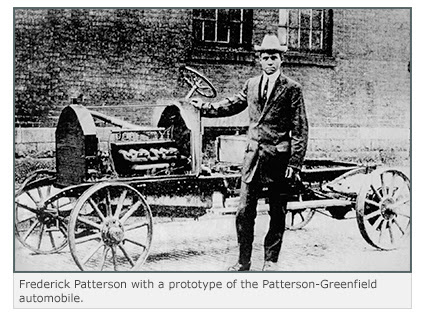
 At first, the company offered repair and restoration services for the “horseless carriages” that were beginning to proliferate on the streets of Greenfield. No doubt this gave workers the opportunity to gain some hands-on knowledge about these noisy, smoky and often unreliable contraptions. Like his father, Frederick was a strong believer in advertising and placed his first ad for auto repair services in the local paper in 1913. Initially, the work mostly involved repainting bodies and reupholstering interiors, but as the shop gained more experience with engines and drivetrains, they began to offer sophisticated upgrades and improvements to electrical and mechanical systems as well.
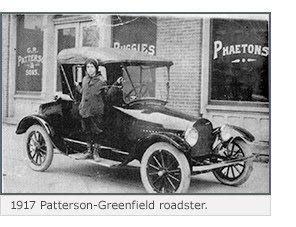 Orders began to come in, and C.R. Patterson & Sons officially entered the ranks of American auto manufacturers. Over the years, several models of coupes and sedans were offered, including a stylish “Red Devil” speedster. Ads featured the car’s 30hp Continental 4-cylinder engine, full floating rear axle, cantilever springs, electric starting and lighting, and a split windshield for ventilation. The build quality of the Patterson-Greenfield automobile was as highly regarded as it had been with their carriages.
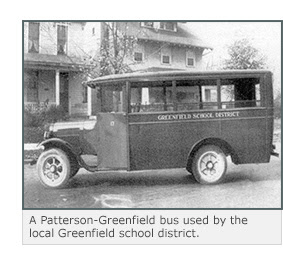 In 1918, having built by some estimates between 30 and 150 vehicles, C.R. Patterson & Sons halted auto production and concentrated once again on the repair side of the business. But they weren’t done yet. In the 1920s, the company began building truck and bus bodies to be fitted on chassis made by other manufacturers. It was in a sense a return to their original skills in building carriage bodies without engines and drivetrains and, for a period of time, the company was quite profitable. Then in 1929, the stock market crashed and the Great Depression set in. As with many small businesses, sales dried up and loans were hard to obtain. The company, now run by the sons of Frederick Patterson, soldiered on until 1939 when, after 74 years, C.R. Patterson & Sons closed its doors forever.


 Be a Seed for Change
You must be logged in to post a comment.