Category Archives: ~ In the Library

“A room without a book is like a body without a soul.”
unknown

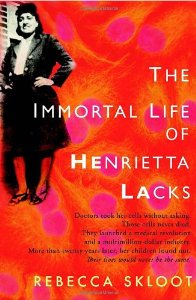
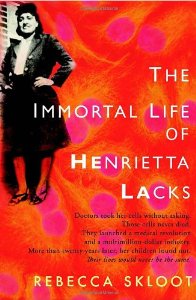
In the Library … The Immortal Life of Henrietta Lacks – by Rebecca Skloot


On 8/11/13, I was watching the MHP show when I heard about the settlement for the family and heirs of Mrs. Lacks. They were completely unaware that scientists had taken her cells or what impact her cells had on so many nor did those who stole a piece of life from her at the time. It was a wow; a how didn’t I know moment and an overwhelming sense that finally; after having read this book a while ago, her family ~not only large, but has gone through some tough times …is finally being recognized and reimbursed for the contribution this woman made, though it took so long and may never really make up for what happened or what they all lost.
To get an idea, read a snippet of her life then go get Rebecca’s book
Her name was Henrietta Lacks, but scientists know her as HeLa.

*****

She was a poor Southern tobacco farmer who worked the same land as her slave ancestors, yet her cells—taken without her knowledge—became one of the most important tools in medicine. The first “immortal” human cells grown in culture, they are still alive today, though she has been dead for more than sixty years.
If you could pile all HeLa cells ever grown onto a scale, they’d weigh more than 50 million metric tons—as much as a hundred Empire State Buildings.
*****
HeLa cells, were vital for developing the polio vaccine; uncovered secrets of cancer, viruses, and the atom bomb’s effects;   her cells helped lead to important advances like in vitro fertilization, cloning, and gene mapping; and have been bought and sold by the billions.
Yet, Henrietta Lacks remains virtually unknown, buried in an unmarked grave, stolen cells lost advantages and money
*****
Now, Rebecca Skloot, takes us on an extraordinary journey, from the “colored” ward of Johns Hopkins Hospital in the 1950s to stark white laboratories with freezers full of HeLa cells; from Henrietta’s small, dying hometown of Clover, Virginia—a land of wooden slave quarters, faith healings, and voodoo—to East Baltimore today, where her children and grandchildren live and struggle with the legacy of her cells.
Henrietta’s family did not learn of her “immortality” until more than twenty years after her death, when scientists investigating HeLa began using her husband and children in research without informed consent. And though the cells had launched a multimillion-dollar industry that sells human biological materials, her family never saw any of the profits. As Rebecca Skloot so brilliantly shows, the story of the Lacks family—past and present—is inextricably connected to the dark history of experimentation on African Americans, the birth of bioethicist, and the legal battles over whether we control the stuff we are made of.
Over the decade it took to uncover this story, Rebecca became enmeshed in the lives of the Lacks family—especially Henrietta’s daughter Deborah, who was devastated to learn about her mother’s cells. She was consumed with questions: Had scientists cloned her mother? Did it hurt her when researchers infected her cells with viruses and shot them into space? What happened to her sister, Elsie, who died in a mental institution at the age of fifteen? And if her mother was so important to medicine, why couldn’t her children afford health insurance?           Intimate in feeling, astonishing in scope, and impossible to put down, The Immortal Life of Henrietta Lacks captures the beauty and drama of scientific discovery, as well as its human consequences.
***********************************

Interestingly, this book is still being debated by folks who feel it could possibly be an exploitation of Mrs. Lacks and the family for a piece of the big pie or settlement after having done a decade of research, and getting personally involved while reports stated that she used personal funds.  Others talk about the family like trash and fail to see why they should be given reparations. We must not ignore or deny, yes realize how important race, and ethics in the healthcare industry or lack of them, and the attempts to reform these issues still exist today. I feel that Rebecca set off a series of events that led to this family not only finding out things about their mother but also recouping some if only a fraction of their mother and the contribution she made.  In my opinion as a mom and daughter, whatever the settlement was it clearly would never ever be enough since they stole her cells and Mrs. Lacks lost her battle to cancer. Sadly, people of colour were treated so poorly in 1951 and while this was and still is a fantastic scientific discovery, it also exposes the widespread discrimination on so many levels.

So, it’s 2023, and the news reports that Ms Lacks’ family is satisfied with the settlement  ~Nativegrl77

 Resource: Rebecca Skloot’s book

Black History Month: The Need Remains … a repost


Lonnie Bunch, museum director, historian, lecturer, and author, is proud to present A Page from Our American Story, a regular on-line series for Museum supporters. It will showcase individuals and events in the African American experience, placing these stories in the context of a larger story — our American story.A Page From Our American StoryEditor’s Note: This edition of A Page from Our American Story was originally a speech made by Lonnie Bunch. It is reprinted here in its entirety.Knowing the Past Opens the Door to the Future
The Continuing Importance of Black History Month

Carter Woodson,
father of Black
History Month,
was commemorated
by the United States
Postal Service with
a stamp in his
image on
February 1, 1984.

No one has played a greater role in helping all Americans know the black past than Carter G. Woodson, the individual who created Negro History Week in Washington, D.C., in February 1926.

Woodson was the second black American to receive a PhD in history from Harvard — following W.E.B. DuBois by a few years. To Woodson, the black experience was too important simply to be left to a small group of academics. Woodson believed that his role was to use black history and culture as a weapon in the struggle for racial uplift. By 1916, Woodson had moved to DC and established the “Association for the Study of Negro Life and Culture,” an organization whose goal was to make black history accessible to a wider audience. Woodson was a strange and driven man whose only passion was history, and he expected everyone to share his passion.

This impatience led Woodson to create Negro History Week in 1926, to ensure that school children be exposed to black history. Woodson chose the second week of February in order to celebrate the birthday of Lincoln and Frederick Douglass. It is important to realize that Negro History Week was not born in a vacuum. The 1920s saw the rise in interest in African American culture that was represented by the Harlem Renaissance where writers like Langston Hughes, Georgia Douglass Johnson, Claude McKay — wrote about the joys and sorrows of blackness, and musicians like Louie Armstrong, Duke Ellington, and Jimmy Lunceford captured the new rhythms of the cities created in part by the thousands of southern blacks who migrated to urban centers like Chicago. And artists like Aaron Douglass, Richard Barthe, and Lois Jones created images that celebrated blackness and provided more positive images of the African American experience.

Woodson hoped to build upon this creativity and further stimulate interest through Negro History Week. Woodson had two goals. One was to use history to prove to white America that blacks had played important roles in the creation of America and thereby deserve to be treated equally as citizens. In essence, Woodson — by celebrating heroic black figures — be they inventors, entertainers, or soldiers — hoped to prove our worth, and by proving our worth — he believed that equality would soon follow. His other goal was to increase the visibility of black life and history, at a time when few newspapers, books, and universities took notice of the black community, except to dwell upon the negative. Ultimately Woodson believed Negro History Week — which became Black History Month in 1976 — would be a vehicle for racial transformation forever.  Read the full speech now…

All the best,
Lonnie Bunch
Director


On this Day … Moby Dick Published


On this day in 1851, Moby-Dick, a novel by Herman Melville about the voyage of the whaling ship Pequod, is published by Harper & Brothers in New York. Moby-Dick is now considered a great classic of American literature and contains one of the most famous opening lines in fiction: “Call me Ishmael.” Initially, though, the book about Captain Ahab and his quest for a giant white whale was a flop.

Herman Melville was born in New York City in 1819 and as a young man spent time in the merchant marines, the U.S. Navy and on a whaling ship in the South Seas. In 1846, he published his first novel, Typee, a romantic adventure based on his experiences in Polynesia. The book was a success and a sequel, Omoo, was published in 1847. Three more novels followed, with mixed critical and commercial results. Melville’s sixth book, Moby-Dick, was first published in October 1851 in London, in three volumes titled The Whale, and then in the U.S. a month later. Melville had promised his publisher an adventure story similar to his popular earlier works, but instead, Moby-Dick was a tragic epic, influenced in part by Melville’s friend and Pittsfield, Massachusetts, neighbor, Nathaniel Hawthorne, whose novels include The Scarlet Letter.

After Moby-Dick‘s disappointing reception, Melville continued to produce novels, short stories (Bartleby) and poetry, but writing wasn’t paying the bills so in 1865 he returned to New York to work as a customs inspector, a job he held for 20 years.

Melville died in 1891, largely forgotten by the literary world. By the 1920s, scholars had rediscovered his work, particularly Moby-Dick, which would eventually become a staple of high school reading lists across the United States. Billy Budd, Melville’s final novel, was published in 1924, 33 years after his death.

history.com

Mann VS FORD … a reminder


I was looking through my posts for environmental cases that have been resolved or not and found that the Mann V Ford case is probably not the only one, but it is still active, at least as of a couple of years ago. Sometime around 2006, I read about this case and then the trailer came out as well, informing us all about the Environmental Waste Disaster case named, Mann V Ford.  I posted it several times. I am still looking for the author of the article below, but the words are not to be denied or ignored. Furthermore, I also wrote Pop Tort for an update on the case but have not heard back, so I went to wiki and found among other things that the Mann V Ford case is active, though a settlement was determined in 2009 with an amount of $12.5 million.  The so-called experts claimed they could not find a connection or a correlation or attach any health issues or the many deaths to Ford’s environmental waste. Reports are that the claimants received checks in 2010 and the max given out was about 35K. However, most got less. The truth is beyond offensive but get this …   the EPA has had 5 attempts to finish the job, but the residents found and keep finding more paint sludge even while Lisa Jackson was in charge.  Meanwhile, more folks have died. The questions environmentalists need to ask, and the EPA needs to answer … did/is Ford doing what they were expected, promised, and required to do in order to ensure the residents were all compensated appropriately, did they continue to check the land, water and grounds before they deemed them safe lest we talk about a constant watch on the health of the next generation …

The information written below is from poptort.com around 2006- 2011

If you’re a PopTort.com fan, you know that there have been a few documentaries already out this year about the civil justice system, except that the business community, with all their money, can’t seem to make ones that anyone wants to watch. I don’t know, maybe the problem is their basic theme: Hbodocs-logo

“Please feel sorry for us, we can’t make as much money as we want at the expense of everyday people, wah wah wah”.

Last Monday night, an example of this phenomenon aired on the Reelz channel, a film called Injustice that received almost no news coverage except by piggybacking off publicity for the critically acclaimed film Hot Coffee, and even so, was covered mostly by a few legal blogs like Above the Law, which lambasted it saying, “I’m not sure if anyone was even able to watch it. And if they had been able to do so, I’m pretty sure they would have changed the channel pretty quickly….” (We were happy to see them pick up our “this isn’t a film, it’s an infomercial” theme! ) Even noted film and media scholar Patricia Aufderheide, professor of Film and Media Arts in the School of Communication at American University and director of the Center for Social Media, noticed, tweeting: Dueling documentaries; looks like the big-biz folks aren’t as good filmmakers….

http://wapo.st/qwM4N7

@hotcoffeemovie

On the other side of that coin, once again tonight HBO airs another very powerful documentary film, called Mann v. Ford, by co-directors Maro Chermayeff and Micah Fink, which showcases how vitally important the civil justice system and plaintiff’s lawyers are to help communities seek justice when powerful corporations have harmed them. Here is what HBO says about it:

The Ramapough Mountain Indians have lived in the hills and forests of northern New Jersey, less than 40 miles from midtown Manhattan, for hundreds of years. In the 1960s, their neighbor in nearby Mahwah, the Ford Motor Company, bought their land and began dumping toxic waste in the woods and abandoned iron mines surrounding their homes. Ford has acknowledged the dumping.

In the 1980s, the Ramapough’s homeland was placed on the Environmental Protection Agency’s list of federally monitored Superfund sites – and supposedly cleaned up by Ford. However, thousands of tons of toxic waste were left behind. In 2006, the residents of Upper Ringwood, after suffering for years from a range of mysterious ailments, including deadly cancers, skin rashes and high rates of miscarriage, filed a mass action lawsuit seeking millions of dollars from Ford as compensation for their suffering. Ford denied all responsibility for the illnesses devastating the community and claimed its flawed cleanup had fully complied with all EPA rules.

MANN v. FORD tells the story of a small community’s epic battle against two American giants: the Ford Motor Company and the Environmental Protection Agency, which failed to ensure that Ford cleaned the land of deadly toxins and erroneously declared the community safe and clean of toxic waste. The documentary debuts MONDAY, JULY 18 (9:00-10:45 p.m. ET/PT), exclusively on HBO.

Impressive. We should point out the New Jersey newspaper, The Record (reporters Jan Barry, Thomas E. Franklin, Mary Jo Layton, Tim Nostrand, Alex Nussbaum,Tom Troncone, Debra Lynn Vial, Lindy Washburn, Barbara Williams) initially broke this story for the wider public in an award-winning series called Toxic Legacy. The paper’s web site says,

A generation ago, the Ford Motor Company churned out six millions cars and trucks at a sprawling assembly plant in Mahwah. But that remarkable production came at a cost. Before the plant closed in 1980, it also generated an ocean of pollution that was dumped in the forests of North Jersey, contaminating a mountain community in Ringwood and threatening the region’s most important watershed.

In 2005, a team of reporters from The Record spent months conducting an investigation of the failed cleanups that had taken place up to that point, and documenting its impact on the people living amid the waste.

So again, the film aired on MONDAY, JULY 18 (9:00-10:45 p.m. ET/PT), exclusively on HBO.

http://www.youtube.com/watch?v=9gnvDz5vT3k&feature=player_embedded

Terry McMillan excerpted in Essence 2008 … Black History is American History


AP – FILE – In this Feb. 11, 2008 file photo, author Terry McMillan arrives to the Evidence Dance Company’s …

By HILLEL ITALIE, AP National Writer Hillel Italie, Ap National Writer Tue May 18, 6:29 am ET

NEW YORK – In honor of its 40th anniversary, Essence magazine is bringing back an old friend: Terry McMillan.

A few pages of excerpts from McMillan’s “Getting to Happy,” a sequel to her million-selling “Waiting to Exhale,” will appear in the next four issues of Essence, starting with the June edition, which came out this week. It’s a familiar place for McMillan, whose ties to the magazine date back to the 1970s, when she was in college and won an Essence writing contest.

“They’re like family,” McMillan, whose book comes out this fall, says of Essence, “and Essence readers have been a large part of my audience.”

Essence senior editor Patrik Henry Bass noted the magazine’s long support for black women writers, including Alice Walker, Toni Morrison and Gloria Naylor. When Essence started, Morrison’s debut novel, “The Bluest Eye,” had just been released. Walker was years away from writing “The Color Purple” and Toni Cade Bambara had yet to publish her first book.

“Nobody in the mainstream media was paying attention to these women,” Bass says.

“We wanted to do something special for the anniversary and when I heard that Terry was writing `Getting to Happy,’ I said, `Terry, what do you have so far? Could you do something original for us?’ And she said, `Well, I just finished the sequel and we thought, “Why not do excerpts?”‘ She couldn’t believe it, because so few people do excerpts anymore.”

McMillan’s “Waiting to Exhale,” published in 1992, tells of the personal and professional conflicts of four women living in Phoenix. The novel sold more than 1 million copies and is still cited as a landmark for convincing publishers of the large audience size for black fiction.

McMillan, whose other books include “How Stella Got Her Groove Back” and “The Interruption of Everything,” said she had no intention of writing a sequel to “Exhale” until she spoke at a church in Oakland, Calif., around a year ago. A resident of the Bay area, the author was still getting over her vicious, public feud with ex-husband Jonathan Plummer and read a poem about her experience.

“So these women responded big time to this poem, and there was this aura, women crying and all kinds of stuff. When it was time to sign books, there were women I had gone to college with, women who had been ex-professors, financial aid counselors. I spoke to them and realized how many of them had never been married, how many were divorced, how many never had children,” she says.

“I wanted to be able to dramatize that in some way. I didn’t want to tell just one woman’s story. And that’s when it dawned on me that I had four women I might be able to turn to. I got the paperback off the shelf and looked over it and said, `You know, they were the perfect candidates.'”

McMillan, 58, is a native of Port Huron, Mich., who, in 1987, self-published her first novel, “Mama.” She became a major best seller with “Disappearing Acts” and a superstar after “Waiting to Exhale.” Her appeal has long been her rough take on relationships, a knack that Essence seems to have appreciated long ago. The topic for the magazine’s writing contest: Are black men and women closer than they used to be, or further apart?