Category Archives: ~ politics petitions pollution and pop culture

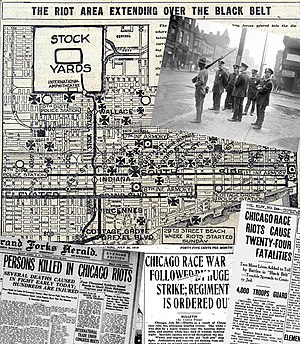
1919 Chicago race riot (15 whites & 23 blacks killed, 500 injured)


On July 27, 1919, an African American teenager drowned in Lake Michigan after violating the unofficial segregation of Chicago’s beaches and being stoned by a group of white youths.

His death, and the police’s refusal to arrest the white man whom eyewitnesses identified as causing it, sparked a week of rioting between gangs of Black and white Chicagoans, concentrated on the South Side neighborhood surrounding the stockyards.

When the riots ended on August 3, 15 white and 23 Black people had been killed and more than 500 people injured; an additional 1,000 Black families had lost their homes when they were torched by rioters.

1919 Chicago Race Riot.jpg


July 27 – August 3, 191

Did you know? In the summer of 1919, Richard J. Daley, who served as Chicago’s powerful mayor from 1955 until his death in 1976, was a 17-year-old member of an Irish-American organization called the Hamburg Athletic Club. Though an investigation later identified the club among the instigators of the rioting, Daley and his supporters never admitted that he participated in the violence.

For the complete article: history.com

So, what’s so sad is that there is no mention of his name or the conditions aka temperature that would make a black teen and friends try to have fun…least we talk about that poor child…was a child, referred only as Williams!

1947 – U.S. President Truman signed The National Security Act. The act created the National Security Council, the Department of Defense, the Central Intelligence Agency and the Joint Chiefs of Staff.


A Look Back … The National Security Act of 1947
President Harry S. Truman signed the National Security Act of 1947 (P.L. 80-235, 61 Stat 496) on July 26, 1947. The act – an intricate series of compromises – took well over a year to craft. It remained the charter of the U.S. national security establishment until significantly altered with the passage of the National Security Intelligence Reform and Terrorism Prevention Act of December 2004, which created the Office of the Director of National Intelligence.
This landmark legislation reorganized and modernized the US armed forces, foreign policy, and the Intelligence Community apparatus. It directed a major reorganization of the foreign policy and military establishments of the US government. And it created many of the institutions that US presidents would find useful when formulating and implementing foreign policy.

A Brief Overview of the Act
The act:
Established the National Security Council (NSC)
Merged the War and Navy departments into the National Military Establishment (NME) headed by the secretary of defense, and
Recognized the US Air Force as an independent service from the Army.
Initially each of the three service secretaries maintained quasi-cabinet status, but the act was amended on August 10, 1949 to formalize their subordination to the secretary of defense. At the same time the NME was renamed the Department of Defense.
In the intelligence field, the act ratified President Truman’s creation (in 1946) of the post of Director of Central Intelligence (DCI), and transformed the Central Intelligence Group into the statutory Central Intelligence Agency (CIA), the nation’s first peacetime intelligence agency.
Most of these provisions prompted sharp debates in the Executive Branch and Congress. Several compromises were struck in order for the act to win passage. These compromises would have far-reaching im

President Truman’s Goals:
Unify the Armed Services & Reform Intelligence
President Truman’s main goal in guiding this legislation through Congress was to modernize the nation’s “antiquated defense setup” by unifying the armed services under a civilian chief. Intelligence reform was a secondary goal, and the White House kept the bill’s passages on intelligence as brief as possible to ensure that its details did not hamper prospects for military unification. This tactic almost backfired.
When the president sent his bill forward in February 1947, the brevity of its intelligence provisions caused Congressional scrutiny. More than a few members of Congress read the bill with concerns about its proposed concentration of military power.
They also eventually debated almost every word of its bill’s intelligence section. Some members argued that the DCI and the new CIA could become a menace to civil liberties–an “American Gestapo.” Administration witnesses alleviated this concern by reminding Congress that the Agency’s authorized mission would be foreign intelligence.

The Act Establishes the Role for CIA
When lawmakers finished editing the section on intelligence, however, the language managed to summarize and ratify most of the crucial arrangements already made by the Truman administration. The National Security Act would:
authorize a Central Intelligence Agency (but leave the powers and duties of the Agency’s head for a separate bill to enumerate);
that CIA would be an independent agency under the supervision of the NSC;
that CIA would conduct both analysis and clandestine activities, but would have no policymaking role and no law enforcement powers;
and, finally, that the DCI would be confirmed by the Senate and could be either a civilian or an officer on detail from his home service.
The legislation gave America something new; no other nation had structured its foreign intelligence establishment in quite the same way.
The CIA would be an independent, central agency, overseeing strategic analysis and coordinating clandestine activities abroad. It would not be a controlling agency. The CIA would both rival and complement the efforts of the departmental intelligence organizations. This prescription of coordination without control guaranteed competition as the CIA and the departmental agencies pursued common targets, but it also fostered a healthy exchange of views and abilities.
What the act did not do, however, was almost as important as what it did. It helped ensure that American intelligence remained a loose confederation of agencies lacking strong direction from either civilian or military decisionmakers. President Truman had endorsed the Army and Navy view that “every department required its own intelligence.” The National Security Act left this concession in tact. Only later would the Defense Intelligence Agency be created to coordinate military intelligence.

Separation Between Foreign & Domestic Intelligence
The act also made a crucial concession to members concerned about threats to civil liberties. It drew a bright line between foreign and domestic intelligence and assigning these realms, in effect, to the CIA and the Federal Bureau of Investigation, respectively. The CIA, furthermore, would have no “police, subpoena, or law enforcement powers,” according to the act.

The importance of the National Security Act cannot be overstated. It was a central document in U.S. Cold War policy and reflected the nation’s acceptance of its position as a world leader.

Historical Document
Posted: Jul 31, 2008 10:37 AM
Last Updated: Apr 30, 2013 12:06 PM

plications for the Intelligence Community.


Cia.gov

GRAND RAPIDS UPRISING (1967)


CONTRIBUTED BY: WILL MACK

Grand Rapids Uprising, 1967
Fair use image

The 1967 Grand Rapids Uprising occurred on July 25, 1967 in a predominantly black and impoverished neighborhood in Grand Rapids, Michigan.  The uprising came only days after the much larger uprising in Detroit, Michigan but a post-riot official report titled “Anatomy of a Riot” written by the city’s Planning Department in November 1967, did not believe the two were related and that it was only a matter of time before the African American community in Grand Rapids would have exploded.

For the complete article: blackpast.org

on this day … 7/25


0326 – Constantine refused to carry out the traditional pagan sacrifices.

1394 – Charles VI of France issued a decree for the general expulsion of Jews from France.

1564 – Maximillian II became emperor of the Holy Roman Empire.

1587 – Japanese strong-man Hideyoshi banned Christianity in Japan and ordered all Christians to leave.

1593 – France’s King Henry IV converted from Protestantism to Roman Catholicism.

1759 – British forces defeated a French army at Fort Niagara in Canada.

1799 – Napoleon Bonaparte defeated the Ottomans at Aboukir, Egypt.

1805 – Aaron Burr visited New Orleans with plans to establish a new country, with New Orleans as the capital city.

1845 – China granted Belgium equal trading rights with Britain, France and the United States.

1850 – In Worcester, MA, Harvard and Yale University freshmen met in the first intercollegiate billiards match.

1850 – Gold was discovered in the Rogue River in OR.

1854 – The paper collar was patented by Walter Hunt.

1861 – The Crittenden Resolution, which called for the American Civil War to be fought to preserve the Union and not for slavery, was passed by the U.S. Congress. 

1866 – Ulysses S. Grant was named General of the Army. He was the first American officer to hold the rank.

1868 – The U.S. Congress passed an act creating the Wyoming Territory.

1871 – Seth Wheeler patented perforated wrapping paper.

1907 – Korea became a protectorate of Japan.

1909 – French aviator Louis Bleriot flew across the English Channel in a monoplane. He traveled from Calais to Dover in 37 minutes. He was the first man to fly across the channel.

1914 – Russia declared that it would act to protect Serbian sovereignty.

1924 – Greece announced the deportation of 50,000 Armenians. 

1941 – The U.S. government froze all Japanese and Chinese assets. 

1943 – Italian Fascist dictator Benito Mussolini was overthrown in a coup.

1946 – The U.S. detonated an atomic bomb at Bikini Atoll in the Pacific. It was the first underwater test of the device. 

1947 – Fortune Gordien of Oslo, Norway set a world record discus throw of 178.47 feet.

1952 – Puerto Rico became a self-governing commonwealth of the U.S. 

1978 – Louise Joy Brown, the first test-tube baby, was born in Oldham, England. She had been conceived through in-vitro fertilization.

1978 – Pete Rose (Cincinnati Red) broke the National League record for consecutive base hits as he got a hit in 38 straight games.

1984 – Soviet cosmonaut Svetlana Savitskaya became the first woman to walk in space. She was aboard the orbiting space station Salyut 7.

1987 – The Salt Lake City Trappers set a professional baseball record as the team won its 29th game in a row. (Utah)

1994 – Israel and Jordan formally ended the state of war that had existed between them since 1948.

1997 – K.R. Narayanan became India’s president. He was the first member of the Dalits caste to do so.

1998 – The USS Harry S. Truman was commissioned and put into service by the U.S. Navy.

2010 – WikiLeaks leaked to the public more than 90,000 internal reports involving the U.S.-led War in Afghanistan from 2004-2010.