
Category Archives: ~ politics petitions pollution and pop culture

Bernard Whitfield Robinson ~ June 18, 1942 – Black History


Bernard W. Robinson, the first African American
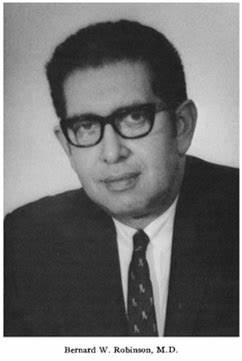
Naval officer, commissioned in the US Naval Reserve.  Robinson attended Harvard Medical School and became a prominent radiologist after the war. Dedicated to the care of veterans, Robinson served in the Veterans Administration Hospitals system for the remainder of his career, interrupted only by his re-enlistment in the Navy from 1953-55. Robinson passed away suddenly in his Allen Park, Michigan home on August 23rd, 1972.

Robinson’s commission marks one of many firsts for African Americans during WWII, despite unfavorable odds. African Americans were not only fighting for victory abroad, but also victory at home against racial prejudice. On the Home Front and the battlefronts, blacks encountered restrictions solely based on the color of their skin. The military was segregated and African Americans struggled to find jobs in defense factories. If they did manage to secure work, it was usually at a much lower pay than their white counterparts.

Robinson’s experiences mirror other successes, acts of courage, and achievements of African Americans throughout the war. The Tuskegee Airmen became the first black pilots of the war, with a stellar flying record. The Montford Point Marines, who served in the Marshall Islands, Saipan, Guam, Iwo Jima and Okinawa, became the first African American Marines in the Corps’ 167 year history. The all-black 761st Tank Battalion spent 183 days in continuous combat, far surpassing the average of 17 days in continuous service.

Recognizing the accomplishments and sacrifices of returning black veterans, Harry Truman desegregated the military in 1948. Proving their skill and leadership on the battlefield, former servicemen like Ralph Abernathy, Whitney Young and Medger Evers began to fight for the second part of the Double Victory campaign – Victory at Home- as they returned to the United States at the war’s conclusion.

To learn more and download a fact sheet, visit WWII at a Glance

Teachers! Bring the experiences of African Americans during WWII into your classroom. Book our Double Victory Virtual Field Trip.

Posted by Chrissy Gregg, Virtual Classroom Coordinator at The National WWII Museum.

Resource nww2m.com

Glass Recycling in Seattle


Story by KOMO News Staff

Now that glass is being recycled again, here are some tips to help:

  • Keep glass bottles and jars out of the trash
  • Rinse the bottles and jars out. Make sure they’re clean, dry, and empty when you put them in your blue bin.
  • Don’t contaminate glass with food, caps, and other materials.

Source: KOMO News, for the complete article

image came from the internet, Sibelco

Lincoln: House Divided Speech Springfield, Illinois June 16, 1858


On June 16, 1858 more than 1,000 delegates met in the Springfield, Illinois, statehouse for the Republican State Convention. At 5:00 p.m. they chose Abraham Lincoln as their candidate for the U.S. Senate, running against Democrat Stephen A. Douglas. At 8:00 p.m. Lincoln delivered this address to his Republican colleagues in the Hall of Representatives. The title reflects part of the speech’s introduction, “A house divided against itself cannot stand,” a concept familiar to Lincoln’s audience as a statement by Jesus recorded in all three synoptic gospels (Matthew, Mark, Luke).

Even Lincoln’s friends regarded the speech as too radical for the occasion. His law partner, William H. Herndon, considered Lincoln as morally courageous but politically incorrect. Lincoln read the speech to him before delivering it, referring to the “house divided” language this way: “The proposition is indisputably true … and I will deliver it as written. I want to use some universally known figure, expressed in simple language as universally known, that it may strike home to the minds of men in order to rouse them to the peril of the times.”

The speech created many repercussions, giving Lincoln’s political opponent fresh ammunition. Herndon remarked, “when I saw Senator Douglas making such headway against Mr. Lincoln’s house divided speech I was nettled & irritable, and said to Mr. Lincoln one day this — ‘Mr. Lincoln — why in the world do you not say to Mr. Douglas, when he is making capitol out of your speech, — ‘Douglas why whine and complain to me because of that speech. I am not the author of it. God is. Go and whine and complain to Him for its revelation, and utterance.’ Mr. Lincoln looked at me one short quizzical moment, and replied ‘I can’t.'”

Reflecting on it several years later, Herndon said the speech did awaken the people, and despite Lincoln’s defeat, he thought the speech made him President. “Through logic inductively seen,” he said, “Lincoln as a statesman, and political philosopher, announced an eternal truth — not only as broad as America, but covers the world.”

Another colleague, Leonard Swett, said the speech defeated Lincoln in the Senate campaign. In 1866 he wrote to Herndon complaining, “Nothing could have been more unfortunate or inappropriate; it was saying first the wrong thing, yet he saw it was an abstract truth, but standing by the speech would ultimately find him in the right place.”

for the full speech and more information  … click or go to : abrahamlincolnonline.org

1858 – Lincoln warns that America is becoming a “house divided”


On June 16, 1858, newly nominated senatorial candidate Abraham Lincoln addresses the Illinois Republican Convention in Springfield and warns that the nation faces a crisis that could destroy the Union. Speaking to more than 1,000 delegates in an ominous tone, Lincoln paraphrased …read more

READ MORE: Why Lincoln’s ‘House Divided’ Speech Was So Important