Category Archives: ~ politics petitions pollution and pop culture

AI ~ The Founding Fathers of the US were staunchly opposed to monarchy, advocating for a government based on the rule of law rather than the whims of a King.


Founding Fathers’ Views on Monarchy

The Founding Fathers expressed their disdain for kings and monarchy through various writings and speeches. Here are some key insights and quotes that reflect their views:

  1. Opposition to Monarchy: The Founders believed that kings were not the rightful rulers of the people. They asserted that “kings are the servants, not the proprietors of the people,” emphasizing that authority should derive from the consent of the governed rather than hereditary privilege. 1
  2. Rule of Law: They championed the idea that “in America, the rule of law is king,” indicating that laws should govern society, not individuals. This principle was foundational in the creation of the U.S. Constitution, which aimed to prevent the concentration of power in any single ruler. 1
  3. Historical Context: The Founders were influenced by their experiences under British rule, where King George III was seen as a tyrant. They believed that “the President of the United States would be an officer elected by the people for four years,” contrasting the elected presidency with the perpetual and hereditary nature of kingship. 1
  4. Attempts to Establish a Monarchy: Interestingly, there was a moment in American history when some Founders considered inviting a European prince to become king of the United States. This proposal was ultimately rejected, as the Founders recognized the dangers of monarchy and sought to establish a republic instead. 1
  5. Warnings Against Tyranny: The Founders warned that “government, even in its best state, is but a necessary evil,” highlighting their belief that power must be carefully checked to prevent tyranny
  6. Source: time.com, ammo.com
1886 – Statue of Liberty


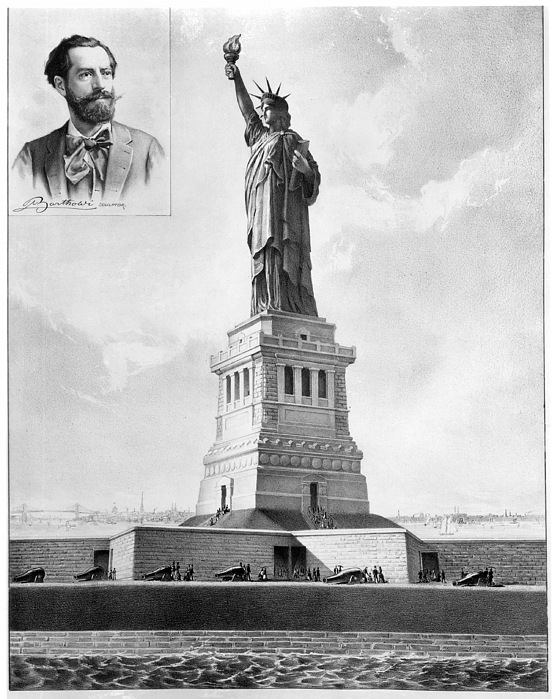
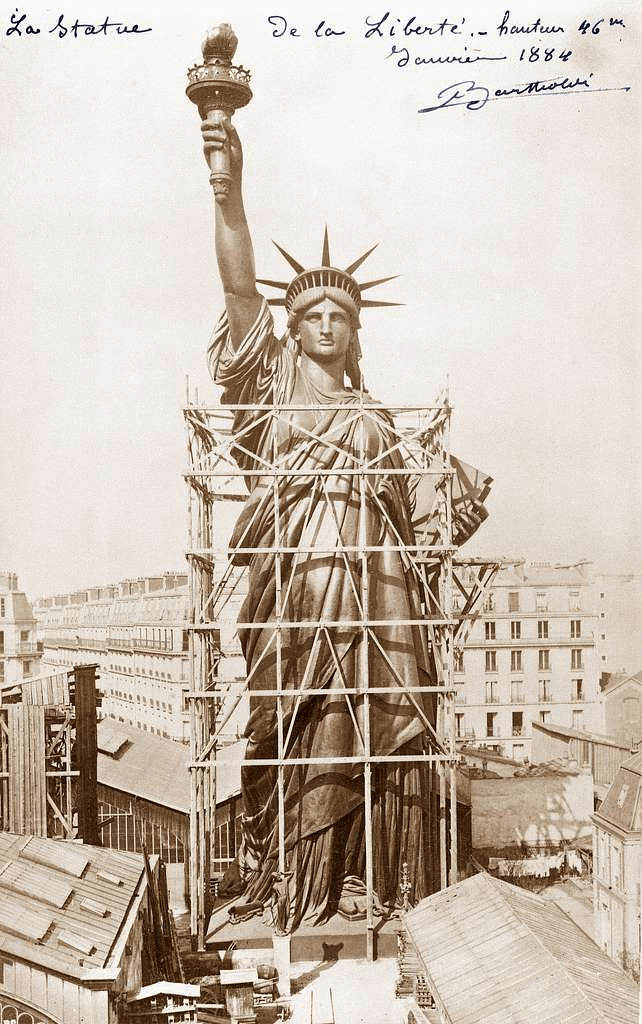
  The Statue of Liberty was dedicated on Bedloe’s Island in New York Harbor. The statue was a gift from the people of France commemorating the French-American alliance during the American Revolutionary War. Designed by Frederic Auguste Bartholdi, the entire structure stands 300 feet (92.9 meters) tall. The pedestal contains the words: “Give me your tired, your poor, your huddled masses yearning to breathe free, the wretched refuse of your teeming shore. Send these, the homeless, tempest-tost to me, I lift my lamp beside the golden door!”

1919 – The U.S. Congress enacted the Volstead Act, also known as the National Prohibition Act. Prohibition was repealed in 1933 with the passing of the 21st Amendment to the U.S. Constitution.


The Volstead Act
October 28, 1919

Collection of the U.S. House of Representatives
Serving a total of 10 terms in the House of Representatives, Andrew Volstead of Minnesota chaired the Judiciary Committee in the 66th and 67th Congresses (1919-1923).

On this date, the 66th Congress (1919–1921) overrode President Woodrow Wilson’s veto of the National Prohibition Act. Known as the Volstead Act (H.R. 6810), after Judiciary Chairman Andrew Volstead of Minnesota, this law was introduced by the House to implement the Prohibition Amendment by defining the process and procedures for banning alcoholic beverages, as well as their production and distribution. When Volstead introduced an earlier version of the law (H.R. 3458) on May 27, 1919, Democrats countered with what would be known as the “wet law,” or repeal of the Wartime Prohibition. The battle between the “wets” and the “bone-drys,” as Prohibition supporters were known, ensued that summer in the House. In one debate, Chairman Volstead defended the act, stating “The American people have said that they do not want any liquor sold, and they have said it emphatically by passing almost unanimously the constitutional amendment.” With a Republican majority in the House, the law passed the chamber convincingly on July 22, 1919 with a vote 287 to 100. The Volstead Act remained in effect until the passage of the 21st Amendment, which repealed Prohibition in 1933.

Resource: history.house.gov/

1886 – The Statue of Liberty


The original idea for the Statue of Liberty

1886 – The Statue of Liberty was dedicated on Bedloe’s Island in New York Harbor. The statue was a gift from the people of France commemorating the French-American alliance during the American Revolutionary War. Designed by Frederic Auguste Bartholdi, the entire structure stands 300 feet (92.9 meters) tall. The pedestal contains the words: “Give me your tired, your poor, your huddled masses yearning to breathe free, the wretched refuse of your teeming shore. Send these, the homeless, tempest-tost to me, I lift my lamp beside the golden door!”

“Give me your tired, your poor, your huddled masses yearning to breathe free.”

The Statue of Liberty is one of the most prominent monuments in the world, but few people know its connection to Civil Rights, slavery, and emancipation. Visitors travel from all over to see the magnificent structure in New York, bringing in roughly 4.5 million people every year. Yet the original meaning behind the Statue of Liberty may not be as well-known as Lady Liberty herself.

The statue came to New York in 1886 as a symbol of liberty and freedom two decades after the American Civil War. Most people associate the monument with immigrants arriving at the New York Harbor. However, many don’t know that the creators behind the statue originally wanted it to honor the end of slavery.

It wasn’t until six years after the statue was unveiled in New York that Ellis Island opened, allowing for millions of immigrants to make their way through the inspection station and into America. The bronze plaque along the pedestal of the statue was then later added in 1903, displaying the recognized line from “The New Colossus,” a poem by Emma Lazarus:

“Give me your tired, your poor, your huddled masses yearning to breathe free.”

Source: statueoflibertytours.com for the complete article