In 1963, Dr. King was arrested at a rally in Birmingham, Ala. while protesting against segregation at lunch counters. The letter he wrote during his 11-day imprisonment argued that “Injustice anywhere is a threat to justice everywhere,” and set the tone for the civil rights movement by inspiring like-minded people to join him in uniting against injustice.
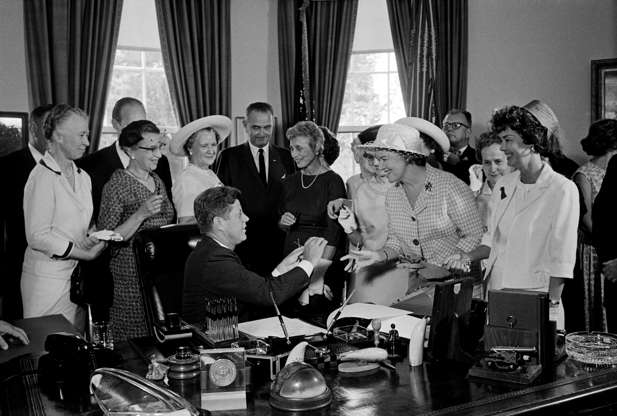
The Equal Pay Act, signed in to law by President John F. Kennedy on June 10, 1963, was one of the first federal anti-discrimination laws that addressed wage differences based on gender. The Act made it illegal to pay men and women working in the same place different salaries for similar work.
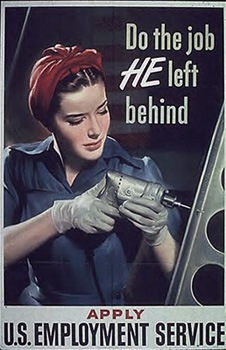
During the first decades of the 20th century, women made up less 24% of the U.S. workforce. During World War II, however, labor shortages brought large numbers of women in to the workplace and by 1945, women made up 37% of the civilian workforce. Because women had traditionally earned less than men for doing similar work, male workers feared that this growing source of cheap labor would replace them or lower their wages. As men began to join the military and women began to take over their civilian jobs, unions started to advocate for equal pay. They felt that this would prevent employers from undercutting future wages for men. In addition, the National War Labor Board endorsed the idea of equal pay for equal work. They issued a General Order supporting equal pay for men and women for work that was of “comparable quality and quantity.”
P.G. Harris, US Employment Service War Manpower Commission, 1942-1945
World War II Employment PosterP.G. Harris, US EmWorld War II Employment PosterP.G. Harris, US Employment Service War Manpower Commission, 1942-1945ployment Service War World War II Employment PosterP.G. Harris, US Employment Service War Manpower Commission, 1942-1945Manpower Commission, 1942-1945
World War II Employment Poster
For the complete article: go to nps.gov
imagage with kennedy : Bettmann Archive/ Getty Images
In a forceful speech, President Dwight D. Eisenhower strikes back at critics of his Cold War foreign policy. He insisted that the United States was committed to the worldwide battle against communism and that he would maintain a strong U.S. defense. Just a few months into his presidency, and with the Korean War still raging, Eisenhower staked out his basic approach to foreign policy with this speech.
In the weeks prior to Eisenhower’s talk, Senator Robert Taft and Gen. Hoyt Vandenberg issued challenges to the president’s conduct of foreign policy. Taft argued that if efforts to reach a peace agreement in Korea failed, the United States should withdraw from the United Nations forces and make its own policy for dealing with North Korea. Vandenberg was upset over Eisenhower’s proposal to cut $5 billion from the Air Force budget.
Heat ~ The National Weather Service (NWS) has issued a heat advisory for several regions across Oregon and Washington, effective from 10 a.m. Sunday through 10 p.m. Monday.
The advisory comes amid forecasts of unusually high temperatures that could pose risks to public health.
According to the NWS, daytime highs are expected to range between 92 and 96 degrees Fahrenheit, with the Portland/Vancouver Metro area and the western Columbia River Gorge seeing the most intense heat.
Facts: The Seattle area is currently experiencing high temperatures known as a heat wave. When outside temperatures are extreme, the danger for heat-related illnesses rises. Older adults, young children, and people with mental illness and chronic diseases are at particularly high risk.
What to do:
Spend time in air-conditioned places. Visit an air-conditioned mall, movie theater or other cool public place.
Cover windows that receive morning or afternoon sun.
Dress in lightweight clothing.
Check on elderly neighbors and relatives and encourage them to stay cool and drink lots of water regularly.
Limit the time you spend in direct sunlight.
Do not leave infants, children, pets or people with limited mobility in a parked car.
Stay tuned to the radio for updates on emergency information.
If you know of someone who is unable to understand, see, or hear this message, please tell them about it.
In 1953, the U.S. Supreme Court made a significant decision regarding segregation in Washington, D.C. Specifically, they ruled that the segregating policies practiced by Thompson’s Cafeteria were illegal.
This landmark case, known as District of Columbia v. John R. Thompson Co. Inc., began on April 30, 1953, and centered around the validity of local Washington Acts from 1872 and 1873.
These Acts prohibited segregation in public places within the District. The court’s support allowed the enforcement of these Acts once again, marking a victory for the national black community.






You must be logged in to post a comment.