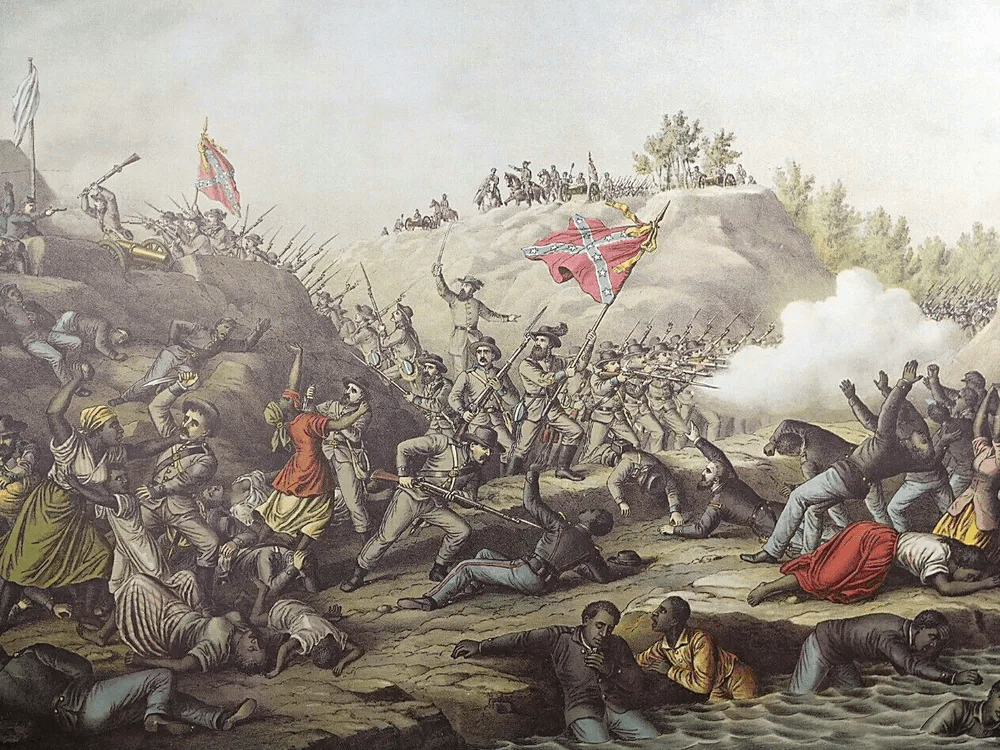
Declaring he did not care whether or not it was the rebellious band of Native Americans he had been searching for, Major Eugene Baker orders his men to attack a sleeping camp of peaceful Blackfeet along the Marias River in northern Montana.
The previous fall, Malcolm Clarke, an influential Montana rancher, had accused a Blackfeet warrior named Owl Child of stealing some of his horses; he punished the man with a brutal whipping. In retribution, Owl Child and several allies murdered Clarke and his son at their home near Helena, and then fled north to join a band of rebellious Blackfeet under the leadership of Mountain Chief. Outraged and frightened, Montanans demanded that Owl Child and his followers be punished, and the government responded by ordering the forces garrisoned under Baker at Fort Ellis (near modern-day Bozeman, Montana) to strike back.
Strengthening his cavalry units with two infantry groups from Fort Shaw near Great Falls, Baker led his troops out into sub-zero winter weather and headed north in search of Mountain Chief’s band. Soldiers later reported that Baker drank a great deal throughout the march. On January 22, Baker discovered a village along the Marias River, and, postponing his attack until the following morning, spent the evening drinking heavily.
At daybreak on the morning of January 23, 1870, Baker ordered his men to surround the camp in preparation for attack. As the darkness faded, Baker’s scout, Joe Kipp, recognized that the painted designs on the buffalo-skin lodges were those of a peaceful band of Blackfeet led by Heavy Runner. Mountain Chief and Owl Child, Kipp quickly realized, must have gotten wind of the approaching soldiers and moved their winter camp elsewhere. Kipp rushed to tell Baker that they had the wrong group, but Baker reportedly replied, “That makes no difference, one band or another of them; they are all Piegans [Blackfeet] and we will attack them.” Baker then ordered a sergeant to shoot Kipp if he tried to warn the sleeping camp of Blackfeet and gave the command to attack.
Baker’s soldiers began blindly firing into the village, catching the peaceful Native Americans utterly unaware and defenseless. By the time the brutal attack was over, Baker and his men had, by the best estimate, murdered 37 men, 90 women, and 50 children. Knocking down lodges with frightened survivors inside, the soldiers set them on fire, burnt some of the Blackfeet alive, and then burned the band’s meager supplies of food for the winter. Baker initially captured about 140 women and children as prisoners to take back to Fort Ellis, but when he discovered many were ill with smallpox, he abandoned them to face the deadly winter without food or shelter.
Source: history.com
“The legitimate object of government, is to do for a community of people, whatever they need to have done, but cannot do, at all, or cannot, so well do, for themselves in their separate, and individual capacities. In all that the people can individually do as well for themselves, government ought not to interfere. The desirable things, which the individuals of a people cannot, do, or cannot well do, for themselves, fall into two classes: those, which have relation to wrongs, and those, which have not. Each of these branches off into an infinite variety of subdivisions. The first that in relation to wrongs embraces all crimes, misdemeanors, and nonperformance of contracts. The other embraces all which, in its nature, and without wrong, requires combined action, as public roads and highways, public schools, charities, pauperism, orphanage, estates of the deceased, and the machinery of government itself. From this it appears that if all men were just, there still would be some, though not so much, need for government.”
~ Abe Lincoln
1789 – W.H. Brown’s “Power of Sympathy” was published. It was the first American novel to be published. The novel is also known as the “Triumph of Nature Founded in Truth”.
1793 – During the French Revolution, King Louis XVI was executed on the guillotine. He had been condemned for treason.
1812 – The Y-bridge in Zanesville, OH, was approved for construction.
1846 – The first issue of the “Daily News,” edited by Charles Dickens, was published.
1853 – Dr. Russell L. Hawes patented the envelope folding machine.
1861 – The future president of the Confederacy, Jefferson Davis of Mississippi, resigned from the U.S. Senate. Four other Southerners also resigned.
1865 – An oil well was drilled by torpedoes for the first time.
1900 – Canadian troops set sail to fight in South Africa. The Boers had attacked Ladysmith on January 8, 1900.
1908 – In New York City, the Sullivan Ordinance was passed. It made smoking in public places by women illegal. The measure was vetoed by Mayor George B. McClellan Jr. two weeks later.
1911 – The first Monte Carlo car rally was held. Seven days later it was won by Henri Rougier.
1915 – The first Kiwanis club was formed in Detroit, MI.
1924 – Soviet leader Vladimir Ilyich Lenin died. Joseph Stalin began a purge of his rivals for the leadership of the Soviet Union.
1927 – The first opera broadcast over a national radio network was presented in Chicago, IL. The opera was “Faust”.
1941 – The British communist newspaper, the “Daily Worker,” was banned due to wartime restrictions.
1946 – “The Fat Man” debuted on ABC radio.
1954 – The Nautilus was launched in Groton, CT. It was the first atomic-powered submarine. U.S. First Lady Mamie Eisenhower broke the traditional bottle of champagne across the bow.
1954 – The gas turbine automobile was introduced in New York City.
1970 – The Boeing 747 made its first commercial flight from New York to London for Pan American.
1970 – ABC-TV presented “The Johnny Cash Show” in prime time.
1976 – The French Concorde SST aircraft began regular commercial service for Air France and British Airways.
1977 – U.S. President Carter pardoned almost all Vietnam War draft evaders.
1980 – Gold was valued at $850 an ounce.
1986 – Former major-league player, Randy Bass, became the highest-paid baseball player in Japanese history. Bass signed a three-year contract for $3.25 million. He played for the Hanshin Tigers.
1994 – A jury in Manassas, VA, acquitted Lorena Bobbitt by reason of temporary insanity of maliciously wounding (severing his penis) her husband John. She accused him of sexually assaulting her.
1997 – Newt Gingrich was fined as the U.S. House of Representatives voted for the first time in history to discipline its leader for ethical misconduct.
1999 – The U.S. Coast Guard intercepted a ship headed for Houston, TX, that had over 9,500 pounds of cocaine aboard. It was one of the largest drug busts in U.S. history.
2002 – In Goma, Congo, about fifty people were killed when lava flow ignited a gas station. The people killed were trying to steal fuel from elevated tanks. The eruption of Mount Nyiragongo began on January 17, 2002.
2002 – In London, a 17th century book by Capt. John Smith, founder of the English settlement at Jamestown, was sold at auction for $48,800. “The General History of Virginia, New England and the Summer Isles” was published in 1632.
You must be logged in to post a comment.